

Paper Hole Punch Mechanism Explainer
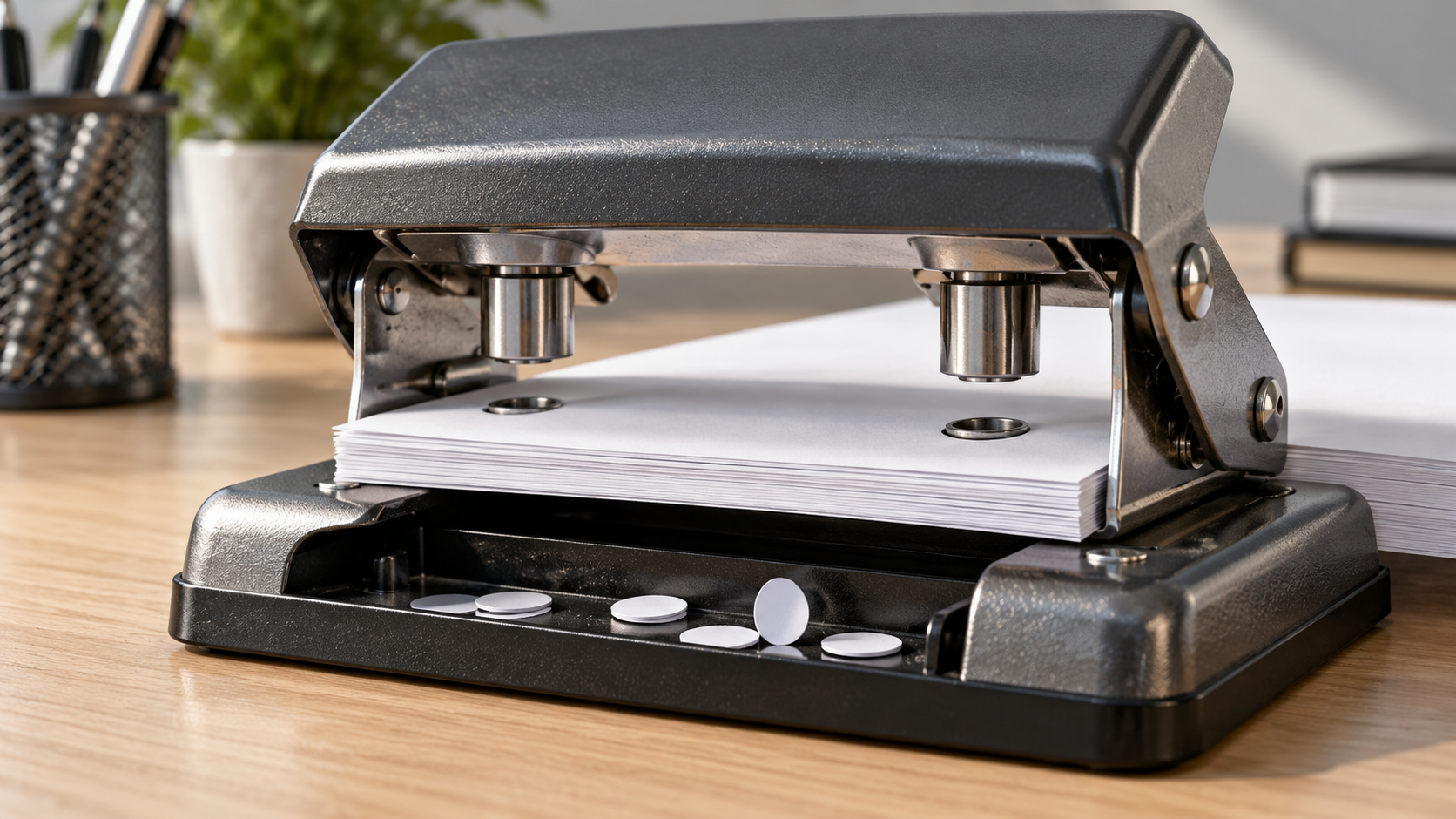
A desktop hole punch cuts paper by shearing it between a moving punch and a stationary die. The punch is a hardened cylindrical tool with a sharp circular edge. Paper rests across a close-fitting opening in the base. When the punch descends through that opening, its edge concentrates force along a narrow ring until the fibers fail and a small disk, called a chad, separates from the sheet.
The long handle reduces the effort required. It pivots near the punch heads, so a hand pressing at the distant end travels farther than the cutters but delivers greater force. In a two-hole model, a crossbar distributes that force to both punches. The punches may begin cutting at slightly different points or use beveled edges, which spreads peak load instead of shearing two complete circles at exactly the same instant.
Clearance between punch and die is deliberately small. Too much clearance lets fibers bend and tear, creating fuzzy holes. Too little causes rubbing, jamming, and rapid wear. The cutter must also remain perpendicular so its edge enters the die without striking it. Metal frames and guide bores keep that alignment under load. A spring raises the handle and cutters after each stroke, clearing the paper for removal.
Paper guides position the edge at a repeatable depth, while adjustable punch heads may set spacing for different binders. The base often contains a covered cavity that catches chads. If that compartment overfills, disks can pack beneath the dies and prevent full cutter travel. The result may look like a dull punch even when the cutting edges are still serviceable. Emptying the tray restores the intended clearance below.
Sheet capacity is a force and clearance limit, not merely a suggestion. A stack that is too thick can wedge in the throat, bend the handle, chip an edge, or pull the cutter out of alignment. Coated films and adhesives may leave residue unlike ordinary paper. Hands should remain outside the throat, especially on heavy-duty models whose leverage can generate much more force than the light handle pressure suggests.
A clean punched hole depends on a coordinated tool pair. The lever multiplies hand force, the guided punch concentrates it into a circular cutting edge, and the die supports the paper immediately around the cut. The return spring resets the mechanism, while the tray removes waste from the work area. When alignment, edge condition, and capacity are maintained, many sheets receive matching holes in one controlled stroke.
A lever drives a sharp cylindrical punch through paper into a close-fitting die, shearing out a disk. Key terms include punch, die, shear, chad, clearance, pivot, leverage, guide, and return spring.
A slanted or shaped edge begins the cut at one point and advances around the circle, reducing the maximum force compared with cutting the whole rim simultaneously.
Accumulated paper disks can block the space below the dies, preventing the cutters from completing their stroke and releasing the stack cleanly.
Explore more "Explainers"
Discover additional explainers across politics, science, business, technology, and other fields. Each explainer breaks down a complex idea into clear, everyday language—helping you better understand how major concepts, systems, and debates shape the world around us.