

Pencil Eraser and Graphite Explainer
A pencil mark is a thin deposit of graphite and clay caught on and between paper fibers. The particles adhere weakly compared with ink that soaks or chemically binds into the sheet. When an eraser rubs across the mark, its flexible surface contacts the graphite at many tiny points. Friction loosens particles from the paper, and the eraser material attracts and traps much of that released graphite.
The eraser must deform enough to reach the page texture without tearing it. Natural or synthetic rubber, vinyl, and other polymers are compounded to produce a particular balance of softness, strength, and tack. Some formulations include mild abrasive particles that help dislodge the graphite. Abrasion removes a tiny amount of material, while adhesion transfers the loosened particles away from the paper surface.
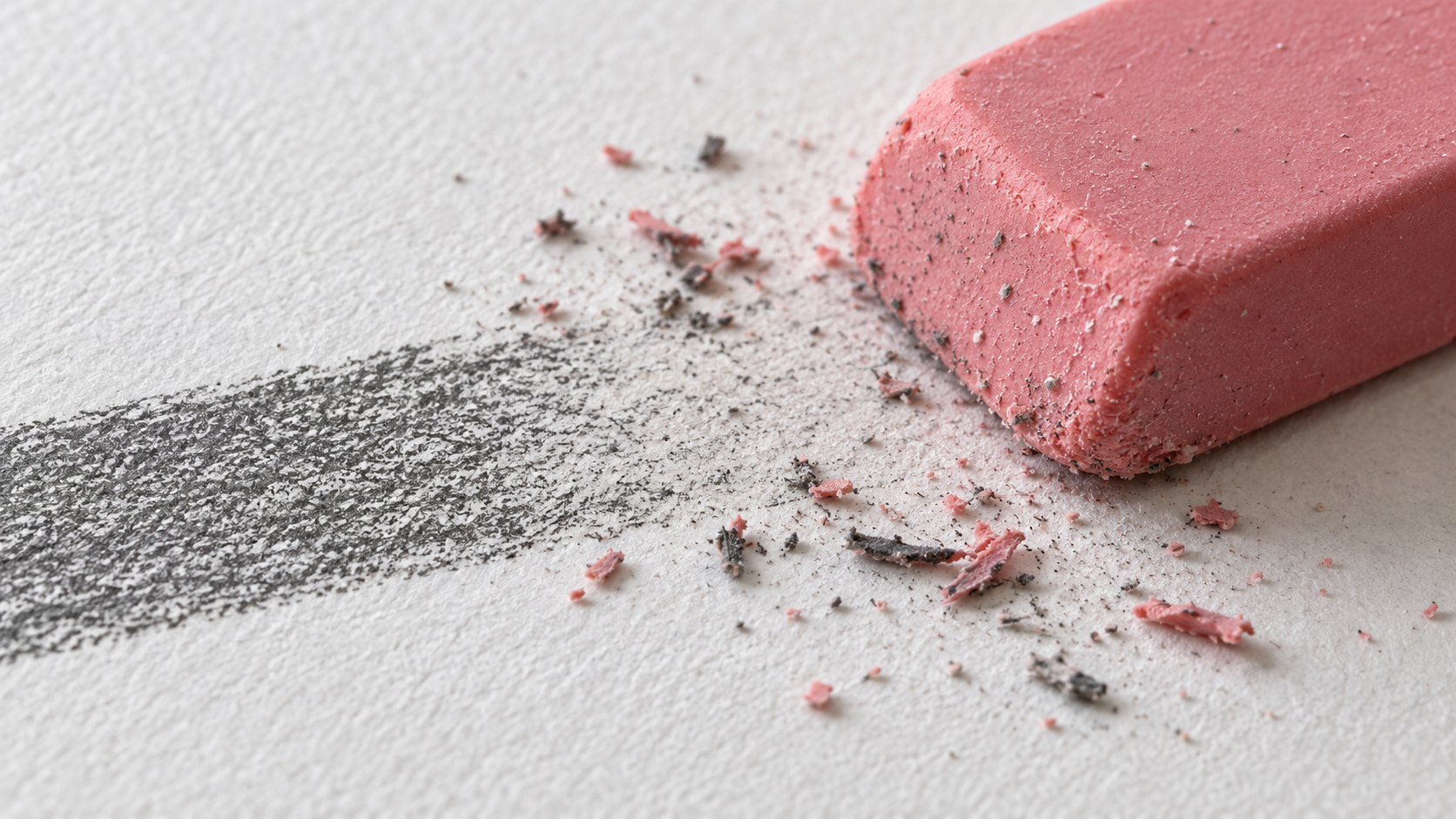
The familiar crumbs are part of the cleaning process. As rubbing warms and stretches the eraser surface, small pieces roll up with graphite embedded inside. Those crumbs carry dark material away instead of smearing it repeatedly. A kneaded eraser behaves differently: it is pressed and lifted so graphite transfers into a pliable mass. Either design needs clean material exposed to the mark to keep accepting particles.
Paper and pencil composition change the result. A hard pencil leaves less graphite but may press a groove into the sheet; the groove can retain particles that the eraser cannot reach. A soft pencil deposits more loose graphite and may smear before it lifts. Rough paper holds particles deeper among fibers. Heavy pressure can burnish the mark, flatten the paper texture, or damage the sheet before erasing begins.
Gentle repeated strokes are safer than one aggressive scrub. The page should be supported on a firm, clean surface, and crumbs should be brushed away rather than ground back into the fibers. A dirty eraser edge can redeposit graphite, so exposing a fresh corner helps. Old rubber may harden and polish the paper instead of cleaning it. Specialty papers may require a softer or kneaded eraser.
Erasing is therefore a controlled competition between surfaces. Graphite initially clings to cellulose fibers, but rubbing provides enough mechanical energy to break many of those contacts. A compliant, slightly tacky eraser presents a more attractive destination and then sacrifices small crumbs to remove the captured material. The paper is left lighter because the graphite travels into the eraser debris, not because the mark simply disappears.
Rubbing loosens graphite from paper, and soft polymer material captures it in eraser crumbs. Key terms include graphite, clay, cellulose fiber, friction, adhesion, abrasion, polymer, and crumb.
The eraser surface wears into small pieces that collect loosened graphite and carry it away, reducing repeated smearing across the page.
Pressure may have driven graphite into deep paper texture or embossed a groove. Removing more material risks thinning or roughening the sheet.
Explore more "Explainers"
Discover additional explainers across politics, science, business, technology, and other fields. Each explainer breaks down a complex idea into clear, everyday language—helping you better understand how major concepts, systems, and debates shape the world around us.