

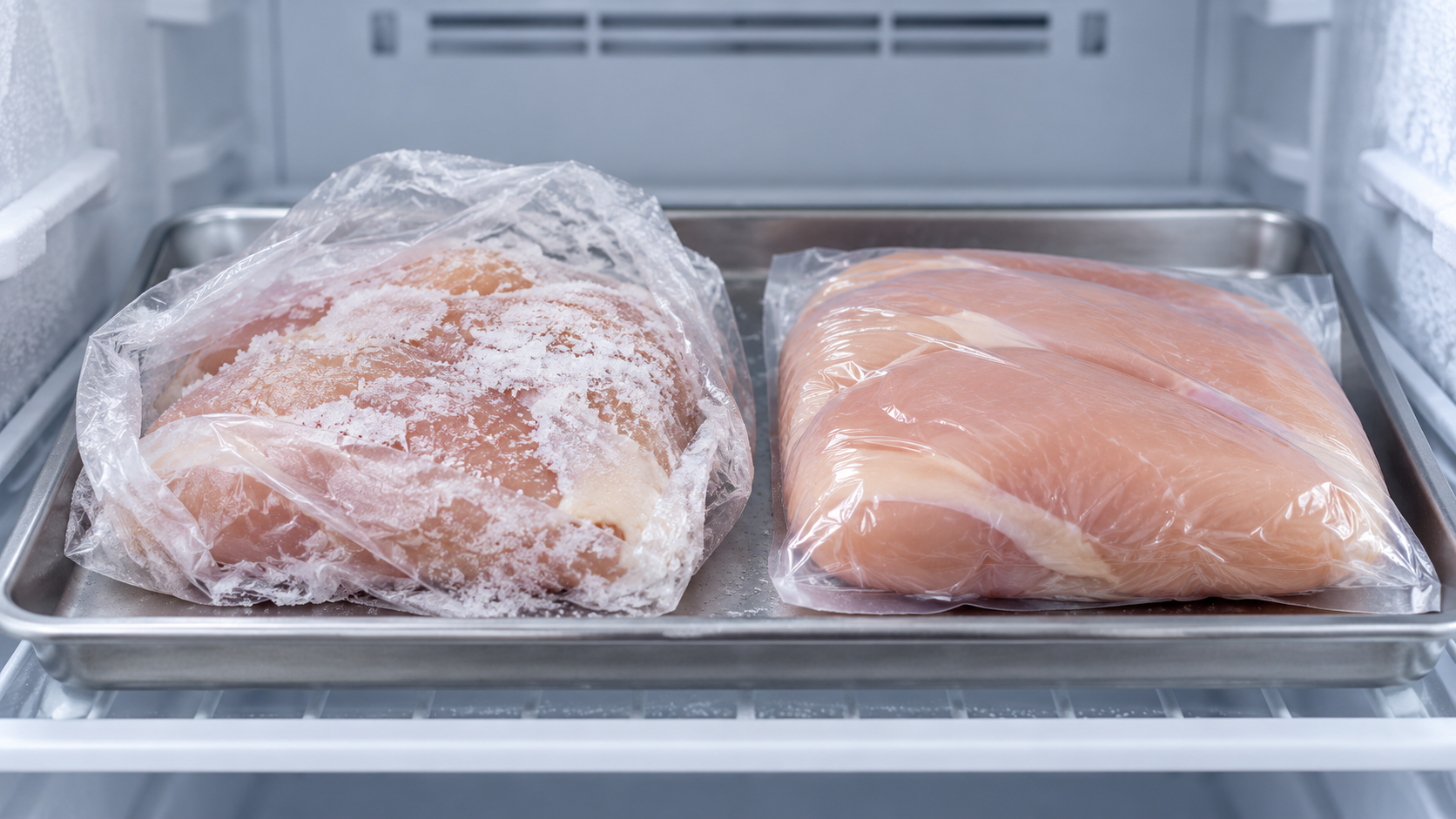
Freezer Burn and Moisture Loss Explainer
Freezer burn is surface dehydration that happens while food remains frozen. Water in the food has turned to ice, but some ice molecules can pass directly into water vapor without first becoming liquid. If the surface is exposed to dry moving air inside the freezer, that vapor leaves the food and may later freeze on colder packaging or freezer surfaces. The abandoned region becomes porous and dry.
This direct solid-to-vapor change is sublimation. It proceeds slowly at stable freezer temperatures but accelerates when packaging admits air, the surface area is large, or temperature fluctuates. Repeated warming and cooling also encourages ice crystals to migrate and grow. Thin edges and protruding pieces lose moisture first because more of their mass is near an exposed surface and their temperature changes quickly.
The familiar white, gray, or brown patches reflect both lost water and changes in pigments, fats, and proteins. Oxygen in the package can oxidize fat and alter flavor, while large ice crystals damage cellular structure. After cooking or thawing, affected areas may feel leathery, fibrous, or tough because the missing moisture is not automatically restored. Freezer burn is primarily a quality problem rather than evidence that freezing failed.
Tight moisture-resistant packaging slows the process by placing a barrier between food and circulating freezer air. Removing excess headspace reduces the reservoir of dry air around the surface. Wrapping closely, using freezer-rated containers, and maintaining a steady temperature all help. Ordinary thin storage film or a poorly closed bag may allow more vapor transmission than packaging designed for long frozen storage.
Freezer burn alone does not make otherwise properly handled food unsafe, but safety still depends on how the food was prepared, frozen, stored, and thawed. Odor, contamination, power outages, and time outside safe temperatures are separate concerns. Small dried portions can often be trimmed for quality; heavily affected food may be unappealing even though the visible damage itself is not spoilage.
The freezer stops most liquid-water activity, but it does not lock every molecule in place. A vapor-pressure difference can still draw water from ice in the food toward drier air and colder surfaces. Good packaging creates a humid, nearly closed microenvironment around the product, so little moisture has somewhere else to go. Freezer burn appears when that protective microenvironment is missing or repeatedly disturbed.
Ice at an exposed food surface sublimates into vapor and migrates away, leaving dehydrated, oxidized patches. Key terms include sublimation, vapor pressure, dehydration, oxidation, headspace, barrier packaging, temperature fluctuation, and ice crystal.
No. It is mainly a quality defect caused by moisture loss and oxidation. Safety still depends on the food's full handling and temperature history.
They have more surface area relative to their volume and change temperature quickly, so moisture can escape from a large share of the tissue.
Explore more "Explainers"
Discover additional explainers across politics, science, business, technology, and other fields. Each explainer breaks down a complex idea into clear, everyday language—helping you better understand how major concepts, systems, and debates shape the world around us.