

Salt and Freezing-Point Depression Explainer
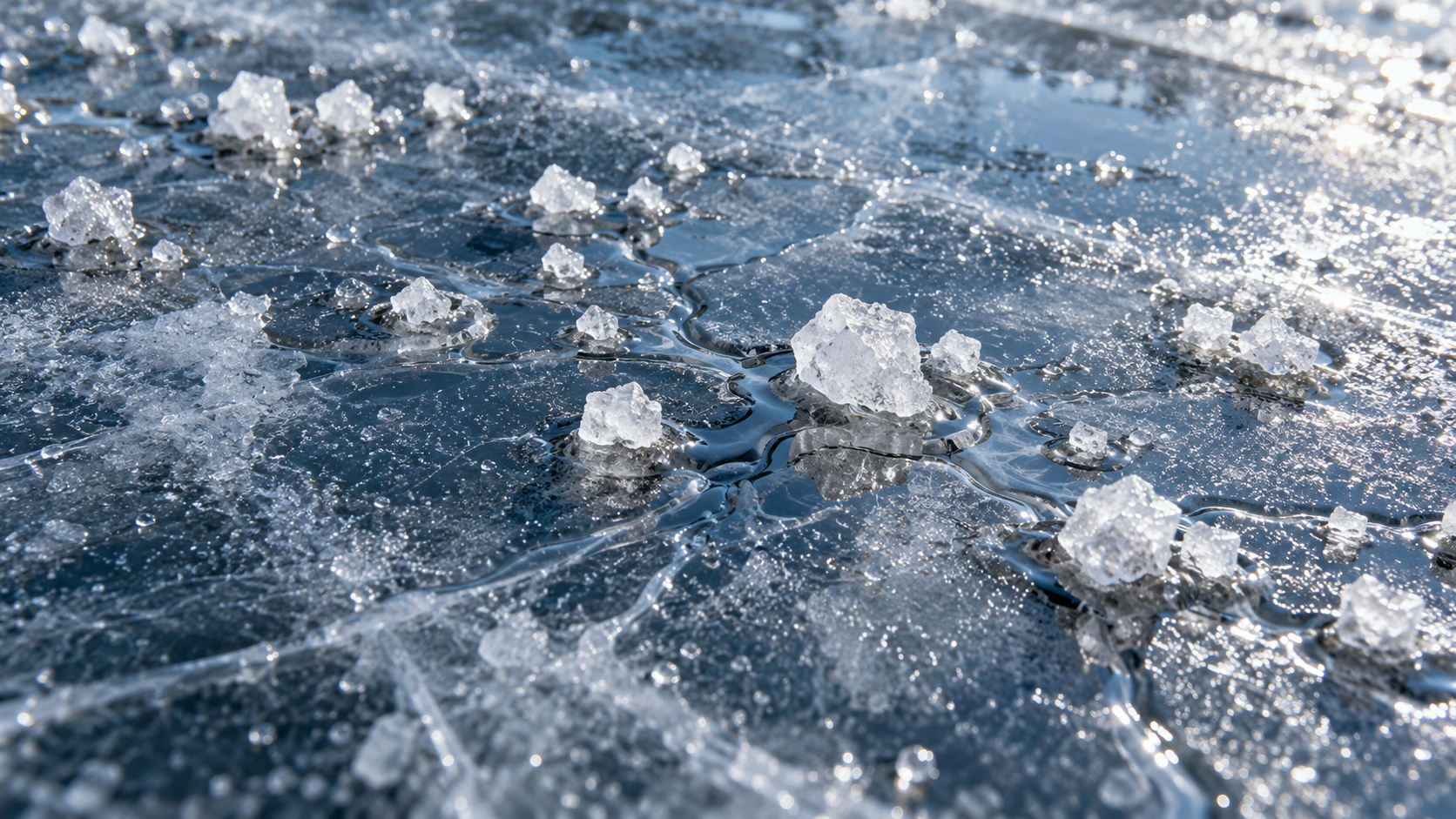
Even below the normal freezing point, an ice surface has a microscopic liquid-like layer and may encounter water from pressure, sunlight, or partial melting. Salt dissolves in that water and separates into ions. The resulting brine has a lower freezing point than pure water, so at the same temperature the existing balance is disturbed and more ice must melt to reach a new equilibrium.
Dissolved particles make it less favorable for water molecules to organize into the regular crystal lattice of ice. This colligative effect depends mainly on the number of dissolved particles, not on salt simply generating heat. Melting actually absorbs heat from the surroundings, which is why an ice-and-salt mixture can become colder and is useful in traditional ice-cream making.
The process needs liquid water to dissolve the salt. On very cold dry ice, action begins slowly, and the brine itself eventually reaches a temperature and concentration at which it can freeze. Sodium chloride has a practical lower limit near its eutectic condition, so it becomes much less effective in severe cold. Other deicers use different ions and have different working ranges, costs, and environmental effects.
Grain size affects timing rather than the basic chemistry. Fine salt dissolves quickly but can scatter or dilute rapidly; coarse grains persist longer and may improve traction while brine forms. Traffic and foot pressure help mix the brine across a surface. Applying far more than can dissolve does not lower the freezing point indefinitely and leaves material to be tracked into soil, water, vehicles, and buildings.
Salt can accelerate corrosion and stress vegetation, concrete, pets’ paws, and freshwater ecosystems. It should be used sparingly and according to local guidance, after loose snow is removed. Traction materials such as sand do not melt ice but can reduce slipping. Refreezing remains possible if brine is diluted by new precipitation or temperatures fall below the mixture’s effective range.
Salt melts ice by changing phase equilibrium. The solid does not absorb salt directly; a liquid brine forms at the boundary, and its dissolved ions reduce the temperature at which that liquid can coexist with ice. More ice melts to dilute the brine until equilibrium returns. The effect is powerful near ordinary winter temperatures but is constrained by concentration, available liquid, and the chemistry of the chosen salt.
Salt dissolves into surface water and lowers its freezing point, so more ice melts to establish a new equilibrium. Key terms include brine, ion, freezing-point depression, colligative property, crystal lattice, eutectic, dilution, and refreezing.
No. Dissolved ions change the freezing equilibrium, and the melting itself absorbs heat. An ice-salt mixture can become colder than the original ice.
Very little liquid may be available to dissolve it, dissolution slows, and the brine approaches a composition and temperature at which it can also freeze.
Explore more "Explainers"
Discover additional explainers across politics, science, business, technology, and other fields. Each explainer breaks down a complex idea into clear, everyday language—helping you better understand how major concepts, systems, and debates shape the world around us.