

Sunscreen UV Protection Explainer
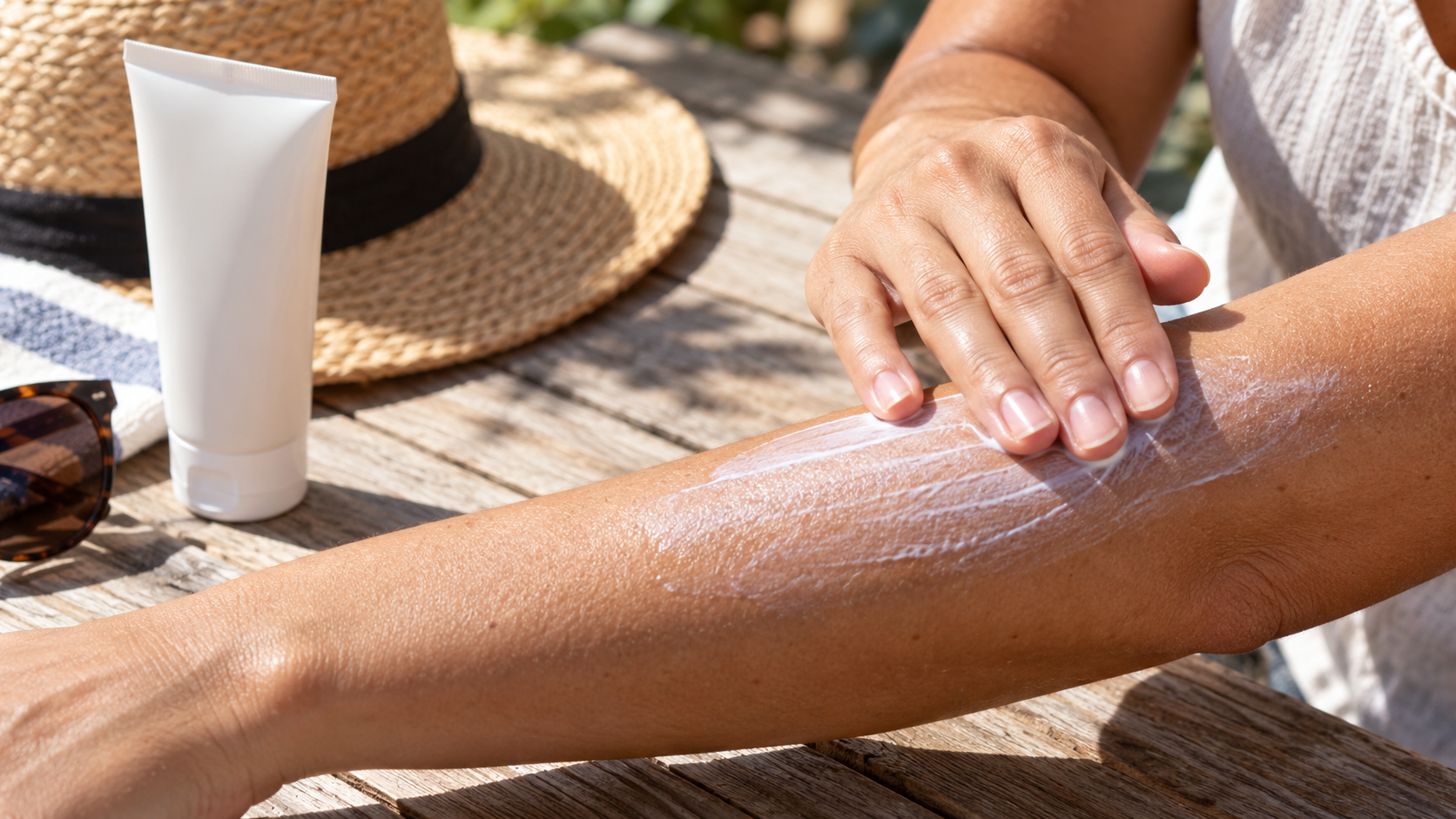
Sunscreen protects by placing ultraviolet-filtering active ingredients in a thin film across the skin. Depending on the ingredient and formulation, incoming UV energy is mostly absorbed and converted into less harmful forms of energy, with some radiation also reflected or scattered. The film reduces the dose reaching living tissue; it does not make skin completely impermeable to sunlight. Coverage must be continuous because uncovered gaps receive little or no benefit.
Sunlight at Earth’s surface includes UVA and UVB. UVB is a major cause of sunburn, while UVA penetrates more deeply and contributes to long-term skin damage. The sun protection factor, or SPF, comes from standardized testing that compares the UV dose needed to produce sunburn with and without the product used as directed. SPF is primarily a measure of UVB sunburn protection, not a simple multiplier for time outdoors.
A broad-spectrum product must also meet a test for protection across UVA and UVB wavelengths. The active filters have different absorption ranges, so formulations often combine ingredients to cover more of the spectrum and remain stable in light. Inactive ingredients help spread the filters, keep them suspended, resist separation, and produce a usable feel. Mineral particles such as zinc oxide and titanium dioxide also act through optical absorption and scattering.
Real protection depends on application. Too little product, missed areas, rubbing from clothing, sweat, swimming, and toweling make the film thinner or discontinuous. Water-resistant labeling refers to tested performance for a stated period under water exposure; it does not mean waterproof. Reapplication follows the label and is especially important after swimming or heavy sweating. Sunscreen is applied to exposed skin before exposure as the product directions specify.
Sunscreen is one part of sun protection rather than permission for unlimited exposure. Shade, clothing, a broad-brimmed hat, and UV-protective sunglasses reduce the amount the product must handle. Intensity varies with time of day, season, altitude, latitude, cloud conditions, and reflection from water, sand, or snow. Babies, allergies, skin conditions, and medication-related sun sensitivity may require advice tailored by a health professional.
The practical mechanism is therefore optical filtering supported by careful film formation. The active ingredients intercept a portion of UV, the formulation distributes them across the surface, and standardized tests describe performance under defined conditions. Everyday use is less controlled, so complete coverage, adequate quantity, reapplication, and other barriers matter. Sunscreen lowers exposure when used correctly, but no formulation blocks every photon or eliminates the biological effects of prolonged sun.
UV-filtering ingredients form a surface film that absorbs, reflects, or scatters part of the incoming radiation. Key terms include UVA, UVB, active ingredient, film, broad spectrum, SPF, water resistance, and reapplication.
No. SPF compares UV doses in a controlled sunburn test. Actual exposure changes with solar intensity, application amount, water, sweat, clothing, and many other conditions.
UV can pass through missed or thin spots. The labeled performance assumes a standardized amount spread across the tested area.
Explore more "Explainers"
Discover additional explainers across politics, science, business, technology, and other fields. Each explainer breaks down a complex idea into clear, everyday language—helping you better understand how major concepts, systems, and debates shape the world around us.