

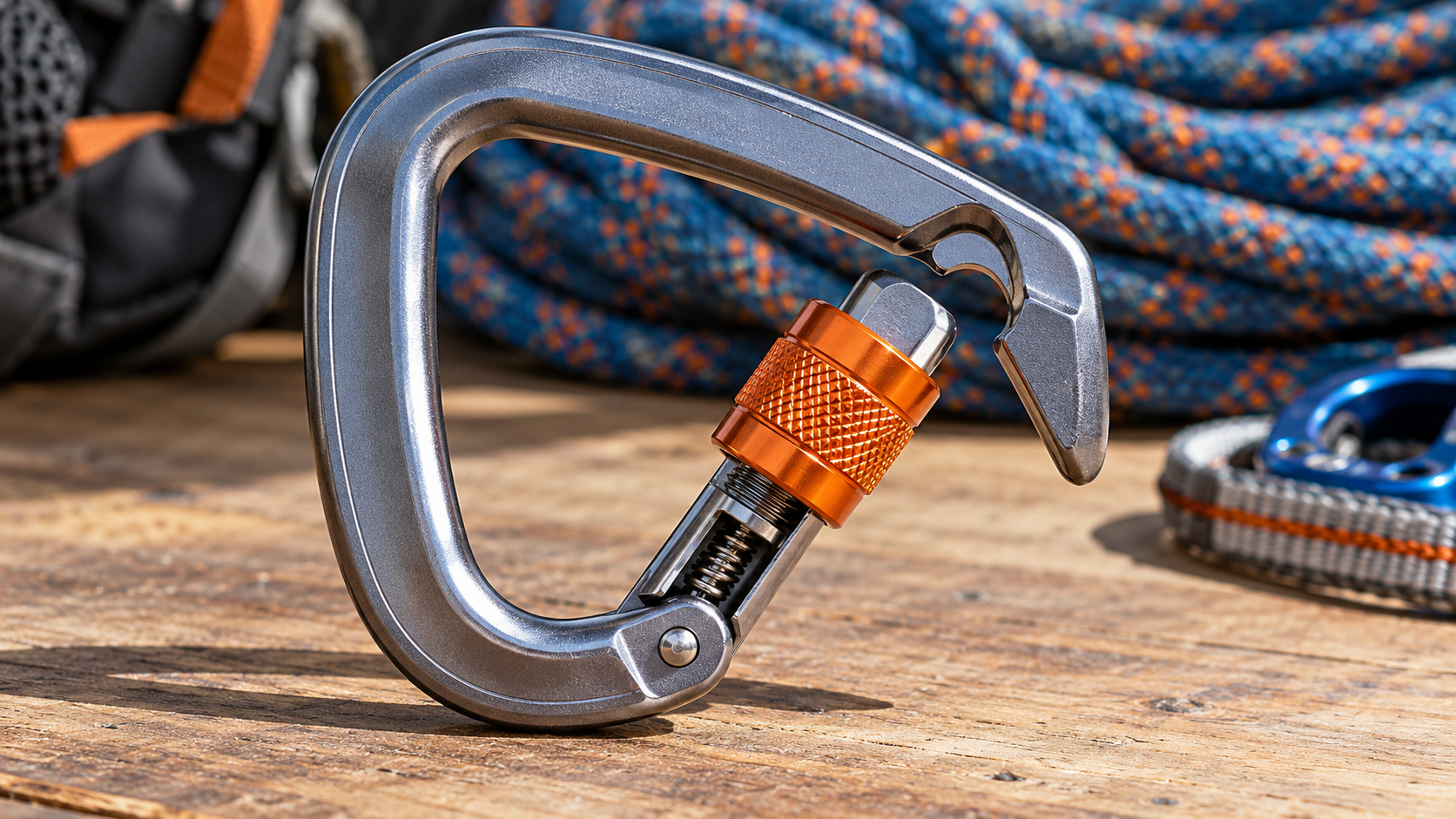
Carabiner Gate Mechanism Explainer
A carabiner is a metal connector with a hinged gate that creates a temporary opening in an otherwise strong frame. A torsion spring, wire spring, or internal spring element biases the gate toward the closed position. Pressing the gate stores a small amount of elastic energy; releasing it lets the spring swing the gate back until its tip seats at the nose. The closed gate completes the intended frame geometry and helps resist deformation.
The hinge and nose carry different tasks. The hinge lets the gate rotate and keeps it aligned, while the nose stops lateral movement and supports the gate end. Keylock noses use smooth mating shapes, whereas hook-and-pin designs use a notch and pin. Wire gates use bent wire itself as both gate and spring. Each approach balances weight, stiffness, snag resistance, ice performance, manufacturing, and the risk that vibration or impact could momentarily open the gate.
Locking carabiners add a sleeve or multi-action mechanism around the gate. A screw-lock sleeve is rotated over the gate-nose junction after closing. Automatic locks use spring-loaded sleeves that require twisting, sliding, or multiple coordinated movements to open. The lock reduces accidental gate movement, but it does not make orientation irrelevant. A carabiner is strongest when loaded along its major axis with the gate closed and without leverage over an edge.
An open gate changes the frame from a continuous loop into a flexible C shape. Published ratings therefore distinguish major-axis gate-closed strength, major-axis gate-open strength, and minor-axis strength. Cross-loading, nose loading, contact with rock, or pressure from other hardware can produce forces the connector was not designed to carry. The stamped ratings describe standardized tests, not permission to improvise a system outside the manufacturer’s instructions.
Before safety-critical use, the frame is checked for cracks, deep grooves, corrosion, or sharp damage. The gate should move freely, snap closed, align with the nose, and lock completely. Dirt is cleaned and lubrication is applied only as directed. A dropped or questionable connector may require retirement even when damage is not obvious. Decorative accessory clips without recognized certification and strength markings are not substitutes for climbing or life-safety carabiners.
The gate stays closed because stored spring energy continually pushes it toward the nose, while a lock can block the opening motion. The carabiner’s useful strength, however, comes from the entire closed frame and correct load path. Hinge, nose, spring, sleeve, body shape, and user checks form one system. A gate that merely looks shut is not enough; it must be fully seated, appropriately locked, correctly oriented, and used within its rated purpose.
A spring biases the hinged gate against the nose, and a locking sleeve can block unintended opening. Key terms include hinge, gate, spring, nose, keylock, screw-lock, major axis, and cross-loading.
The open frame behaves like a flexible C instead of a closed loop, concentrating bending and removing support at the gate-nose junction.
No. The connector still needs correct major-axis loading, proper orientation, a closed gate, compatible equipment, and use within its certified purpose.
Explore more "Explainers"
Discover additional explainers across politics, science, business, technology, and other fields. Each explainer breaks down a complex idea into clear, everyday language—helping you better understand how major concepts, systems, and debates shape the world around us.