

Wheelbarrow Lever and Wheel Explainer
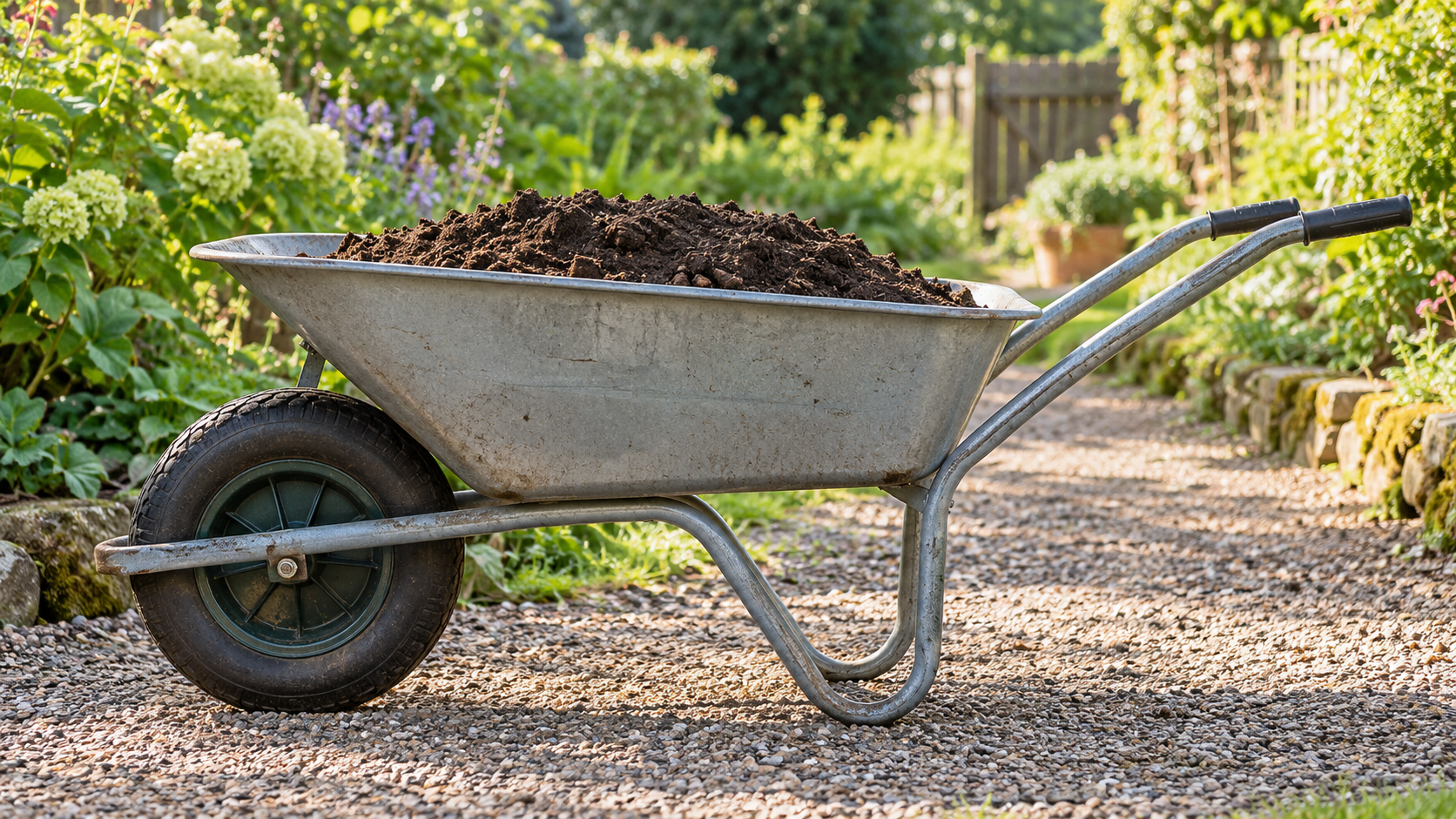
A single-wheel wheelbarrow combines a second-class lever with a wheel and axle. The wheel axle acts as the fulcrum, the load sits in the tub between the wheel and the handles, and the user supplies upward effort at the handle ends. Because the hands are farther from the axle than the load’s center of mass, the handles provide mechanical advantage. The wheel supports the remainder of the weight and carries it forward.
Load placement changes the effort. Moving material toward the wheel shortens its lever arm around the axle, so the user lifts less at the handles. Moving it rearward increases handle force but may improve control over the front on some terrain. The load still has total weight; the machine divides that weight between wheel and hands. Lifting the handles too high or low changes body posture and can make steering and unloading less stable.
Once lifted into balance, rolling replaces much of the sliding friction that would occur if a tray were dragged. The tire deforms against the ground, bearings rotate around the axle, and the user mainly overcomes rolling resistance, slope, and acceleration. A larger wheel crosses small bumps more easily because the obstacle is smaller relative to its radius. Pneumatic tires absorb irregularities but require correct pressure; solid tires avoid flats but transmit more shock.
One wheel gives maneuverability and lets the barrow pivot in narrow spaces, but the user must control side-to-side balance. Two handles provide a broad grip for steering torque. A centered load is easier to balance than one piled to a side, and liquid or loose material can shift as the barrow turns. Two-wheel garden carts trade some maneuverability for greater lateral stability and carry loads with a different distribution.
Capacity is limited by the tub, frame, tire, axle, handles, terrain, and the person operating it. Overloading can bend the frame, collapse a tire, or produce more handle force than can be controlled on a slope. The path is checked for holes and obstacles, loads are kept low and secure, and ramps have adequate width and traction. A wheelbarrow is pushed at a controlled pace rather than pulled blindly or parked where it can roll.
The useful reduction in effort comes from geometry and rolling support. The long handle distance multiplies the user’s lifting moment, the wheel carries a large share of the vertical load, and rotation makes horizontal transport easier than dragging. None of those features removes the need for balance. Best performance comes from placing mass near the wheel without making the front dive, keeping the tire and axle sound, and choosing a path the operator can control.
The wheel is the fulcrum, the load sits between it and the handles, and the long handles provide leverage while the wheel carries much of the weight. Key terms include second-class lever, fulcrum, load arm, effort arm, mechanical advantage, axle, rolling resistance, and center of mass.
It shortens the load’s distance from the fulcrum, reducing the turning moment that the user must balance at the handles.
One contact line gives excellent turning ability but little side-to-side support, so the user must supply stabilizing torque through the handles.
Explore more "Explainers"
Discover additional explainers across politics, science, business, technology, and other fields. Each explainer breaks down a complex idea into clear, everyday language—helping you better understand how major concepts, systems, and debates shape the world around us.