

Adhesive Lint Roller Explainer
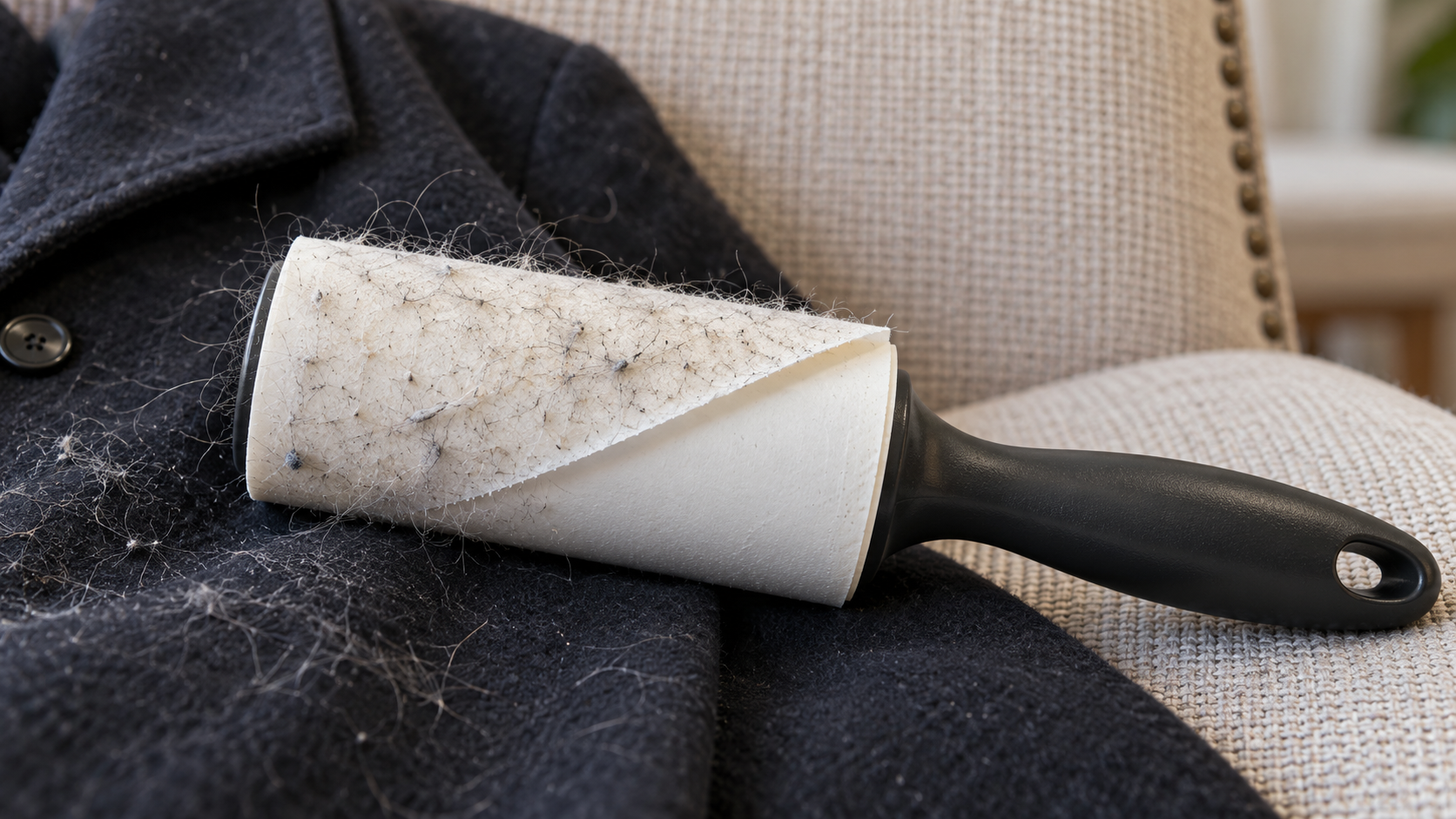
An adhesive lint roller wraps pressure-sensitive adhesive tape around a rotating cylinder with the sticky face outward. When the roller passes over fabric, light hand pressure brings the adhesive into close contact with loose lint, hair, dust, and threads. The tacky polymer flows microscopically around surface irregularities and forms many weak attractions. If those combined attractions exceed the particle’s grip on the fabric, the particle transfers to the roller.
Pressure-sensitive adhesive is designed to bond through contact rather than drying or chemical curing. It must be soft enough to wet the irregular particle surface but cohesive enough to stay on its backing instead of leaving residue. Rolling spreads contact progressively, reducing the force needed compared with pressing a whole flat sheet at once. The cylinder turns on a spindle so the same outward face can follow the contours of clothing, upholstery, or bedding.
The tape is wound in multiple layers. A release coating on the nonsticky side keeps adjacent layers from bonding permanently inside the roll. When the exposed surface fills with debris, a perforation, diagonal cut, or edge tab helps the user lift and peel away one used layer. Peeling concentrates separation at a narrow moving line, so a fresh adhesive face can be exposed without unwinding the entire roll.
Pickup depends on relative adhesion. A strongly embedded fiber, oily stain, or dried material may remain because the roller cannot develop enough contact or because removing it would damage the fabric. Heavy pressure can flatten pile, transfer adhesive, or waste layers without improving pickup. Delicate textiles, loose knits, leather, and specialty coatings may need a test in an inconspicuous area or a different cleaning method.
A loaded sheet loses effectiveness because available adhesive surface is covered. Dust also contaminates exposed rolls during storage, so a cover or wrapper preserves tack. Heat can soften adhesive and cause blocking or residue, while cold may reduce its ability to wet surfaces. The used layer is peeled carefully without touching the fresh surface, and disposal follows local rules. Washable reusable rollers use a different adhesive system that regains tack after cleaning.
The lint roller is a selective transfer device. Rolling pressure creates temporary contact, the adhesive captures particles that are only lightly attached, and the rotating support maintains a convenient approach angle. Layered construction turns a single tool into a sequence of fresh surfaces, while release coating and perforations make those layers separable. Success depends on clean tack, moderate pressure, material compatibility, and recognizing when debris is attached too firmly for adhesive pickup.
A tacky pressure-sensitive adhesive makes broad microscopic contact with loose debris and pulls it away as the cylinder rolls. Key terms include tack, wetting, adhesion, cohesion, backing, release coating, perforation, and peel.
Fine dust can occupy much of the active adhesive area, reducing the clean tack available to contact new fibers even when gaps remain visible.
Peeling concentrates separation along a narrow moving line, so only a small area must release at each moment.
Explore more "Explainers"
Discover additional explainers across politics, science, business, technology, and other fields. Each explainer breaks down a complex idea into clear, everyday language—helping you better understand how major concepts, systems, and debates shape the world around us.