

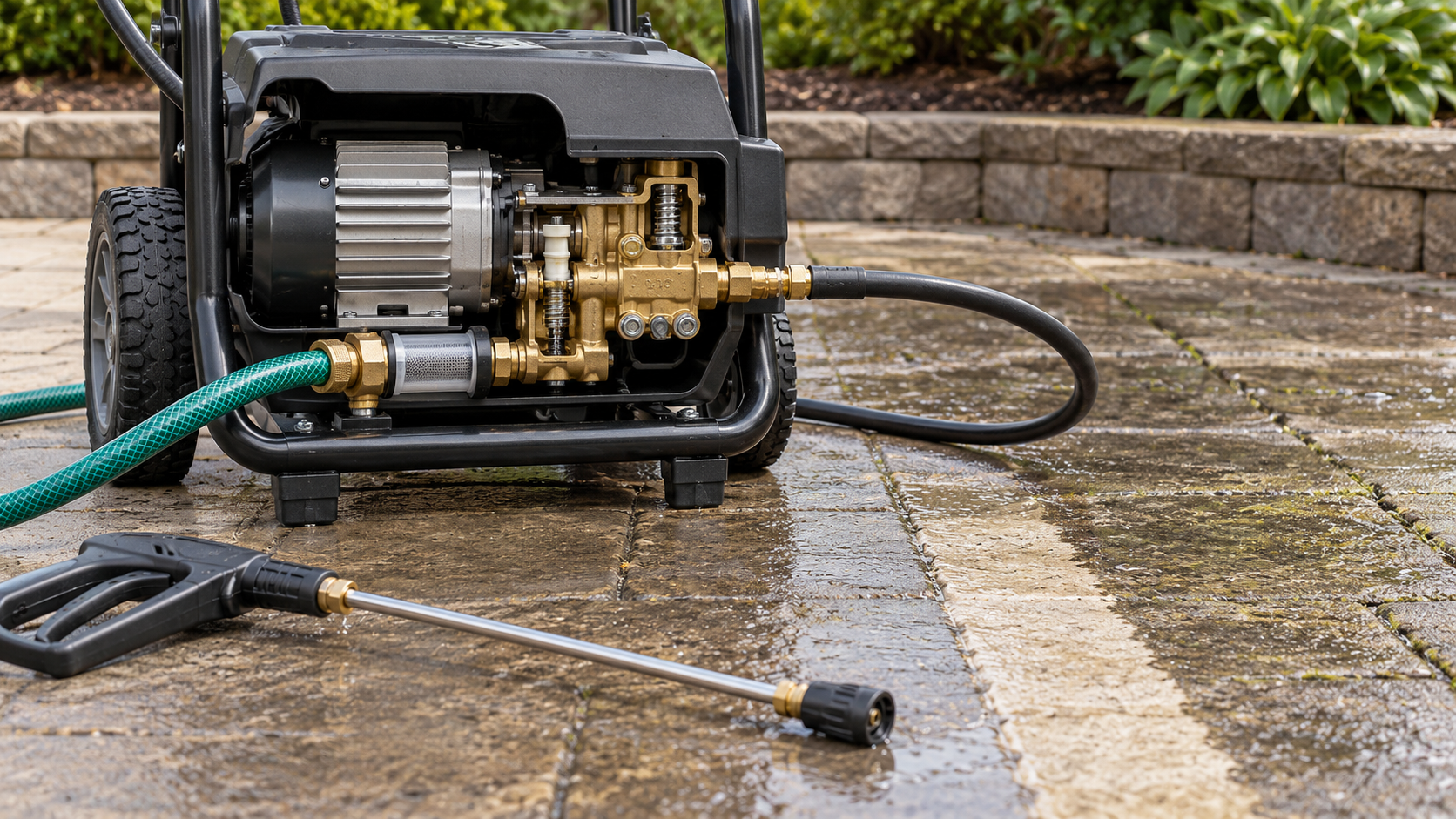
Pressure Washer Pump and Nozzle Explainer
A pressure washer adds mechanical energy to an ordinary water supply. An electric motor or small engine drives a positive-displacement pump containing pistons or plungers. As a piston withdraws, an inlet check valve opens and water fills the pump chamber. As it advances, the inlet closes, the outlet valve opens, and the trapped volume is forced into the high-pressure side. Repeated strokes create a continuing pressurized flow through the hose.
The spray nozzle has a much smaller opening than the supply hose. Pressurized water accelerates through that opening and emerges as a high-speed jet. Different nozzle shapes produce narrow or broad fans, trading impact concentration for coverage. Pressure and flow both matter: a narrow jet can deliver intense force to a small area, while a wider setting distributes energy more gently. The pump, nozzle size, and water supply must be matched.
When the trigger closes, water can no longer leave the wand. An unloader valve senses the pressure rise and redirects pump flow or reduces load, preventing pressure from increasing without limit. Some electric units also stop the motor. Thermal and pressure relief features protect particular designs, but they do not make prolonged bypass harmless. Operation and cool-down follow the manual, and the pump is never run without the required water supply.
Cleaning occurs through impact, shear, and water transport. The moving jet breaks the bond between dirt and a sound surface, while flowing water carries loosened material away. Distance, angle, fan width, detergent, and dwell time influence results. Too much concentration can etch wood, remove paint, damage mortar, force water behind siding, or drive contamination deeper. A test on a hidden area establishes the least aggressive effective setting.
The jet can penetrate skin and create serious injury even when the wound looks small. It is never directed at a person, animal, electrical equipment, or an object that can become a projectile. Eye, foot, and hearing protection follow the task and manual. Electric units require suitable grounded and protected connections kept away from standing water, while gasoline engines stay outdoors well away from doors, windows, and vents because of carbon monoxide.
The washer’s power comes from a sequence of energy conversion. The motor drives reciprocating pump elements, check valves make each stroke one-directional, the high-pressure hose contains the energized water, and the nozzle converts pressure into speed. The trigger and unloader manage changing demand. Effective cleaning uses that energy precisely rather than maximally, because the same concentrated jet that removes dirt can injure people or destroy the surface beneath it.
A motor-driven positive-displacement pump raises water pressure, and a small nozzle converts that pressure into a fast jet. Key terms include piston, plunger, check valve, unloader, pressure, flow, nozzle, and bypass.
The outlet closes and an unloader or control system redirects flow or reduces pump load so pressure does not continue rising unchecked.
The narrow jet can force water and contamination beneath the skin through a small opening, causing deep tissue damage that needs prompt medical care.
Explore more "Explainers"
Discover additional explainers across politics, science, business, technology, and other fields. Each explainer breaks down a complex idea into clear, everyday language—helping you better understand how major concepts, systems, and debates shape the world around us.