

On This Day in Business: June 2, 1896
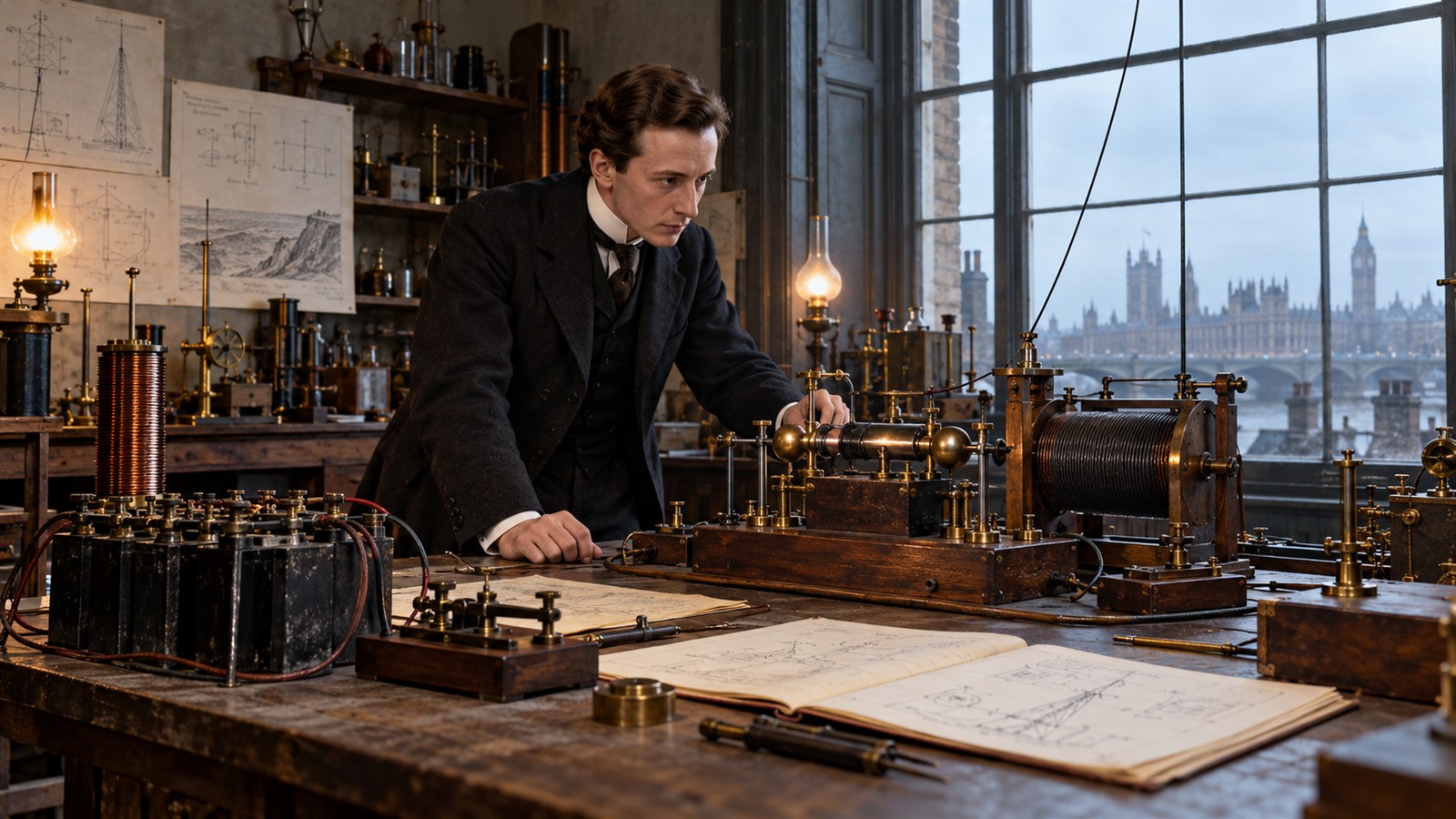
On June 2, 1896, Guglielmo Marconi applied in Britain for a patent covering a practical system of wireless telegraphy. The young Italian experimenter had traveled to London after building apparatus that sent coded signals without connecting wires. His application became British Patent No. 12,039 and described using electrical oscillations, an elevated antenna, grounding, and a receiver to transmit signals over distance. Other scientists had already demonstrated electromagnetic waves, but Marconi concentrated on assembling those principles into a working communications system. The filing gave him a legal and commercial foundation from which to demonstrate, finance, and sell wireless equipment.
The patent was only one part of the strategy. Marconi staged public trials for government officials, naval observers, and potential customers, steadily increasing the range of his transmissions. Wireless promised particular value at sea, where ships could not rely on fixed telegraph lines. The business therefore required more than a transmitter and receiver. It needed trained operators, standardized procedures, coastal stations, reliable components, and agreements with shipping companies. In 1897, investors formed the Wireless Telegraph and Signal Company to commercialize the system. Patents helped attract capital by defining what the company claimed to control while demonstrations converted an unfamiliar effect into evidence customers could understand.
Marconi's enterprise illustrates the challenge of building a network product before the network exists. A single wireless set had little value; usefulness grew when other ships and stations could communicate with it. The company installed equipment, supplied operators, collected service fees, and defended intellectual property as competing systems emerged. Maritime safety became a powerful market after wireless reports assisted rescues and carried distress calls. The technology also crossed national borders and raised questions about interoperability. Governments and industry bodies eventually developed rules, call signs, frequencies, and operating practices so that equipment from different organizations could share the air without making the service unusable.
The June filing matters because it shows how commercialization can be an inventive act of its own. Marconi did not create every scientific principle in his apparatus, but he combined components, protected a system, proved it in demanding environments, and built an organization around it. That process transformed radio from a laboratory possibility into communications infrastructure. Patent rights provided leverage, yet deployment, service quality, and network participation determined whether the invention produced lasting value. Modern platform businesses face the same sequence: define the technical proposition, demonstrate a useful application, recruit enough connected users, and establish standards that let the market grow beyond any single experiment.
Marconi combined known electrical principles into a system intended for practical signaling without physical wires.
His June 2, 1896 British application became Patent No. 12,039 and supplied a foundation for commercial development.
Public demonstrations translated invisible radio waves into clear evidence for officials, investors, and shipping customers.
Maritime use demanded coastal stations, trained operators, dependable equipment, and a network large enough to be useful.
Competition and international traffic pushed the young industry toward shared frequencies, procedures, and call signs.
The venture shows that patents matter most when paired with deployment, service operations, and a growing user network.
Explore more of "On This Day ..."
Discover more events from the same date across news, politics, technology, sports, and other fields. Each link highlights significant moments that shaped history on different fronts.