

On This Day in Business: June 15, 1844
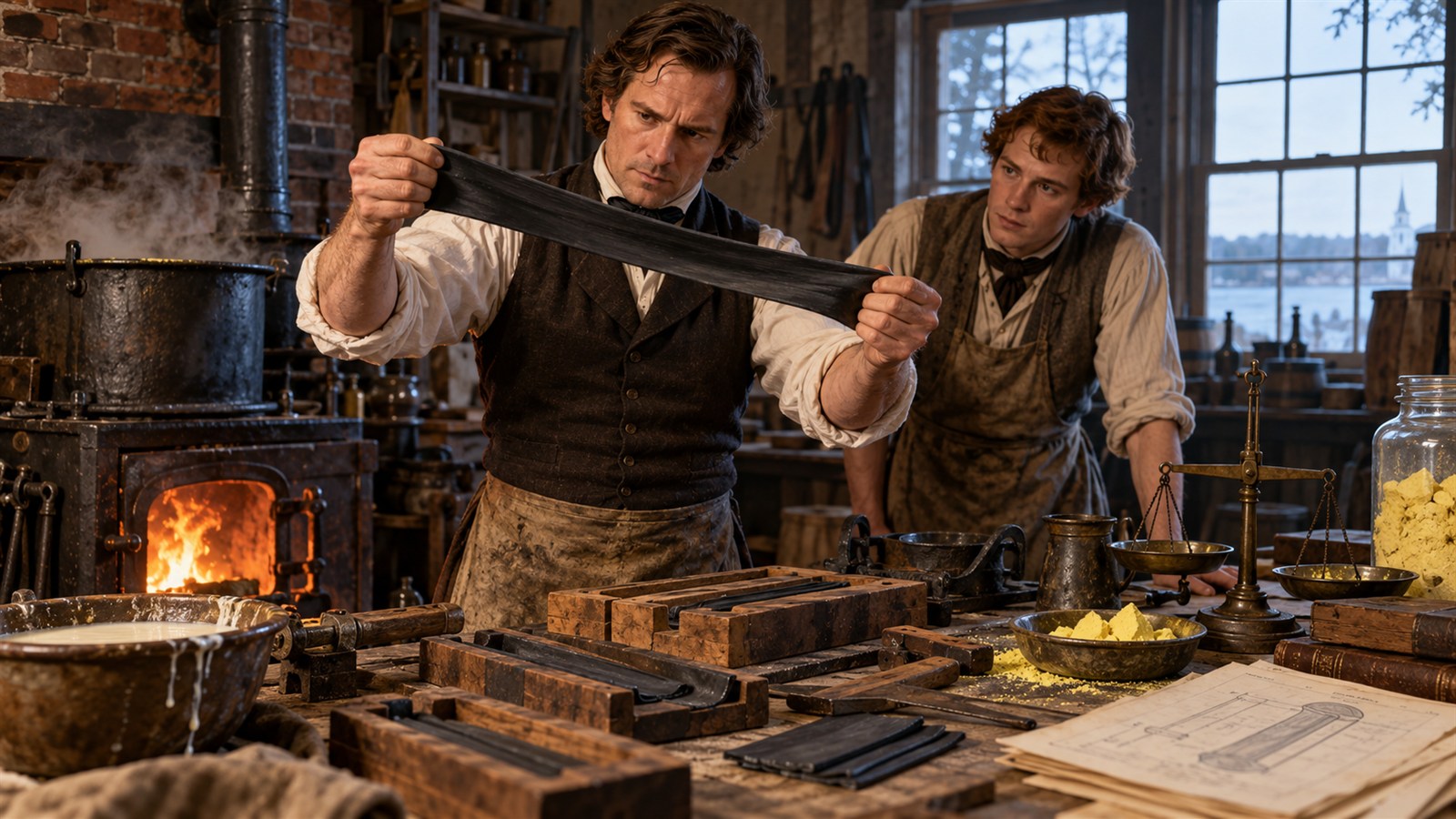
On June 15, 1844, Charles Goodyear received U.S. Patent No. 3,633 for an improved manufacture of rubber. Natural rubber was elastic and waterproof, but heat made it sticky and cold made it hard and brittle. After years of experiments, Goodyear developed a process using sulfur, heat, and other ingredients to create a material that remained more stable across changing temperatures. The treatment later became widely known as vulcanization. The patent described rubber compounds and curing methods that could support dependable products rather than seasonal novelties. It helped convert a troublesome natural substance into a foundation for large manufacturing industries.
The path to the patent was financially punishing. Goodyear borrowed money, sold possessions, spent time in debtors' prison, and continued testing mixtures despite repeated failures. He was an inventive experimenter but not a strong manufacturer or financier. Licensing appeared to offer a way to commercialize the process without owning every factory, yet enforcement proved difficult because the method was relatively easy to copy. Legal battles consumed time and money, while manufacturers and rival claimants disputed rights in the United States and Britain. Technical success therefore did not guarantee that the inventor would capture the value created by his discovery.
Vulcanized rubber enabled more reliable footwear, belts, hoses, seals, fabrics, medical goods, and eventually tires. Its economic impact grew through applications that Goodyear could not control or fully anticipate. Manufacturers still needed consistent raw material, careful temperature control, molds, quality testing, and markets for each finished good. The process became a general-purpose materials platform rather than a single product. That breadth encouraged investment and imitation and made patent boundaries especially important. Goodyear died in debt in 1860, while the later tire company bearing his name was founded by unrelated entrepreneurs decades afterward.
The patent matters because value capture and value creation are different capabilities. Goodyear solved a material problem with enormous commercial consequences, but he lacked the capital, production network, and enforceable control needed to secure a comparable fortune. Inventors and research-driven companies still face that gap. Patents can create bargaining power, yet they do not manufacture quality, select applications, establish distribution, or fund litigation. A platform technology may generate its greatest return for organizations that combine it with complementary assets. Goodyear's work changed industry precisely because others could apply it widely; his personal outcome warns that technical importance alone does not determine who benefits economically. Licensing strategy also required judgment about price and access. Terms that were too restrictive encouraged resistance and copying, while weak enforcement reduced the incentive to pay. General-purpose inventions need a commercialization model that invites broad adoption without giving away the entire basis of return.
Raw natural rubber became sticky in heat and brittle in cold, limiting its usefulness for dependable manufactured goods.
Goodyear's patented treatment used sulfur and controlled heat to create a more stable, elastic, and waterproof material.
Years of experiments brought debt, imprisonment, borrowing, and repeated failure before the process was commercially credible.
Licensing offered reach, but copying and expensive patent disputes prevented the inventor from capturing much of the value.
Footwear, belts, hoses, seals, fabrics, medical goods, and tires turned vulcanized rubber into a general-purpose industrial platform.
The history separates invention from commercialization: patents help, but production, capital, distribution, and enforcement determine returns.
Explore more of "On This Day ..."
Discover more events from the same date across news, politics, technology, sports, and other fields. Each link highlights significant moments that shaped history on different fronts.