

On This Day in Business: July 4, 1817
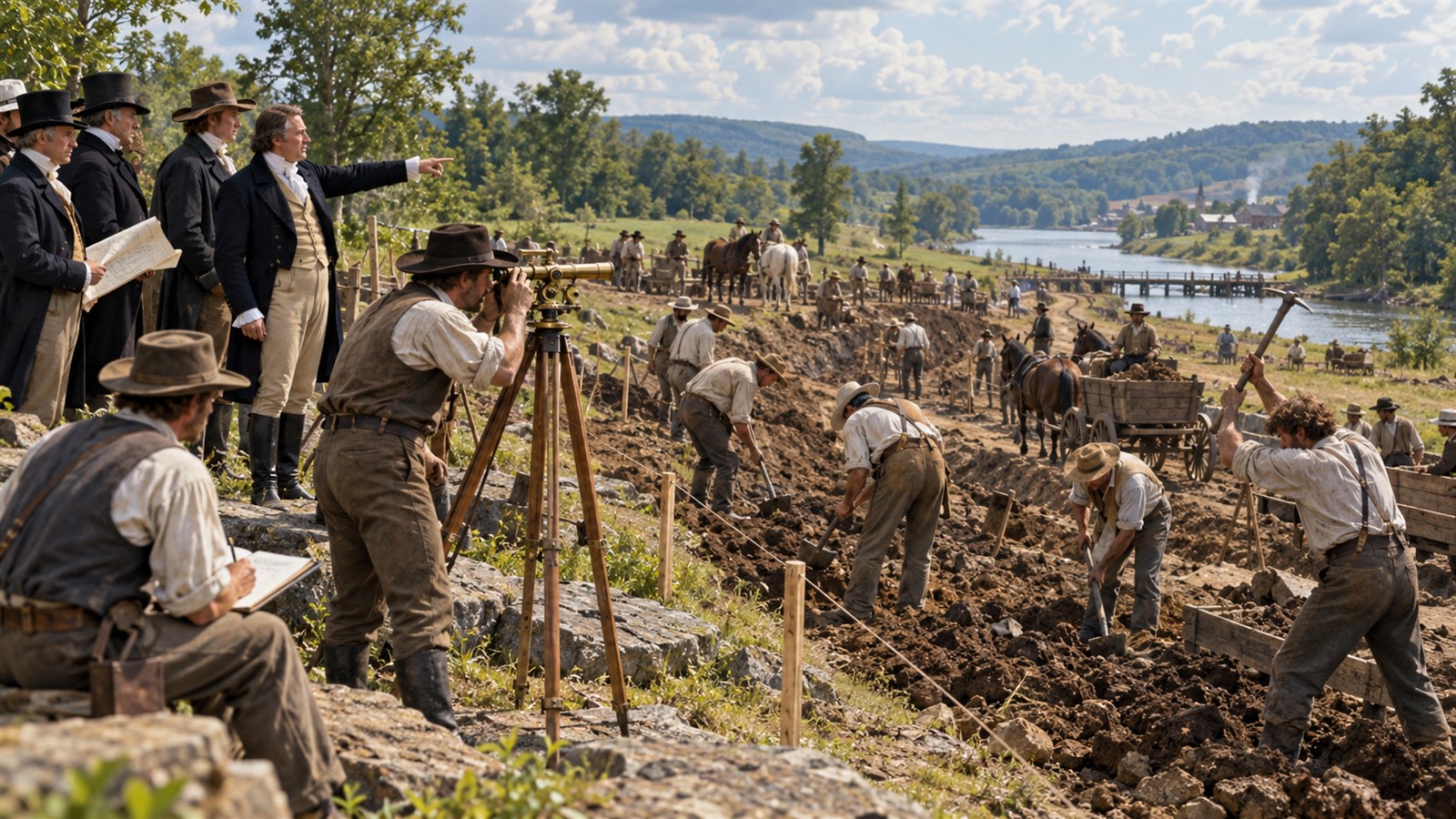
On July 4, 1817, workers broke ground near Rome, New York, for the Erie Canal. The planned waterway would run hundreds of miles between the Hudson River and Lake Erie, crossing forests, swamps, rivers, and a major elevation change. Supporters led by Governor DeWitt Clinton argued that a canal could connect western farms and Great Lakes commerce with New York City and the Atlantic. Critics mocked the expense and engineering ambition. With little federal support, New York financed the project and divided construction into sections that contractors could excavate with hand tools, animal power, and practical experimentation.
The work created a market for labor, timber, stone, iron, boats, provisions, surveying, and mechanical invention. Engineers had limited formal training, so they learned by solving problems in the field. Locks lifted vessels across changes in height, aqueducts carried the channel over streams, and embankments held water across uneven ground. Standard dimensions mattered because boats and structures needed to fit a connected system. The state also had to acquire land, supervise contracts, collect taxes, and maintain political support while costs accumulated years before the full network produced revenue.
The canal opened along its complete route in 1825. Freight costs between the interior and the coast fell sharply, travel became more predictable, and towns along the line expanded. Grain, lumber, and other western products moved east, while manufactured goods and migrants traveled west. New York City's port gained traffic and financial activity, strengthening its position against rival cities. Tolls helped repay construction costs sooner than many opponents expected. The canal's success encouraged more infrastructure investment, although later railroads competed with and eventually surpassed canals for many forms of transport.
The groundbreaking matters because infrastructure changes which businesses are possible. The canal did not invent western agriculture or Atlantic trade; it reduced the cost and uncertainty separating them. That advantage created value for landowners, merchants, shippers, manufacturers, banks, and communities far beyond the trench itself. It also required public institutions to accept concentrated risk for widely distributed future benefits. Modern networks differ in technology, but the economic logic is familiar. When a connection lowers friction across an entire region, its largest returns may appear in new activity that planners could not measure on opening day. The canal also changed inventory strategy. Merchants could plan larger, more regular shipments instead of depending entirely on slow wagon routes and uncertain river paths. More predictable transport encouraged specialization because producers gained confidence that distant inputs and customers would remain reachable. Lower freight cost therefore affected not just trade volume, but the kinds of enterprises communities were willing to build.
New York backed a canal linking the Hudson River with Lake Erie despite doubts about cost and engineering feasibility.
Construction began near Rome on July 4, 1817, using section contracts, hand labor, animals, and field-built solutions.
Locks, aqueducts, embankments, and common dimensions turned separate excavations into one dependable transportation system.
The completed canal lowered freight costs and connected western farms with New York City and Atlantic markets.
Tolls, port traffic, settlement, finance, and manufacturing spread the project's economic effects far beyond the canal route.
The investment shows how infrastructure can create new commerce by reducing the friction between existing producers and customers.
Explore more of "On This Day ..."
Discover more events from the same date across news, politics, technology, sports, and other fields. Each link highlights significant moments that shaped history on different fronts.