

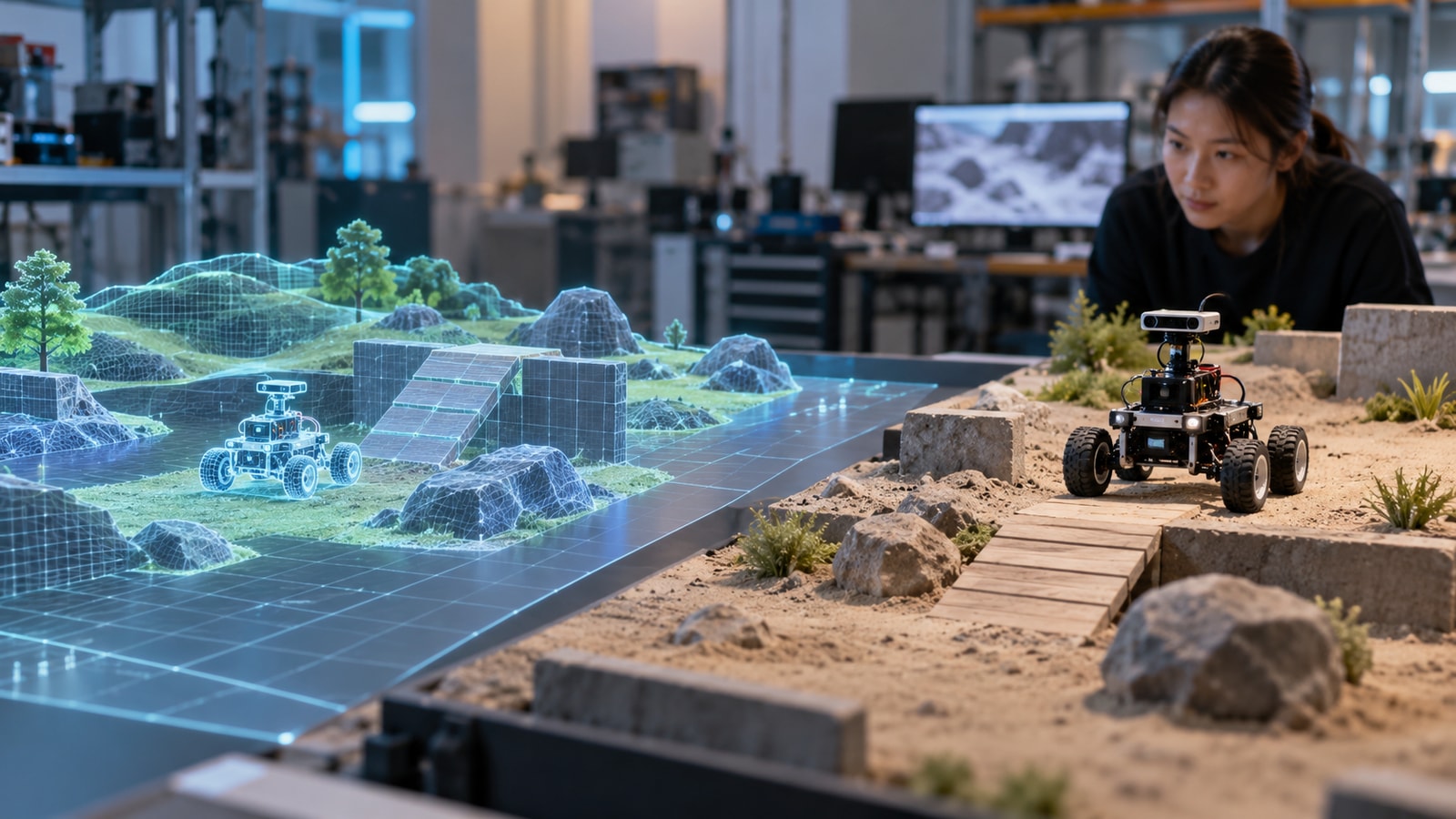
World Model in AI Explainer
A world model is a learned representation of how an environment behaves. Given a current state and possible action, it predicts future states, observations, rewards, or other consequences that an agent can use for decision-making.
Many systems compress high-dimensional observations into a latent state and learn temporal dynamics there. An agent can simulate candidate futures inside that model, sometimes called imagined rollouts, before choosing what to do in the real environment.
World models can improve data efficiency in robotics, games, and planning because simulated experience may be cheaper or safer than physical trials. They also support forecasting, representation learning, and control under partially observed conditions.
The model is never the world itself. Small prediction errors can compound over long rollouts, rare events may be missing, and an agent may exploit unrealistic simulated details. Short horizons, uncertainty estimates, and real-environment checks reduce these risks.
A world model learns an internal representation of how an environment changes so an agent can predict and plan.
Key terms include world model, dynamics, latent state, imagined rollout, planning, observation, action, model error and simulation.
The model predicts how possible actions could change a compact internal state.
An agent can compare several imagined futures before spending real-world time or resources.
Prediction errors and missing events can make long imagined rollouts unrealistic.
Uncertainty, frequent real-data updates, and conservative planning help limit model exploitation.
Explore more "Explainers"
Discover additional explainers across politics, science, business, technology, and other fields. Each explainer breaks down a complex idea into clear, everyday language—helping you better understand how major concepts, systems, and debates shape the world around us.