

On This Day in Business: August 27, 1859
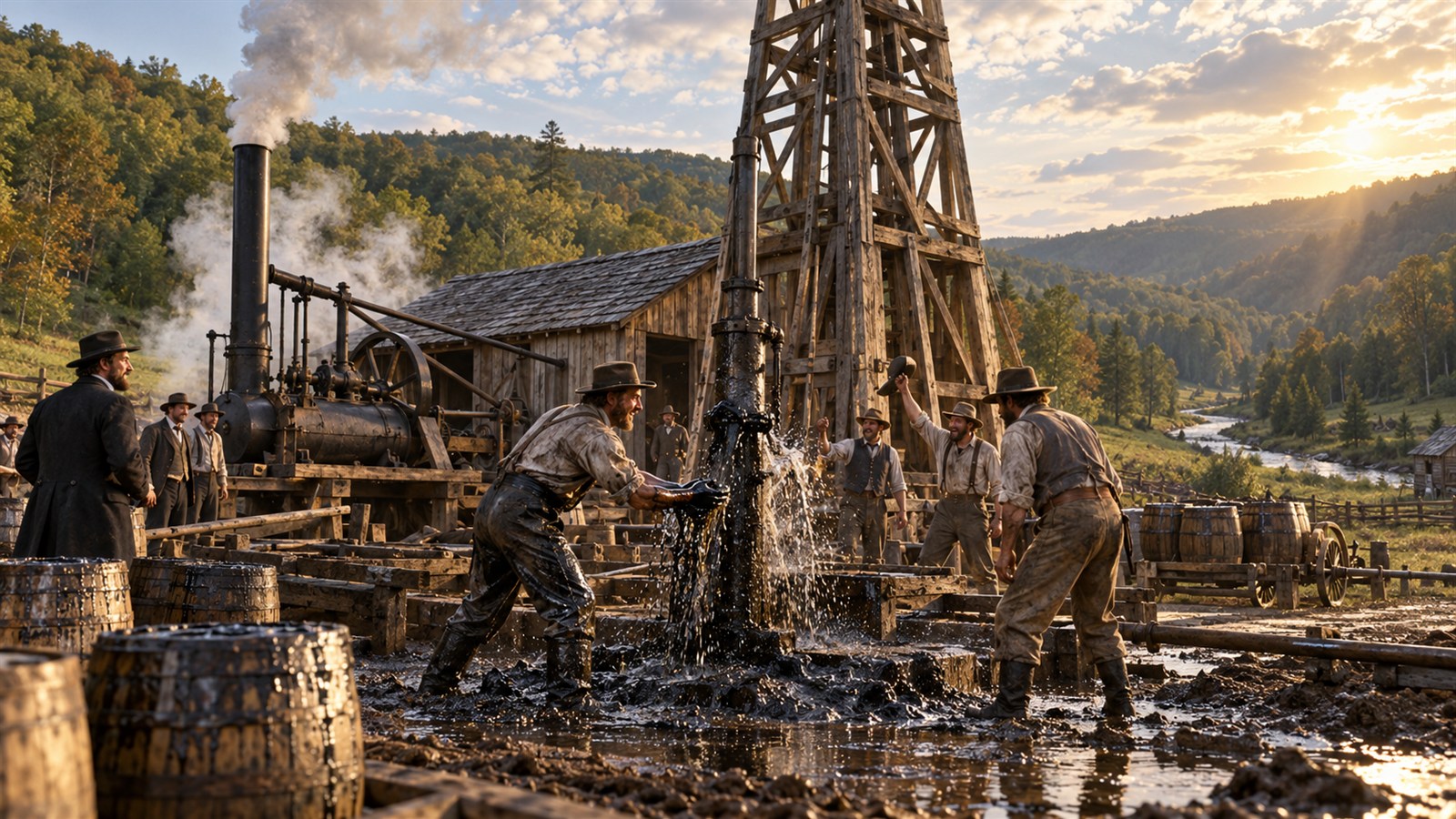
On August 27, 1859, Edwin Drake's drilling operation near Titusville, Pennsylvania, reached petroleum at a depth of about 69.5 feet. Oil had long been collected from natural seeps and used in medicines and lamps, but Drake's team adapted salt-well drilling methods to reach a dependable underground supply. The project was financed by investors who believed petroleum could become a commercial illuminant. After months of delays and ridicule, the well provided evidence that oil could be produced systematically rather than gathered in small quantities from the surface.
The discovery set off a rush into the Oil Creek region. Entrepreneurs leased land, drilled competing wells, built barrels and derricks, and searched for better ways to transport crude. Refineries converted oil into kerosene and other products, while pipelines and rail connections reduced the cost and leakage associated with hauling barrels. Prices swung sharply as production rose faster than markets and storage. The new industry created fortunes and failures at extraordinary speed, a pattern familiar in later resource booms.
Petroleum eventually supplied lubricants, industrial chemicals, gasoline, plastics, and fuels that transformed transportation and manufacturing. The value chain became far larger than drilling: exploration, equipment, refining, logistics, retail distribution, finance, and engineering all developed specialized businesses. Scale encouraged consolidation, most famously through Standard Oil, and prompted government scrutiny over monopoly power. Environmental damage, worker hazards, spills, and carbon emissions also became part of the industry's enduring cost, though those consequences received far less attention during the original boom.
The Drake Well is often described as the birthplace of the modern petroleum industry because it made a repeatable production method commercially visible. Its business lesson is broader than oil. A resource becomes an industry when extraction can be financed, standardized, scaled, transported, processed, and sold into reliable markets. The 1859 strike unlocked all of those activities, reshaping economies and geopolitics for generations. It also created long-term obligations that the first investors could scarcely imagine, reminding us that the full cost of an innovation may emerge only after its commercial success is secure. The boom also demanded financial adaptation. Investors had to judge geological uncertainty, drillers needed credit before production, and traders built markets around volatile output. Resource finance developed ways to distribute enormous risk, while communities learned how quickly prosperity could rise and fall with a single commodity price. Land leases and mineral rights became tradable expectations about what might lie underground, extending speculation well beyond the wells already producing.
Drake's operation struck oil near Titusville on August 27, 1859.
The well adapted drilling methods used in the salt industry to reach petroleum underground.
A reliable source proved that oil production could be systematic rather than limited to surface collection.
The resulting boom created markets for drilling equipment, barrels, pipelines, rail service, and refining.
Petroleum later supported transportation, chemicals, plastics, and a global industrial supply chain.
The industry's enormous value came with monopoly, safety, environmental, and climate consequences.
Explore more of "On This Day ..."
Discover more events from the same date across news, politics, technology, sports, and other fields. Each link highlights significant moments that shaped history on different fronts.