

On This Day in Life: August 4, 1821
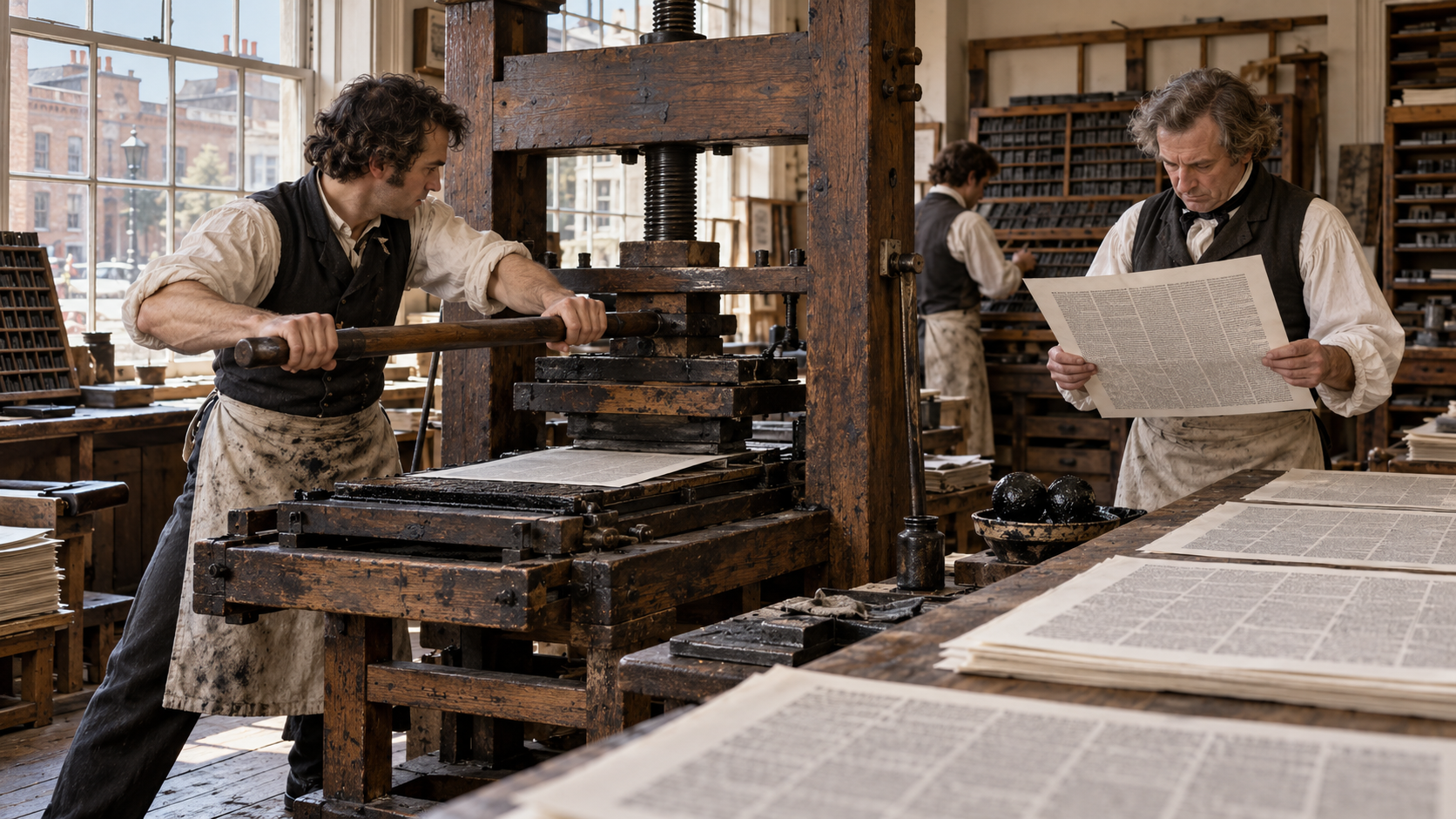
On August 4, 1821, The Saturday Evening Post began publication in Philadelphia as a four-page weekly newspaper carrying news, short articles, poetry, practical material, advertisements, and literary selections. The date matters in lifestyle history because a compact weekly helped establish the general-interest reading habit that magazines would carry into millions of homes. It was not merely a headline for institutions or specialists; it touched the settings, objects, expectations, and shared rituals through which people organized ordinary days. In a narrow Philadelphia print shop, a pressman worked a wooden hand press while freshly printed four-page sheets with dense five-column type dried nearby under daylight from tall windows. Seen at human scale, the episode shows how a public milestone becomes meaningful through repeated personal choices, conversations, and memories.
Publisher Samuel Coate Atkinson and editor Thomas Cottrell Clarke issued the paper from a Market Street printing office associated in local memory with Benjamin Franklin’s publishing tradition. Hand-operated presses required long hours, and dense columns made economical use of expensive paper. The original first issues are not known to survive; the Library of Congress catalog nevertheless records volume one, number one as August 4, 1821. The setting is essential to understanding why the event attracted attention. New ideas rarely arrive in isolation: they meet existing technology, commerce, custom, law, and desire. Contemporary newspapers, public spaces, shops, schools, workplaces, or homes carried the story outward, giving people practical ways to interpret it. Some welcomed the change, others doubted it, and many first encountered it indirectly. That mixture of novelty and familiarity helped the moment travel from a single date into a broader change in behavior.
The weekly blended information and entertainment for household reading at a time when newspapers were often openly political. It emphasized a broad, nonpartisan mixture of domestic and foreign news, essays, stories, etiquette, fashion, business, science, and humor that could be passed among family members. In daily life, the consequences appeared through altered routines, new expectations, and different ways of spending time or money. The publication changed owners and editors, later becoming a mass-circulation magazine known for fiction, reporting, advertising, and illustrated covers. Its long history also included periods of decline, reinvention, and contested claims of continuity with Franklin’s earlier Pennsylvania Gazette. The benefits were never the whole story; major changes also exposed questions about access, responsibility, fairness, cost, and who had power to define progress. Those tensions deserve a place beside the celebration because they show how culture actually develops. The event mattered not because everyone experienced it in the same way, but because it opened a durable argument about how people wanted to live.
Today, the legacy remains visible: general-interest publications now reach readers through print, websites, newsletters, podcasts, and social feeds, but they still balance information, entertainment, identity, and the economics of attention. Familiarity can make that inheritance easy to overlook, yet the practices surrounding it were built through years of experimentation, adaptation, criticism, and use. Looking back does more than celebrate an anniversary. It reveals the chain between public decisions and private habits, between ambitious ideas and the small acts that make them ordinary. On this day, one historical moment became part of the texture of modern life. Remembering the full setting lets the milestone feel less like a frozen fact and more like a living part of experience.
On August 4, 1821, The Saturday Evening Post began publication in Philadelphia as a four-page weekly newspaper carrying news, short articles, poetry, practical material, advertisements, and literary selections.
Publisher Samuel Coate Atkinson and editor Thomas Cottrell Clarke issued the paper from a Market Street printing office associated in local memory with Benjamin Franklin's publishing tradition. Hand-operated presses required long hours, and dense columns made economical use of expensive paper. The original first issues are not known to survive; the Library of Congress catalog nevertheless records volume one, number one as August 4, 1821.
The weekly blended information and entertainment for household reading at a time when newspapers were often openly political. It emphasized a broad, nonpartisan mixture of domestic and foreign news, essays, stories, etiquette, fashion, business, science, and humor that could be passed among family members.
The event matters in lifestyle history because a compact weekly helped establish the general-interest reading habit that magazines would carry into millions of homes.
The publication changed owners and editors, later becoming a mass-circulation magazine known for fiction, reporting, advertising, and illustrated covers. Its long history also included periods of decline, reinvention, and contested claims of continuity with Franklin's earlier Pennsylvania Gazette.
The legacy remains visible today: general-interest publications now reach readers through print, websites, newsletters, podcasts, and social feeds, but they still balance information, entertainment, identity, and the economics of attention.
Explore more of "On This Day ..."
Discover more events from the same date across news, politics, technology, sports, and other fields. Each link highlights significant moments that shaped history on different fronts.