

On This Day in Business: September 10, 1846
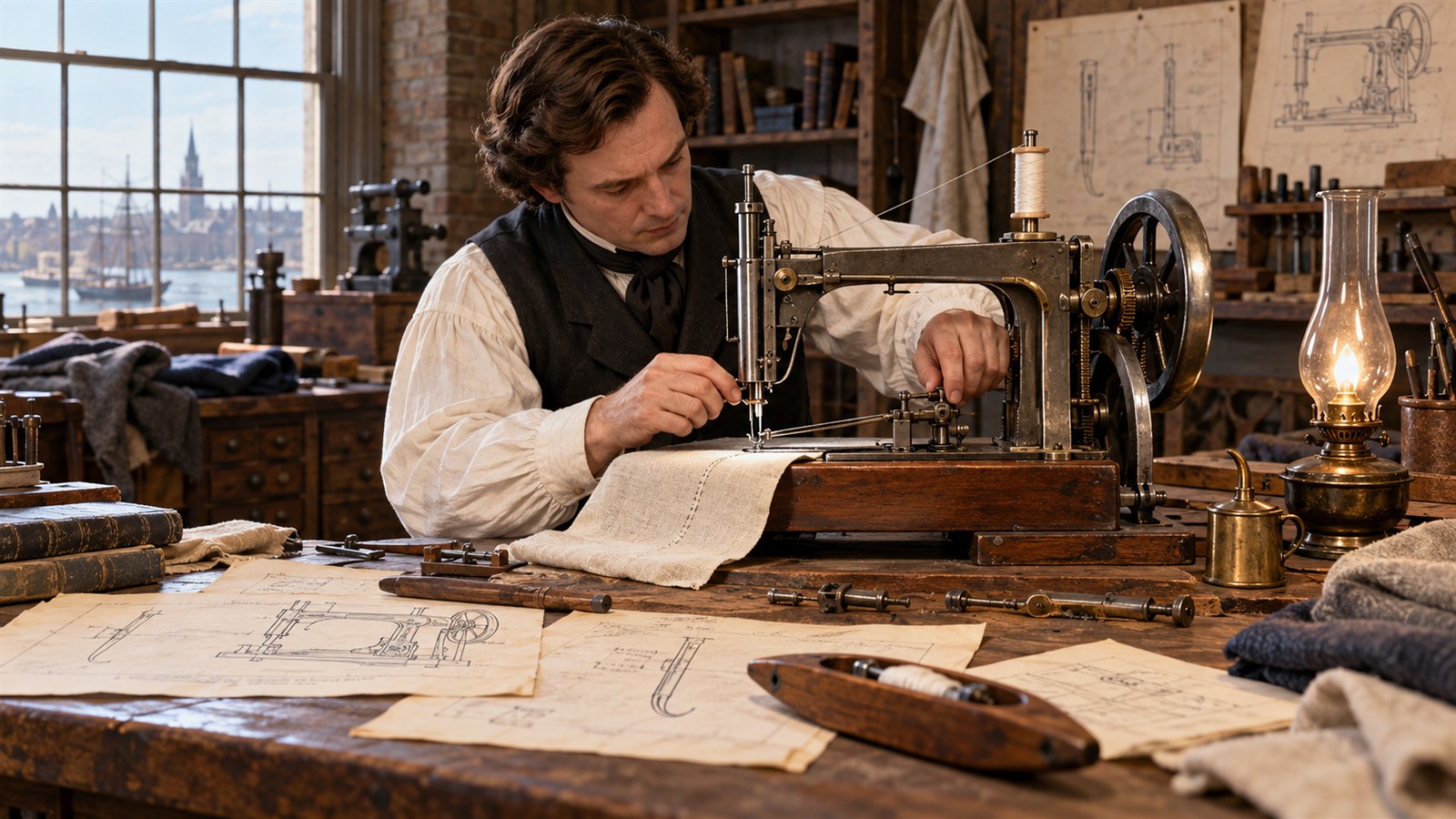
On September 10, 1846, Elias Howe received U.S. Patent No. 4,750 for improvements to the sewing machine. His design used a curved, eye-pointed needle and a shuttle carrying a second thread to form a lockstitch. Sewing machines had been attempted before, but Howe's arrangement offered a workable method for joining fabric repeatedly and securely. The patent did not instantly create a factory empire for its inventor. It did, however, define valuable intellectual property at a moment when textile production was becoming increasingly mechanized and the hand sewing required to assemble garments remained a major labor bottleneck.
A sewing machine had to coordinate several actions precisely: feeding fabric, driving the needle, passing the shuttle, maintaining thread tension, and advancing the work for the next stitch. Reliability mattered more than a spectacular demonstration because manufacturers needed thousands of consistent stitches. Howe struggled to commercialize the invention and spent time in England before returning to an American market where other makers were developing machines. The resulting patent disputes became as important to the business as the original mechanism. Legal recognition of the lockstitch claims gave Howe leverage over companies capable of manufacturing and distributing at scale.
Competing patents initially threatened to block the industry. Manufacturers controlled different essential features, and lawsuits raised costs for everyone. In 1856, major owners created the Sewing Machine Combination, a patent pool that licensed crucial technologies together. The arrangement reduced litigation and allowed manufacturers to focus on production, sales networks, financing, and product improvement while paying royalties. It became an influential example of complementary patent holders turning conflict into a shared licensing framework. Howe received income through the pool even though other firms, especially Singer, built stronger manufacturing and consumer brands.
Mechanized sewing transformed apparel, footwear, upholstery, and household work. It increased output, encouraged standardized clothing sizes, supported new factory systems, and created both opportunities and harsh labor conditions in garment production. Domestic machines were also sold through installment plans, demonstrations, and dealer networks that helped popularize consumer durables. The 1846 patent therefore sits at the intersection of invention, law, manufacturing, finance, and labor. Howe's experience shows that technical authorship alone does not guarantee market leadership, but well-defined intellectual property can still shape an industry's structure. The machine's larger legacy is the way automation reorganized a familiar manual task into a scalable commercial process used in factories and homes around the world. The industry's growth also changed who could enter the clothing market. Faster stitching lowered unit costs and supported larger product lines, but it made cutting, scheduling, quality control, and distribution more important. Automation moved the bottleneck rather than eliminating the need for organization and skill.
Elias Howe received U.S. Patent No. 4,750 for a sewing machine on September 10, 1846.
His design used an eye-pointed needle and shuttle thread to produce a lockstitch.
Commercialization depended on reliable fabric feed, thread tension, manufacturing, and distribution.
Patent disputes gave Howe licensing leverage but slowed an industry with overlapping inventions.
A patent pool later combined essential rights and reduced litigation among major manufacturers.
Mechanized sewing reshaped garment output, consumer finance, household work, and factory labor.
Explore more of "On This Day ..."
Discover more events from the same date across news, politics, technology, sports, and other fields. Each link highlights significant moments that shaped history on different fronts.