

On This Day in Business: October 14, 1947
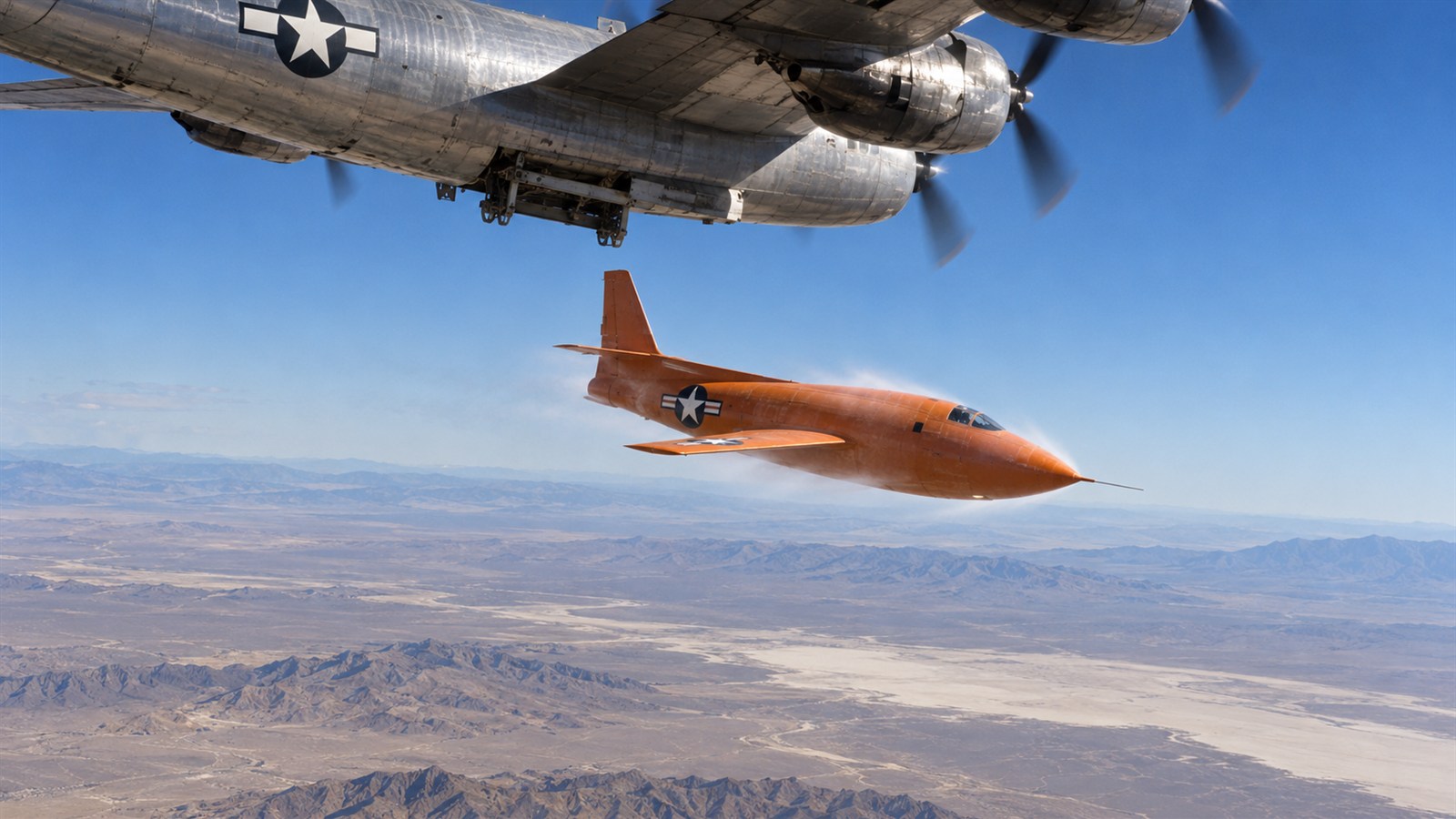
On October 14, 1947, Air Force Captain Charles E. 'Chuck' Yeager flew the rocket-powered Bell X-1 faster than the speed of sound over California's Mojave Desert. A B-29 carried the orange research aircraft aloft and released it at altitude; Yeager then fired its engine and reached about Mach 1.06. The flight supplied the first confirmed evidence that a piloted aircraft could pass through the so-called sound barrier in controlled level flight. It was the product of cooperation among the Army Air Forces, the National Advisory Committee for Aeronautics, Bell Aircraft, and a network of engineers, mechanics, instrument specialists, and suppliers.
Transonic flight had created dangerous control problems as shock waves formed around aircraft approaching Mach 1. Designers gave the X-1 a thin wing, a fuselage shaped like a .50-caliber bullet, and a movable horizontal stabilizer that helped maintain control. The aircraft was built as a flying laboratory rather than a commercial prototype. Sensors turned each flight into data about pressure, stability, heating, and pilot response. Public funding absorbed risks that no airline passenger market would have justified, while a private manufacturer translated research requirements into hardware.
The achievement strengthened the experimental-aircraft program and informed later military designs capable of routine supersonic operation. Research methods, materials, propulsion knowledge, and aerodynamic understanding flowed through the aerospace supply chain. Commercial supersonic travel arrived much later and never became ordinary because fuel use, noise, range, cost, and regulation constrained the market. That gap between technical possibility and profitable service is instructive. Breaking a performance barrier can create knowledge and strategic advantage without automatically producing a mass-market business.
The X-1 is now preserved by the Smithsonian, and its flight remains an emblem of disciplined experimentation. October 14 shows how government can act as an early customer for technologies with uncertain private demand, especially when national defense and scientific knowledge are involved. It also highlights the importance of measurement: a dramatic claim became credible because instruments documented speed, altitude, and behavior. The aerospace industry that followed depended on this combination of public research, specialized contractors, test operations, and accumulated data. Yeager's flight was a singular moment, but the business capability behind it was a repeatable system for converting hazardous unknowns into engineering knowledge. Test programs also preserve options. Even when a specific research aircraft never enters production, validated data can prevent failures and shorten development elsewhere. The return appears across a portfolio of later designs rather than in sales of the experimental vehicle itself.
Chuck Yeager flew the Bell X-1 beyond Mach 1 on October 14, 1947.
A B-29 released the rocket-powered research aircraft over California's Mojave Desert.
The thin wing and movable stabilizer helped address dangerous transonic control problems.
Government agencies, Bell Aircraft, test crews, and suppliers shared the risk and knowledge.
Supersonic research improved military aviation, although commercial economics remained difficult.
The program shows how instrumented public research can turn technical uncertainty into industrial capability.
Explore more of "On This Day ..."
Discover more events from the same date across news, politics, technology, sports, and other fields. Each link highlights significant moments that shaped history on different fronts.