

On This Day in Business: October 21, 1879
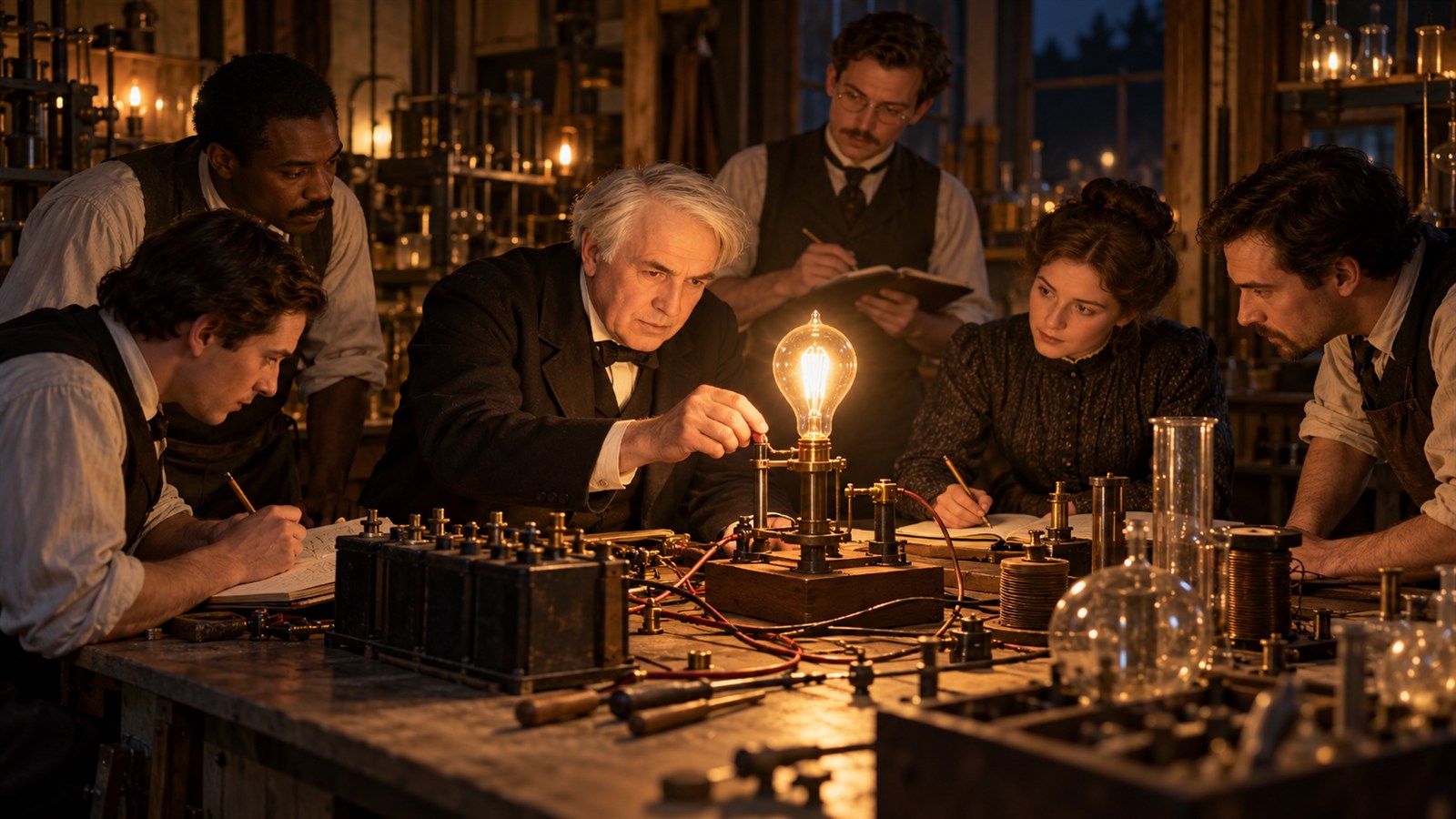
On October 21, 1879, Thomas Edison's laboratory at Menlo Park, New Jersey, tested an incandescent lamp using a carbonized cotton-thread filament that burned for more than thirteen hours. It was not the first electric light or even the first incandescent lamp. The significance lay in a continuing effort to create a practical system: a durable high-resistance bulb, generators, wiring, meters, switches, sockets, and distribution economics that could compete with gas lighting. The test offered evidence that Edison's team was moving toward a product suitable for homes and businesses rather than a short-lived laboratory demonstration.
Edison organized invention as a collaborative industrial process. Machinists, chemists, draftsmen, glassblowers, and experimenters tested thousands of materials and recorded results. Patents protected components, investors supplied capital, and publicity attracted attention, but the central challenge was compatibility across the system. A low-cost bulb would have little value without dependable power, and a generating station would have no customers without safe fixtures. By designing the network and the endpoint together, the enterprise could control performance and make adoption easier.
The Edison Electric Illuminating Company opened its Pearl Street station in lower Manhattan in 1882, serving nearby customers with direct-current electricity. Electric light reduced flame, smoke, and some fire hazards inside buildings, while extending useful hours for shops, factories, offices, and entertainment. Competition soon emerged over alternating and direct current, patents, equipment standards, and municipal franchises. Companies combined and evolved into the modern electrical industry. The business was capital intensive: wires and generating equipment had to be installed before enough usage existed to recover the cost.
The October lamp test became a symbol of invention, but its deeper lesson is commercialization through systems engineering. Edison's team did not succeed because one filament solved every problem. It succeeded by linking a device with production, intellectual property, finance, infrastructure, service, and a clear customer use. Electric lighting also brought new risks and social changes, including dangerous early installations and longer working hours. Even so, the practical lamp helped convert electricity from spectacle into utility. Modern platform businesses follow a similar pattern when the value of a product depends on an entire supporting network being available at the moment the customer turns it on. The network created recurring revenue as consumption grew, but it also produced natural-monopoly characteristics. Regulators and municipalities therefore became central to pricing, access, safety, and expansion. Commercial scale brought public obligations alongside engineering opportunity. These regulatory choices shaped who could connect, what service cost, and how quickly the network expanded.
Edison's Menlo Park laboratory tested a carbon-filament lamp on October 21, 1879.
The experiment was one step in building a practical system rather than the first incandescent light.
Generators, wiring, meters, fixtures, sockets, and lamps all had to work as an integrated network.
A multidisciplinary laboratory turned invention into a repeatable, documented industrial process.
Electric lighting created demand for capital-intensive generation and distribution infrastructure.
The commercial breakthrough came from coordinating a complete system around a useful customer experience.
Explore more of "On This Day ..."
Discover more events from the same date across news, politics, technology, sports, and other fields. Each link highlights significant moments that shaped history on different fronts.