

On This Day in Lifestyles: October 5, 1947
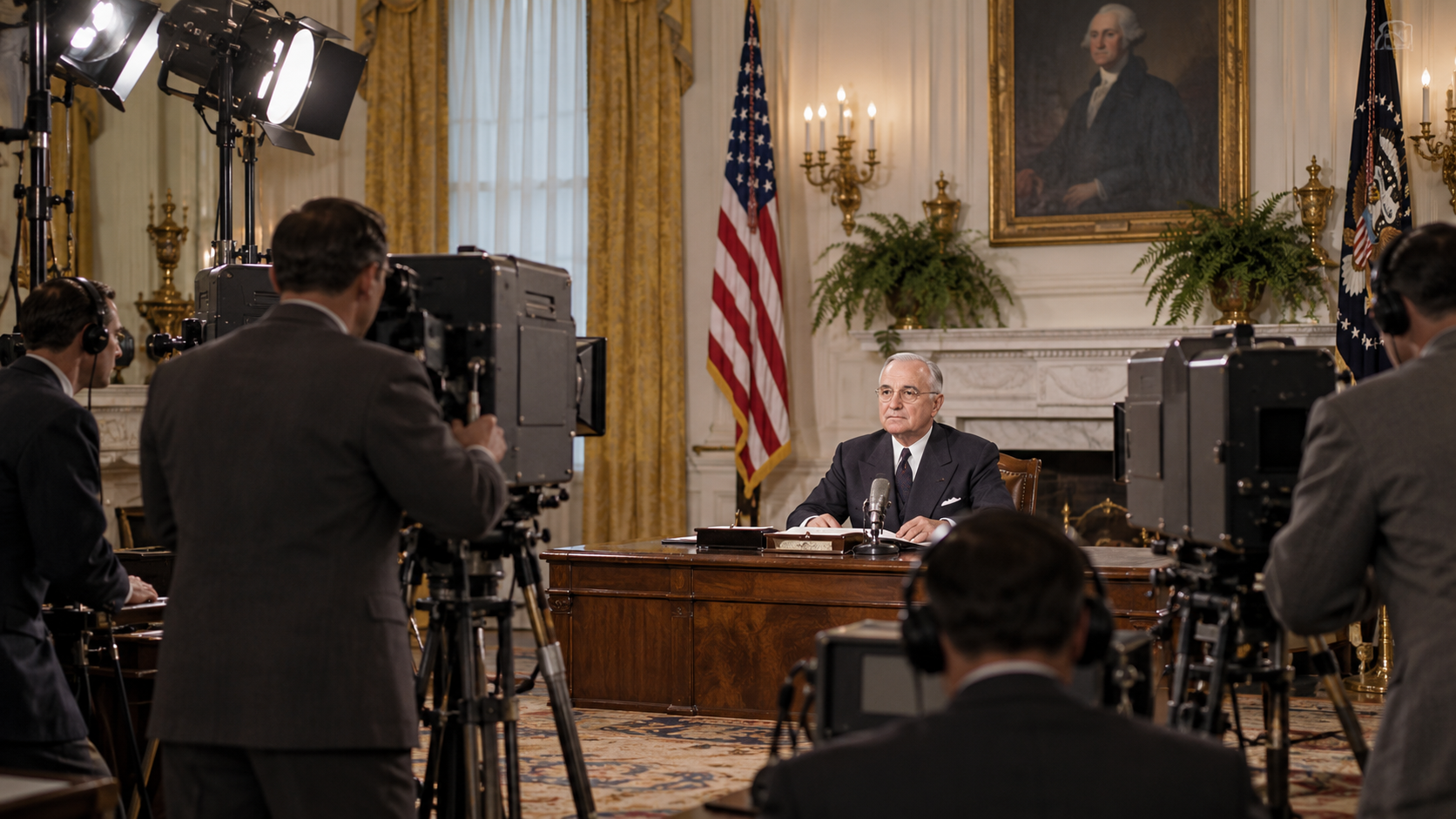
On October 5, 1947, President Harry S. Truman made the first televised presidential address from the White House. The date matters in lifestyle history because a presidential appeal made the visual performance of leadership part of household political life. It was not merely a headline for institutions or specialists; it touched the settings, objects, expectations, and shared rituals through which people organized ordinary days. Truman sat at a desk beneath intense 1947 television lights while large broadcast cameras and technicians crowded the formal White House room Seen at human scale, the episode shows how a public milestone becomes meaningful through repeated personal choices, conversations, and memories.
The short appearance closed a food-conservation program and asked Americans to reduce consumption so more grain could help people facing hunger in postwar Europe. Television ownership remained rare, so far more citizens heard the remarks by radio than watched them. Heavy cameras, strong studio lights, microphones, and a limited network carried the image from the Diplomatic Reception Room. The setting is essential to understanding why the event attracted attention. New ideas rarely arrive in isolation: they meet existing technology, commerce, custom, law, and desire. Contemporary newspapers, public spaces, shops, schools, workplaces, or homes carried the story outward, giving people practical ways to interpret it. Some welcomed the change, others doubted it, and many first encountered it indirectly. That mixture of novelty and familiarity helped the moment travel from a single date into a broader change in behavior.
The broadcast showed that television could bring a president’s face and manner directly into public gathering places and a small number of homes. Political communication began acquiring a visual dimension in which setting, expression, staging, and timing mattered alongside words. The conservation appeal also connected domestic habits such as meatless and eggless days to international recovery. In daily life, the consequences appeared through altered routines, new expectations, and different ways of spending time or money. Televised speeches, debates, press conferences, and ceremonial moments became routine parts of national politics. Each new medium—from cable to livestreams and social video—has further shortened the distance between public officials and audiences while increasing the importance of production and image management. The benefits were never the whole story; major changes also exposed questions about access, responsibility, fairness, cost, and who had power to define progress. Those tensions deserve a place beside the celebration because they show how culture actually develops. The event mattered not because everyone experienced it in the same way, but because it opened a durable argument about how people wanted to live.
Today, the legacy remains visible: leaders speak through live video, clipped highlights, and personal feeds, making media literacy essential to understanding how public messages are framed. Familiarity can make that inheritance easy to overlook, yet the practices surrounding it were built through years of experimentation, adaptation, criticism, and use. Looking back does more than celebrate an anniversary. It reveals the chain between public decisions and private habits, between ambitious ideas and the small acts that make them ordinary. On this day, one historical moment became part of the texture of modern life. Remembering the full setting lets the milestone feel less like a frozen fact and more like a living part of experience.
On October 5, 1947, President Harry S. Truman made the first televised presidential address from the White House.
The short appearance closed a food-conservation program and asked Americans to reduce consumption so more grain could help people facing hunger in postwar Europe. Television ownership remained rare, so far more citizens heard the remarks by radio than watched them. Heavy cameras, strong studio lights, microphones, and a limited network carried the image from the Diplomatic Reception Room.
The broadcast showed that television could bring a president's face and manner directly into public gathering places and a small number of homes. Political communication began acquiring a visual dimension in which setting, expression, staging, and timing mattered alongside words. The conservation appeal also connected domestic habits such as meatless and eggless days to international recovery.
The event matters in lifestyle history because a presidential appeal made the visual performance of leadership part of household political life.
Televised speeches, debates, press conferences, and ceremonial moments became routine parts of national politics. Each new medium—from cable to livestreams and social video—has further shortened the distance between public officials and audiences while increasing the importance of production and image management.
The legacy remains visible today: leaders speak through live video, clipped highlights, and personal feeds, making media literacy essential to understanding how public messages are framed.
Explore more of “This Day in Lifestyles”
Discover more moments in everyday life, design, education, travel, food, fashion, and culture. Each story connects a calendar date with an event that changed how people lived.