

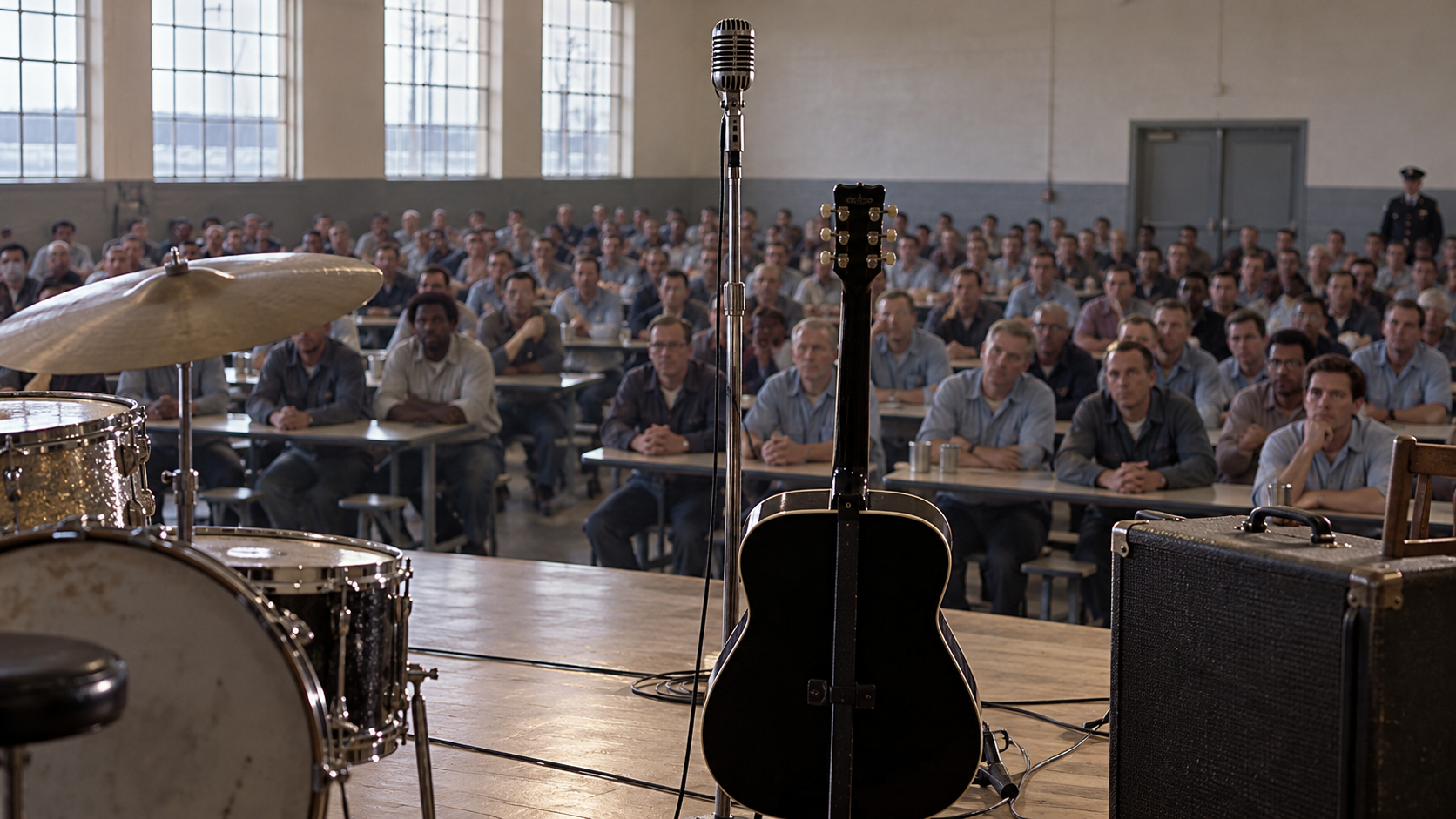
On This Day in Pop: January 13, 1968
Johnny Cash performed and recorded two concerts at Folsom State Prison in California on January 13, 1968, creating the material for the live album At Folsom Prison. Cash had been interested in prisons since seeing the film Inside the Walls of Folsom Prison during Air Force service in the early 1950s. He wrote “Folsom Prison Blues,” first recorded in 1955, and began playing correctional facilities before the album project took shape. For the 1968 visit, Cash arrived with the Tennessee Three, June Carter, Carl Perkins and the Statler Brothers. Producer Bob Johnston and Columbia Records engineers captured an early show and a second performance in the prison dining hall, using the repeat as practical insurance against technical or musical problems.
The conditions gave the recording an energy that a studio could not manufacture. Cash opened with his familiar introduction and addressed an audience that understood the confinement in his songs more directly than ordinary concertgoers. The set moved through train songs, murder ballads, spiritual material and “Folsom Prison Blues,” while “Greystone Chapel,” written by inmate Glen Sherley, connected the program to a voice from inside the institution. The famous cheers heard on the album were part of a carefully edited record rather than an untouched transcript; live albums are constructed from performances, microphone choices and later assembly. Even so, the rapport was real. Cash treated the prisoners as an audience rather than scenery, and his plain black clothes, deep voice and repertoire aligned with the outsider identity he had been building for years.
Released in May 1968, At Folsom Prison reached the top of the country chart and crossed into the pop market, reviving Cash’s commercial momentum after a difficult period marked by addiction and inconsistent sales. The record helped establish the concert album as a powerful form of country storytelling and strengthened Cash’s public association with people excluded from respectable society. That image could simplify both the singer and the realities of incarceration, and the performance did not by itself reform prisons. Cash nevertheless used the attention to speak publicly about prison conditions and later testified before the U.S. Senate. The January concerts endured because sound, place and persona converged with unusual clarity. Listeners could hear not only a career turning point, but the friction between entertainment, confinement, empathy and American ideas about punishment. The prison recordings also helped cement the productive partnership between Cash and producer Bob Johnston, whose lean approach let the room’s charged atmosphere remain central to the finished record.
Cash had played prisons before 1968 and built his repertoire around trains, crime, judgment and redemption long before the album session.
Columbia recorded two shows in the dining hall so the production team would have alternate performances and protection against technical failure.
The resulting album restored Cash’s chart position and brought a country record to a large pop audience.
Editing shaped the final listening experience, and the concert’s fame should not be confused with direct prison reform.
The album became a model for live recording because the setting deepened the meaning of the songs instead of merely providing atmosphere.
Cash later used his visibility to advocate for changes in corrections while continuing to perform for incarcerated audiences.
Explore more of "On This Day ..."
Discover more events from the same date across news, politics, technology, sports, and other fields. Each link highlights significant moments that shaped history on different fronts.