

Motion Capture Explainer
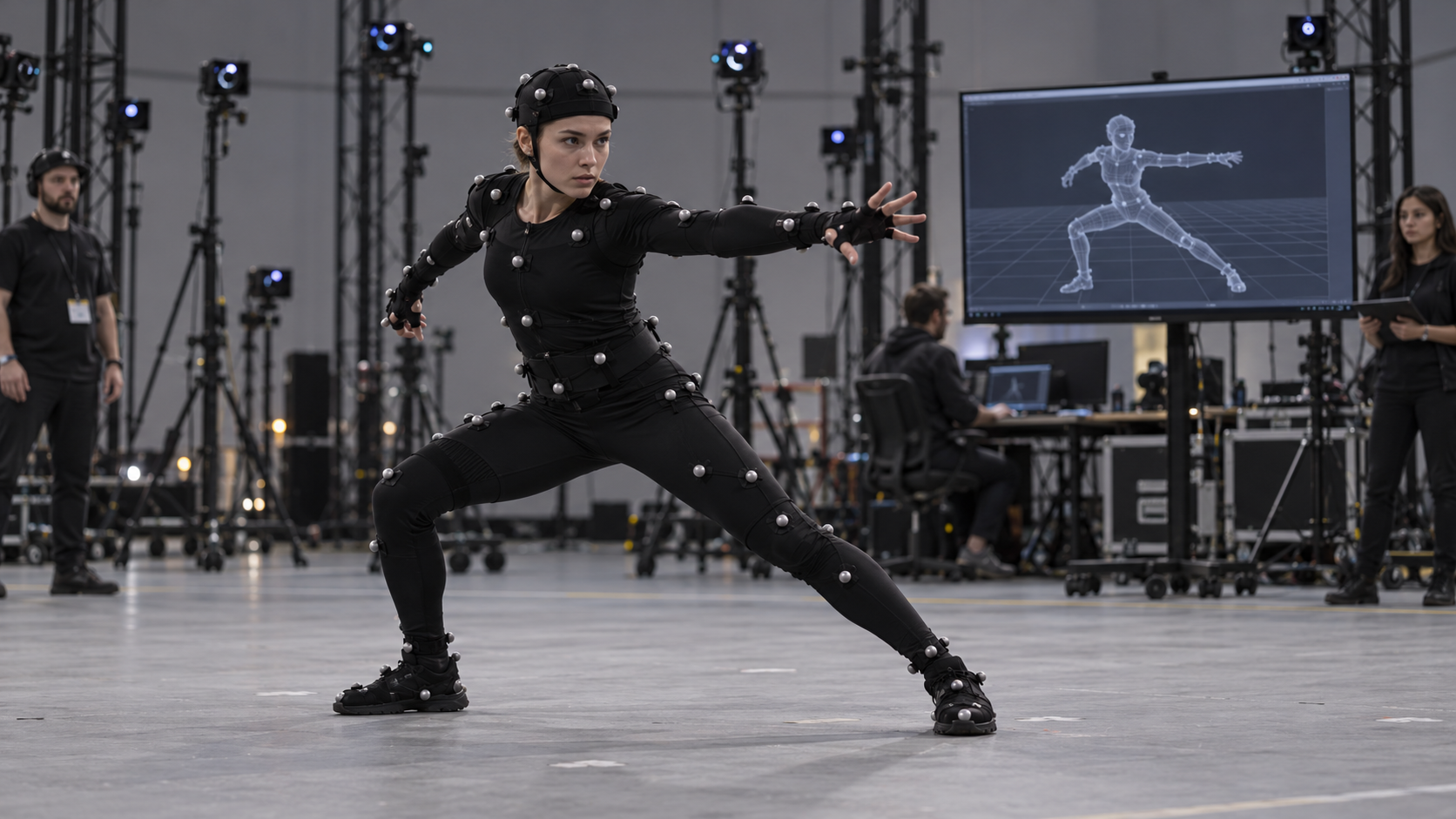
Motion capture records the movement of a performer or object and converts it into data that can drive a digital model. Optical systems commonly track reflective or illuminated markers with multiple cameras, while inertial suits use body-worn sensors; other approaches combine depth cameras, video analysis, or mechanical devices. Performance capture may add facial motion, fingers, voice, and on-set reference. The technology does not create a finished character by itself. It supplies measurements that artists interpret through a digital rig, animation, simulation, lighting, and final rendering.
A capture volume is calibrated so cameras agree on three-dimensional space. Markers are placed at known landmarks, the performer completes range-of-motion poses, and the system reconstructs marker positions across time. Technicians label the data and solve it onto a skeleton. Occlusion, swapped markers, reflective props, or unusual contact can produce gaps and noise. Cleanup artists correct those problems, while retargeting maps the human performance onto a character whose limb lengths, proportions, or anatomy may be quite different.
The actor contributes timing, intention, weight shifts, eyelines, and interaction. A director can stage scenes with several performers and preserve the energy of their exchange. At the same time, animators may adjust silhouettes, contacts, rhythm, or exaggeration so the movement works for the designed body and camera. The result is collaborative authorship rather than a binary choice between acting and animation. Even technically accurate data may need creative revision because realism of measurement is not the same as clarity in a finished shot.
Motion capture is used beyond humanoid characters. Productions can track cameras for virtual cinematography, props for contact and scale, stunt performers for dangerous actions, and crowds for varied background movement. Games apply captured clips within interactive systems, where transitions and player input change how motion is experienced. Sports, medicine, ergonomics, and research also use related tracking tools, though their accuracy requirements and processing priorities differ from entertainment. The phrase therefore covers a family of methods, not one standard suit or workflow. Common misconceptions come from promotional images that show markers beside a polished character. The visible similarity can hide extensive work between the two. Data must be selected, cleaned, edited, retargeted, and integrated with cloth, hair, muscles, environments, and camera choices. Some performances are captured in long takes; others are assembled from many sessions or blended with keyframe animation. Evaluating the craft means recognizing both the performer's embodied decisions and the artists who transform recorded movement into a coherent screen performance. A practical way to read or discuss Motion Capture is to separate the basic definition from the choices made in a particular example. Motion capture measures movement over time; performance capture usually refers to a broader recording of body, face, hands, voice, and interaction. Then identify who sets the relevant rules, which parts are creative decisions, and which parts follow from law, contracts, technology, or production limits. Examples that look similar on the surface can operate differently because their purpose, audience, timing, and surrounding agreements are different. Occlusion and contact create difficult data, so technicians and animators repair gaps and preserve believable foot, hand, and object interaction. It is also useful to check whether a source is describing a formal industry category, an informal critical label, or one organization's current practice. Those distinctions prevent a memorable anecdote from becoming a false universal rule. The date and market matter too: tools, distribution systems, and standard agreements change, while older examples can preserve assumptions that no longer apply everywhere. When a claim sounds absolute, compare it with a second type of source and look for the conditions under which it is actually true. Finally, compare the visible result with the less visible work that produced it. The final performance joins acting, direction, capture engineering, data processing, rigging, animation, simulation, cinematography, and rendering. That approach keeps the explanation grounded while leaving room for reasonable disagreement about borderline cases.
Motion capture measures movement over time; performance capture usually refers to a broader recording of body, face, hands, voice, and interaction.
Optical stages triangulate markers seen by several calibrated cameras, while inertial systems estimate movement from sensors worn on the body.
A solve maps tracked points to a digital skeleton, and retargeting adapts that skeleton's motion to the proportions of a specific character rig.
Occlusion and contact create difficult data, so technicians and animators repair gaps and preserve believable foot, hand, and object interaction.
Captured movement is editable source material: animation may clarify silhouettes, change timing, add exaggeration, or accommodate a nonhuman body.
The final performance joins acting, direction, capture engineering, data processing, rigging, animation, simulation, cinematography, and rendering.
Explore more "Explainers"
Discover additional explainers across politics, science, business, technology, and other fields. Each explainer breaks down a complex idea into clear, everyday language—helping you better understand how major concepts, systems, and debates shape the world around us.