

Foley Art Explainer
Foley is the craft of performing and recording everyday sounds in synchronization with moving images. Footsteps, clothing movement, hand contact, and the handling of props may be difficult to capture cleanly on set, especially when dialogue is the priority. Foley artists recreate those details on a specialized stage while watching the edited scene. The name comes from sound-effects pioneer Jack Foley, but the work is not simply a library of noises. It is a live performance shaped to the timing, weight, personality, and emotional rhythm of characters on screen.
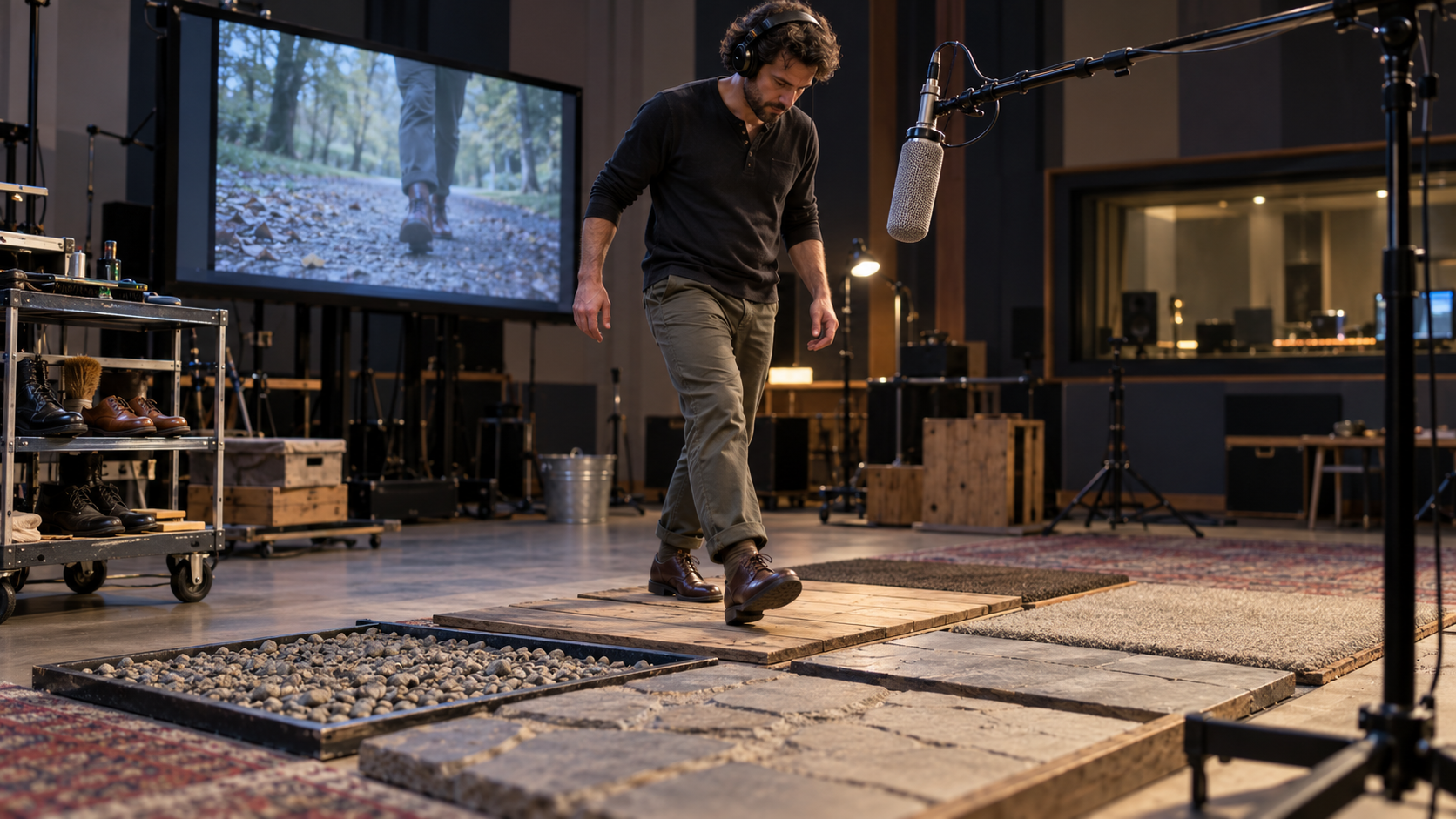
A Foley stage contains surfaces and objects chosen for their acoustic usefulness rather than their visual resemblance. Small pits of gravel, wood, concrete, or leaves can represent many locations. Shoes are selected for sole, heel, and fit, while cloth, bags, dishes, tools, and improvised props supply movement and handling sounds. Artists perform repeated passes to picture as microphones capture close detail. A recordist and editor organize the takes, adjust synchronization, and prepare them to join dialogue, backgrounds, designed effects, and music.
Performance matters because the same object can tell different stories. A hurried step has another cadence and force than a cautious one; a cup placed gently suggests a different intention than the same cup slammed down. Foley artists study posture and movement, then exaggerate or soften what reality would produce so it reads within a complex soundtrack. The most accurate sound is not always the most believable sound. Cinema uses selection and emphasis to guide attention, just as lighting and framing do in the image.
Foley overlaps with other sound-effects work but is usually distinguished by its human-scale, synchronized performance. Large explosions, vehicles, weather beds, and fantastical transformations may come from field recordings, libraries, synthesis, or layered sound design. Production sound can also supply usable footsteps and props. The supervising sound team decides what needs replacement or reinforcement. Foley becomes especially valuable when dialogue has been replaced, sets were quiet, costumes need presence, or a scene's emotional clarity depends on intimate tactile detail. The final mix places Foley in perspective. A footstep recorded a few inches from a microphone may need filtering, reverberation, and level changes to belong in a distant hallway or crowded street. Some sounds disappear beneath music, while one tiny movement may be highlighted before a dramatic decision. Good Foley often goes unnoticed because it feels inseparable from the picture. Listening closely reveals that its realism is constructed: artists make invisible choices about which physical actions deserve to be heard and how strongly the audience should feel them. A practical way to read or discuss Foley Art is to separate the basic definition from the choices made in a particular example. Foley artists perform synchronized character and prop sounds to picture, often replacing details that production microphones could not isolate. Then identify who sets the relevant rules, which parts are creative decisions, and which parts follow from law, contracts, technology, or production limits. Examples that look similar on the surface can operate differently because their purpose, audience, timing, and surrounding agreements are different. Foley is one part of post-production sound, alongside dialogue editing, ambience, designed effects, music, and rerecording mixing. It is also useful to check whether a source is describing a formal industry category, an informal critical label, or one organization's current practice. Those distinctions prevent a memorable anecdote from becoming a false universal rule. The date and market matter too: tools, distribution systems, and standard agreements change, while older examples can preserve assumptions that no longer apply everywhere. When a claim sounds absolute, compare it with a second type of source and look for the conditions under which it is actually true. Finally, compare the visible result with the less visible work that produced it. In the mix, level, equalization, reverberation, and perspective make a close studio recording appear to live inside the photographed space. That approach keeps the explanation grounded while leaving room for reasonable disagreement about borderline cases.
Foley artists perform synchronized character and prop sounds to picture, often replacing details that production microphones could not isolate.
Specialized stages provide many walkable surfaces, shoes, cloth, doors, dishes, and improvised objects that can suggest a much larger world.
Timing follows edited movement closely, but performance communicates weight, mood, age, urgency, and intention rather than copying motion mechanically.
Foley is one part of post-production sound, alongside dialogue editing, ambience, designed effects, music, and rerecording mixing.
An object does not need to look like the pictured source if its recorded texture creates the desired impression after processing.
In the mix, level, equalization, reverberation, and perspective make a close studio recording appear to live inside the photographed space.
Explore more "Explainers"
Discover additional explainers across politics, science, business, technology, and other fields. Each explainer breaks down a complex idea into clear, everyday language—helping you better understand how major concepts, systems, and debates shape the world around us.