

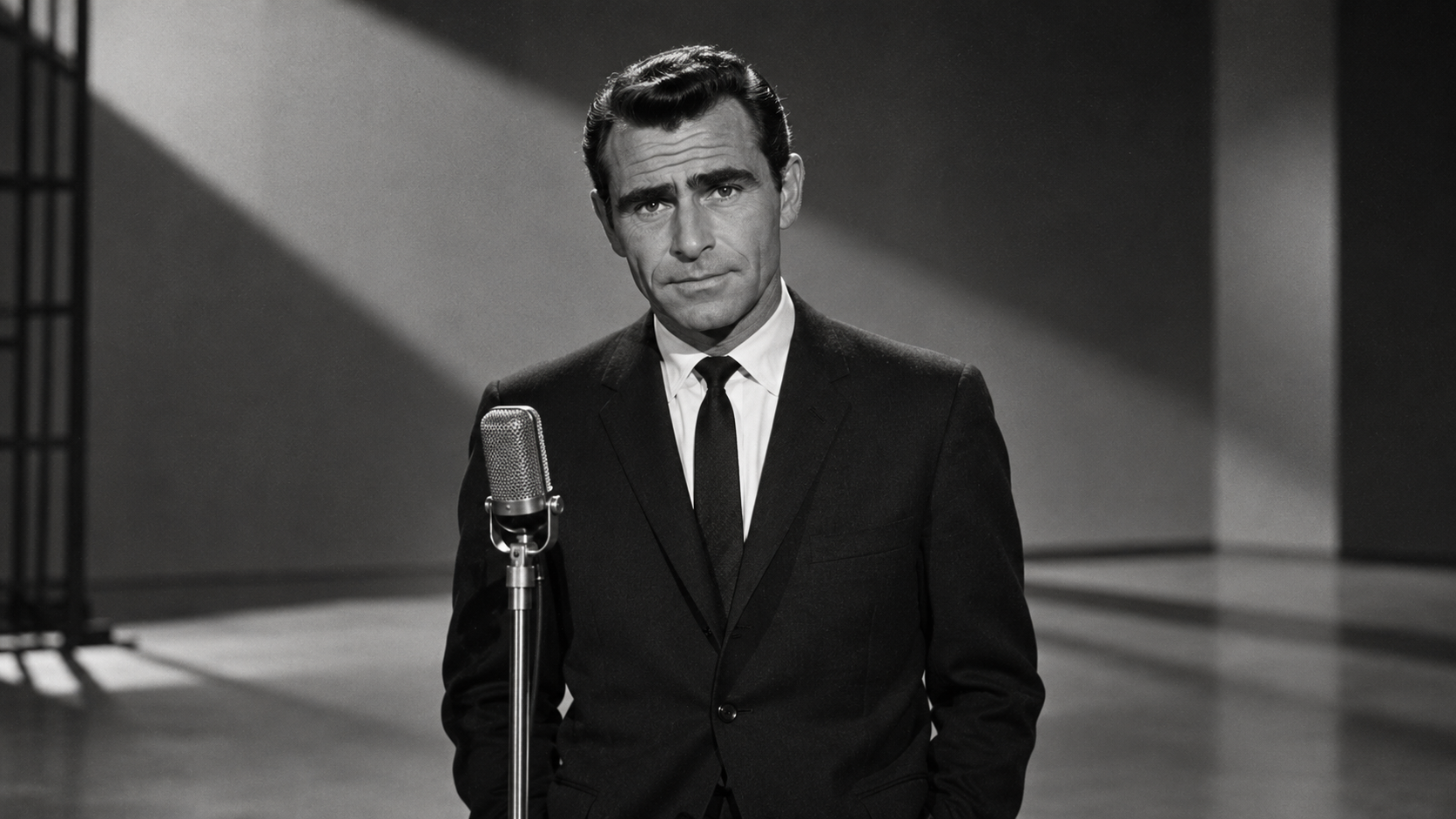
“The writer’s role is to be a menacer of the public’s conscience.”
Rod Serling described the writer’s role as “to be a menacer of the public’s conscience” in a 1970 interview, after years of conflict with television sponsors and network standards. Before The Twilight Zone, his teleplays had addressed war, racism, labor, and mob violence, sometimes only to be diluted by commercial pressure. Anthology science fiction gave him another route. By relocating prejudice or authoritarianism to an invented town, a future society, or an uncanny situation, he could make familiar habits strange enough for viewers to examine them again.
“Menacer” is a deliberately uncomfortable word. Serling did not define the writer as a supplier of correct opinions or a lecturer standing outside the audience. A menace interrupts comfort. It introduces the detail that ruins an easy excuse, lets an apparently ordinary character reveal a moral failure, or withholds the reassuring ending a sponsor might prefer. Conscience is public because popular stories help establish what a society considers normal. When television reaches millions of homes, the decision to challenge or flatter that normality becomes part of the medium’s civic effect.
Provocation alone is not moral seriousness. A work can shock audiences while reinforcing cruelty, or mistake contempt for courage. The writer who menaces conscience also needs craft, proportion, and curiosity about people who do not fit a thesis. Serling’s strongest stories often trap viewers inside a reversal: the feared outsider becomes recognizable, the confident majority becomes monstrous, or the punishment exposes a desire the audience briefly shared. The form implicates rather than merely condemns. That is harder than announcing virtue and more likely to survive the politics of a single week.
The quote remains relevant across prestige drama, horror, satire, games, and short-form video. Platforms reward immediate emotional certainty, but conscience is often activated by a question that cannot be resolved with a reaction button. Creators can test a draft by locating its safest assumption. Who receives sympathy without scrutiny? Which consequence occurs offscreen? What would the antagonist say if granted one credible fact? Revising around those questions does not require false balance. It requires the work to earn its judgment. Serling’s formulation asks popular storytelling to do more than distract from the world. It can return viewers to the world less comfortable with the stories they use to excuse themselves. That discomfort becomes productive when it opens inquiry instead of merely punishing the audience for watching from a familiar seat in comfort.
Serling used the phrase in a 1970 interview after a career shaped by repeated disputes with sponsors and network censors. His turn toward speculative anthology television allowed social criticism to travel through allegory when direct treatments were vulnerable to commercial interference.
To menace conscience is to disturb complacency, not simply to shock. Provocation without empathy or craft can reproduce the harm it claims to expose. Serling’s reversals work because they implicate the audience in a moral assumption before revealing its cost.
Find the safest assumption in a draft: the person never scrutinized, the harm left offscreen, or the conclusion reached too easily. Add one credible complication that forces the audience to examine its first response rather than merely applaud the intended message.
Explore more "Quotes of The Day"
Discover more notable quotes from influential voices across politics, science, business, technology, sports, and culture. Each quote offers insight into how ideas, beliefs, and decisions shape the world around us.