

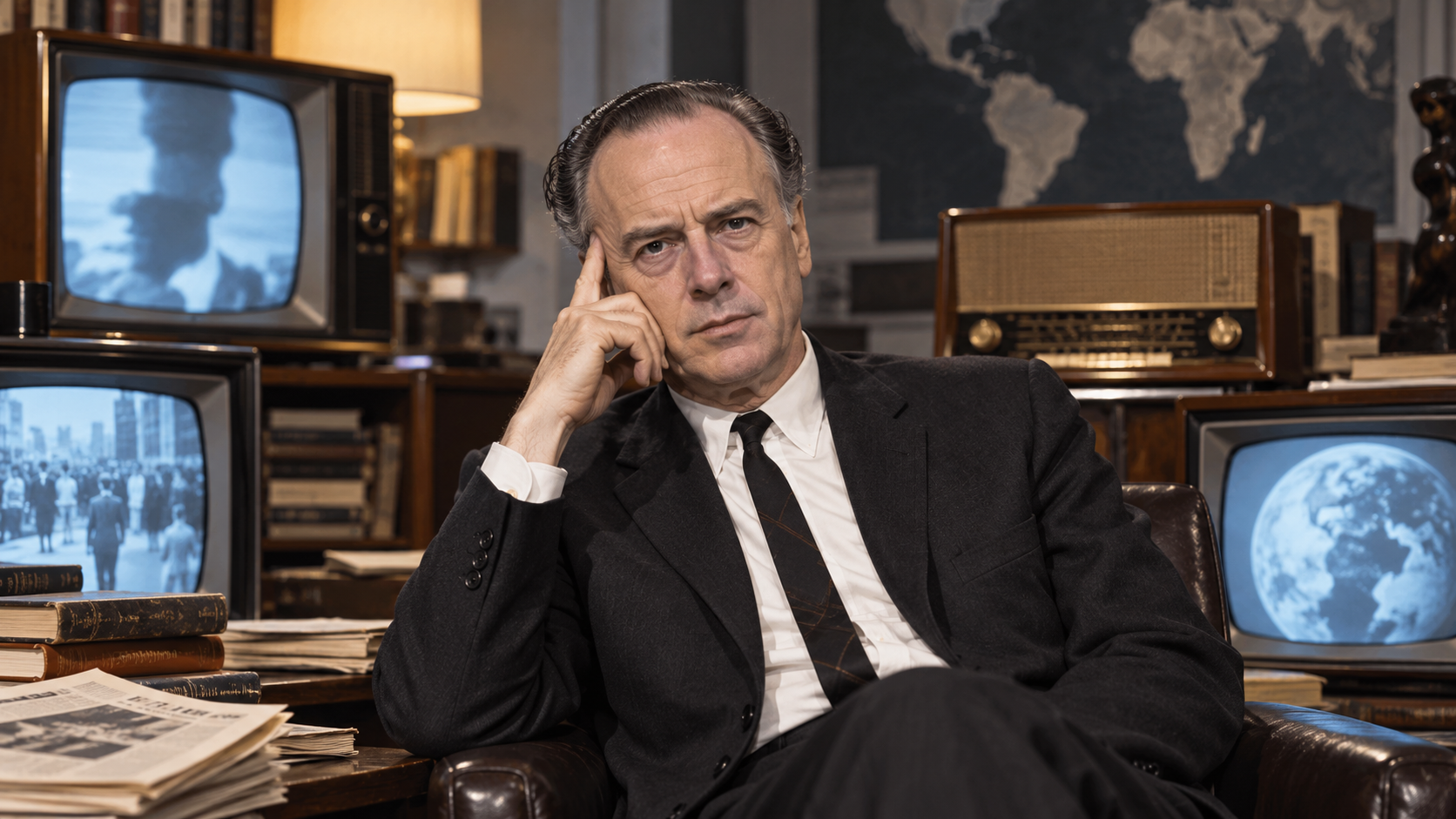
“The medium is the message.”
Marshall McLuhan placed the phrase “the medium is the message” at the center of Understanding Media, published in 1964. He was not claiming that content is meaningless. He was directing attention to the larger changes produced by a communication technology’s form, scale, speed, and patterns of use. Electric light was one of his provocative examples: it may carry no story, yet it reorganizes night, labor, streets, and social life. In the same way, television changes attention and domestic experience before any individual program is judged good or bad.
The aphorism is useful because content is easier to see than infrastructure. People debate a headline, episode, or post while the medium quietly alters who can speak, how quickly a response is expected, and which behaviors become habitual. A printed book encourages one sequence of attention; broadcast television synchronizes a mass audience; a phone turns communication into a portable, interrupting environment. The “message” is therefore the pattern of life a medium makes ordinary. It includes the new possibilities people welcome and the old arrangements they stop noticing as they adapt.
McLuhan’s compression can also be abused. It does not follow that every message carried by the same platform has equal value or that creators bear no responsibility for content. Institutions, ownership, regulation, and culture influence how a technology is built and used. The medium creates pressures rather than a single destiny. People can resist defaults, invent new conventions, and use the same tool differently across communities. A serious analysis must examine the technology’s structure without treating human choices as irrelevant.
The line feels newly sharp in a world of algorithmic feeds, vertical video, notifications, and generative tools. Ask not only whether a piece of content is accurate or entertaining, but what repeated contact with its format trains you to expect. Does the platform reward speed over reflection, conflict over ambiguity, constant availability over boundaries? Then alter one condition: disable a prompt, move a conversation to a slower channel, read the full work outside the feed, or design a format that values completion rather than endless scrolling. McLuhan’s sentence remains powerful because it changes the unit of analysis. The most consequential message may be the environment through which all the visible messages arrive. Once that environment is named, its defaults can be compared, resisted, and redesigned rather than mistaken for nature or an unavoidable universal law of attention governing everyone equally today online.
McLuhan developed the phrase in his 1964 book Understanding Media. He used examples such as electric light to show that a medium can reorganize social life through its form and scale even when it carries no obvious narrative content.
The claim redirects attention from individual content to the habits and structures a technology creates. It is not technological determinism: ownership, policy, culture, and human choice affect outcomes, and the quality of particular messages still matters.
Audit one medium you use daily. Identify the behavior its design rewards—speed, interruption, performance, or completion—then change one setting or routine that weakens the least useful pressure. Analyze the environment as carefully as the content.
Explore more "Quotes of The Day"
Discover more notable quotes from influential voices across politics, science, business, technology, sports, and culture. Each quote offers insight into how ideas, beliefs, and decisions shape the world around us.