

On This Day in Pop: June 6, 1933
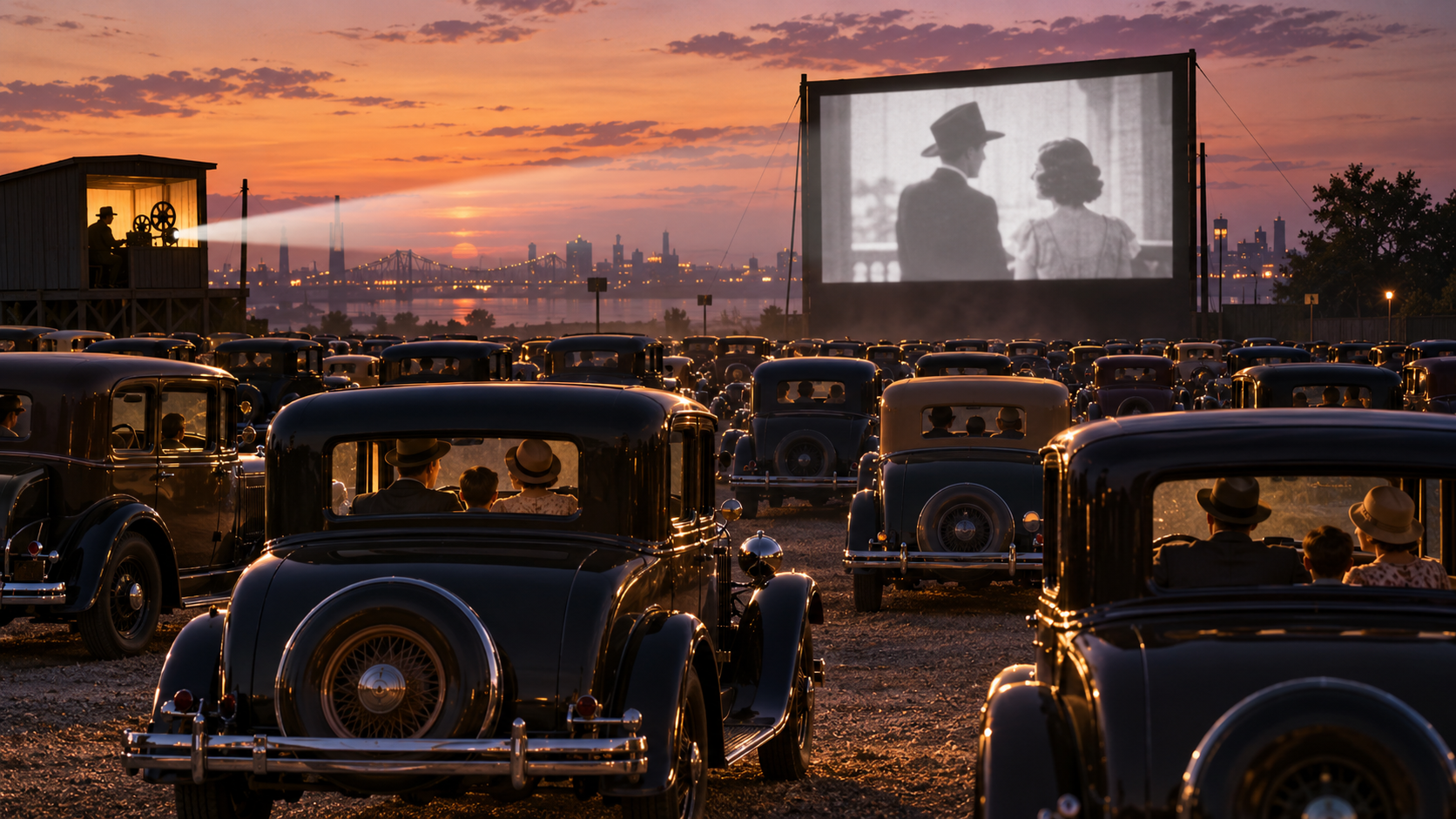
On June 6, 1933, motorists drove into an outdoor theater on Admiral Wilson Boulevard in Camden, New Jersey, for the opening of Richard Hollingshead Jr.’s Automobile Movie Theatre. Hollingshead, a sales manager at his father’s auto-products business, had experimented in his driveway with a projector, a screen fixed between trees and a radio placed behind the screen. His crucial design problem was sightlines: cars had to be arranged on graded ramps so patrons in back could see over those ahead. He patented the system and built a venue with space for hundreds of automobiles, a large screen and individual speakers positioned near vehicles. The feature on opening night was Wives Beware, and the attraction’s practical promise was summed up by the idea that an entire family could attend regardless of weather, clothing or restless children.
The experiment mattered because it joined two expanding American habits—the private automobile and mass moviegoing. Conventional theaters gathered audiences in carefully managed interior spaces; the drive-in let viewers bring a portion of home with them. Cars became seats, conversation booths and shelters, while the giant screen turned a parking field into a shared spectacle after dark. The first Camden operation was not an immediate national blueprint, and early sound systems were imperfect, but the form spread as suburban development and car ownership grew. By the postwar era, drive-ins offered double features, playgrounds, snack bars and a flexible social environment that served families, teenagers and communities without nearby indoor theaters.
Drive-in attendance peaked in the 1950s and 1960s before rising land values, daylight-saving schedules, television and multiplex competition closed many sites. Yet the format never disappeared. Its imagery—rows of tail fins beneath a glowing screen—became a durable symbol of mid-century leisure, courtship and roadside America. Surviving theaters adapted with FM sound, digital projection and special events, while temporary drive-ins returned during the COVID-19 pandemic because cars provided natural separation. The Camden theater itself is gone, but Hollingshead’s basic insight remains recognizable: architecture can reorganize moviegoing around the audience’s existing technology. On that June night, the screen did not merely move outdoors; the automobile became part of the auditorium, permanently expanding the places and ways in which popular entertainment could be consumed.
Remembering the first patented drive-in theater opens in camden on June 6 is valuable because anniversaries turn a familiar cultural object back into a specific decision, release or broadcast. The surrounding technology, business and audience conditions explain why the moment could happen then, while its later uses show that meaning never stops changing. Seen at that scale, the date is not trivia. It is a checkpoint between creation and memory: a place to separate what occurred from the legend accumulated around it and to ask why the work still attracts attention.
Richard Hollingshead Jr.'s Automobile Movie Theatre opened in Camden, New Jersey, on June 6, 1933.
The moment reached audiences through the media and distribution systems of 1933, influencing how the initial response developed.
Its patented ramp arrangement improved sightlines for patrons watching from their cars.
Its early impact was substantial but not universal, and later retellings sometimes compressed a more complicated contemporary response.
Drive-ins later became major postwar social spaces with speakers, snack bars, playgrounds and double features.
Anniversary coverage continues to place Drive-In Movies Begin within the broader history of popular culture while distinguishing documented evidence from later legend.
Explore more of "On This Day ..."
Discover more events from the same date across news, politics, technology, sports, and other fields. Each link highlights significant moments that shaped history on different fronts.