

On This Day in Pop: June 18, 1967
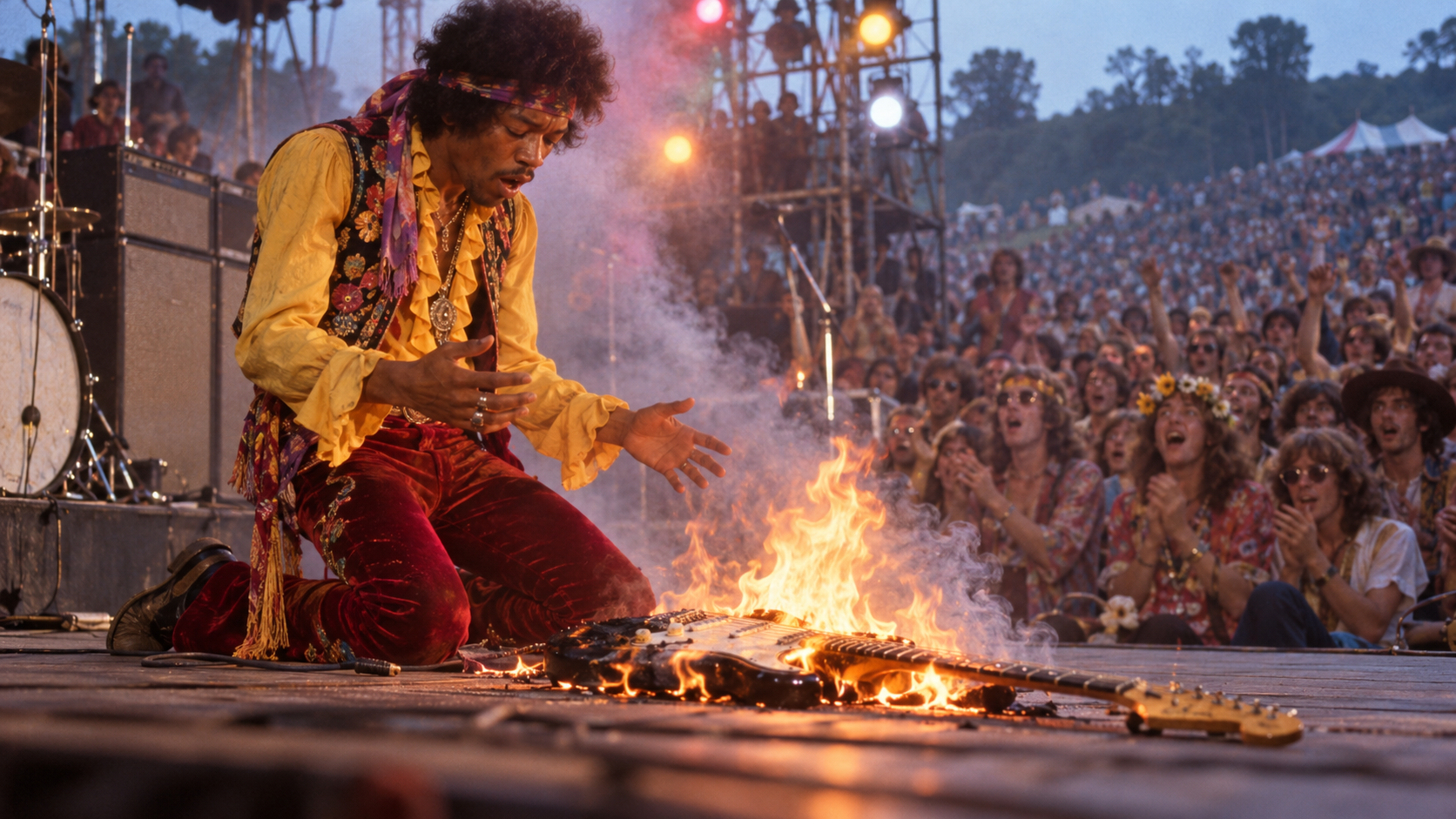
On June 18, 1967, the Jimi Hendrix Experience played the Monterey International Pop Festival, ending with an act that became one of rock’s defining images. Hendrix had built his reputation in Britain after leaving the American rhythm-and-blues circuit, but Monterey offered a major introduction to a large U.S. audience. Introduced by Brian Jones, the trio tore through songs including Killing Floor, Foxy Lady, Hey Joe and Wild Thing. During the finale, Hendrix knelt over a decorated Fender Stratocaster, poured lighter fluid on it, set it aflame and smashed what remained. Photographer Ed Caraeff and filmmaker D. A. Pennebaker preserved the moment from different angles, turning a brief stage ritual into an endlessly reproduced symbol of musical danger and 1960s transformation.
The performance mattered because spectacle and musicianship were inseparable in Hendrix’s presentation. He played behind his back and with his teeth, but those gestures framed extraordinary control of feedback, volume, rhythm and tone. Audiences who had never seen him could understand immediately that the electric guitar’s conventional boundaries were being challenged. The Who had destroyed instruments earlier at the festival, and the sequence of sets added competitive energy, yet Hendrix’s fire carried a different sense of sacrifice. He appeared to offer the guitar to the moment after drawing unprecedented sounds from it. The act could be read as destruction, theater, publicity or ritual; its ambiguity is why the image survived beyond simple shock.
Monterey helped launch Hendrix nationally, leading to wider American touring and the rapid expansion of a career that would last only until his death in 1970. His studio albums and later Woodstock performance proved that the burning guitar was not a substitute for musical depth, but an exclamation point within it. Fragments of the Monterey instrument entered museum collections, while Caraeff’s photograph became a standard image of rock rebellion. The episode also influenced expectations for the live concert as visual art—lighting, gesture and risk could carry meanings distinct from the recording. Looking back, the most important fact is not merely that something burned. On June 18, an artist returned to his home country with a new musical language, and the flame ensured that no one could pretend they had missed the arrival.
Remembering jimi hendrix burns his guitar at monterey pop on June 18 is valuable because anniversaries turn a familiar cultural object back into a specific decision, release or broadcast. The surrounding technology, business and audience conditions explain why the moment could happen then, while its later uses show that meaning never stops changing. Seen at that scale, the date is not trivia. It is a checkpoint between creation and memory: a place to separate what occurred from the legend accumulated around it and to ask why the work still attracts attention.
The Jimi Hendrix Experience performed at the Monterey International Pop Festival on June 18, 1967.
The moment reached audiences through the media and distribution systems of 1967, influencing how the initial response developed.
Hendrix ended Wild Thing by setting a Fender Stratocaster on fire and smashing it onstage.
Its early impact was substantial but not universal, and later retellings sometimes compressed a more complicated contemporary response.
Photographs and D. A. Pennebaker's film made the act a lasting image of rock performance and helped launch Hendrix in the United States.
Anniversary coverage continues to place Hendrix Ignites Monterey within the broader history of popular culture while distinguishing documented evidence from later legend.
Explore more of "On This Day ..."
Discover more events from the same date across news, politics, technology, sports, and other fields. Each link highlights significant moments that shaped history on different fronts.