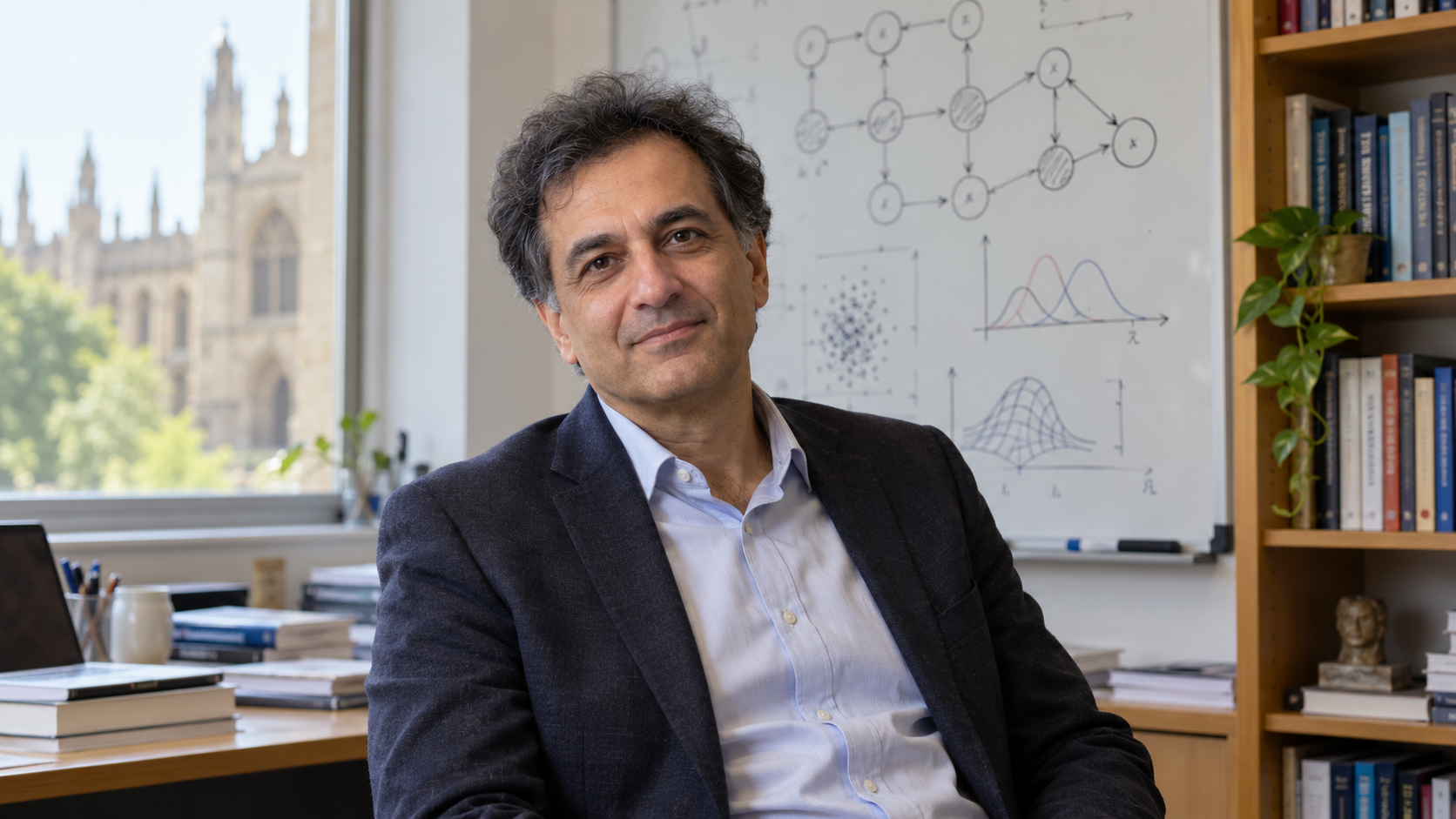
Zoubin Ghahramani, 2015
Zoubin Ghahramani placed uncertainty and probability at the center of learning from experience under uncertainty for today’s AI systems.

Don't Just Read it – Explore It
Zoubin Ghahramani placed uncertainty and probability at the center of learning from experience under uncertainty for today’s AI systems.
Leo Breiman contrasted data models with algorithmic models and challenged statistics to learn from predictive practice for today’s AI systems.
Tin Kam Ho showed how many diverse decision trees could combine into a stronger classifier for today’s AI systems.
Sepp Hochreiter and Jürgen Schmidhuber introduced long short-term memory to help networks learn across time for today’s AI systems.
David Rumelhart and colleagues showed how back-propagation could train layered neural networks efficiently in practice for today’s AI systems.
Corinna Cortes and Vladimir Vapnik introduced support-vector networks as a disciplined approach to classification for today’s AI systems.
Frank Rosenblatt framed the perceptron as a model of learning, not merely a pattern-recognition device for today’s AI systems.
John Searle’s Chinese Room argument challenges the idea that executing a program is enough to produce genuine understanding. for today’s AI systems.
Maja Matarić’s socially assistive robotics uses interaction, coaching, and encouragement to support people without replacing human care. for today’s AI systems.
François Chollet defines intelligence through efficient skill acquisition and generalization, not performance on one familiar task. for today’s AI systems.
Joanna Bryson argues that society can choose how AI is built and governed because technology and its institutions are human artifacts. for today’s AI systems.
Richard Sutton’s Bitter Lesson argues that scalable learning and search tend to outlast systems built around handcrafted human knowledge. for today’s AI systems.