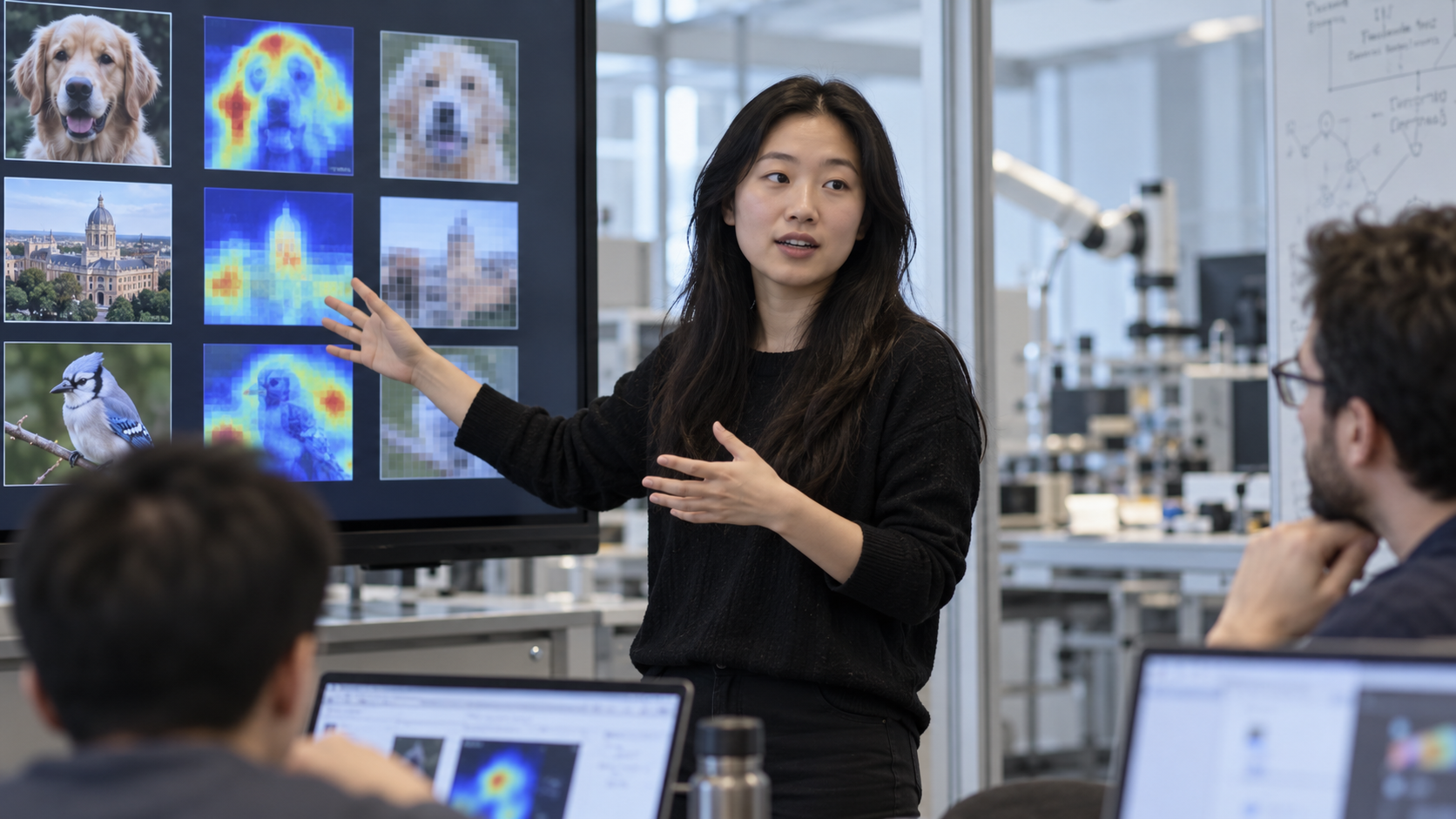
Been Kim and colleagues, 2018
Been Kim’s TCAV method let people test neural networks using human-friendly concepts instead of examining individual pixels alone. for today’s AI systems.

Don't Just Read it – Explore It
Been Kim’s TCAV method let people test neural networks using human-friendly concepts instead of examining individual pixels alone. for today’s AI systems.
John Schulman’s proximal policy optimization method offered a practical balance that helped reinforcement learning move into wider use. for today’s AI systems.
Jan Leike framed scalable agent alignment around a direct question: how can system behavior reliably follow human intentions? for today’s AI systems.
Paul Christiano and colleagues explored how human comparisons could train agents when writing a complete reward function is impractical. for today’s AI systems.
John Hopfield showed how networks of simple interacting units can store and recover patterns through collective dynamics. for today’s AI systems.
Kunihiko Fukushima’s neocognitron anticipated core ideas behind modern convolutional networks and shift-tolerant visual recognition. for today’s AI systems.
Jared Kaplan and colleagues described predictable scaling relationships that influenced how organizations plan large language-model training. for today’s AI systems.
Alec Radford’s GPT-2 report showed that predicting text at web scale could produce surprising zero-shot language abilities. for today’s AI systems.
Tom Brown and colleagues documented GPT-3’s few-shot performance and made model scale a central question in language AI. for today’s AI systems.
Oriol Vinyals and colleagues showed how one neural architecture could map an input sequence directly to an output sequence. for today’s AI systems.
David Silver and colleagues combined deep networks, search, and self-play to make AlphaGo a landmark in machine decision-making. for today’s AI systems.
Volodymyr Mnih’s Atari agent learned from pixels and rewards, demonstrating a general reinforcement-learning approach across many games. for today’s AI systems.