

On This Day in Business: January 8, 1889
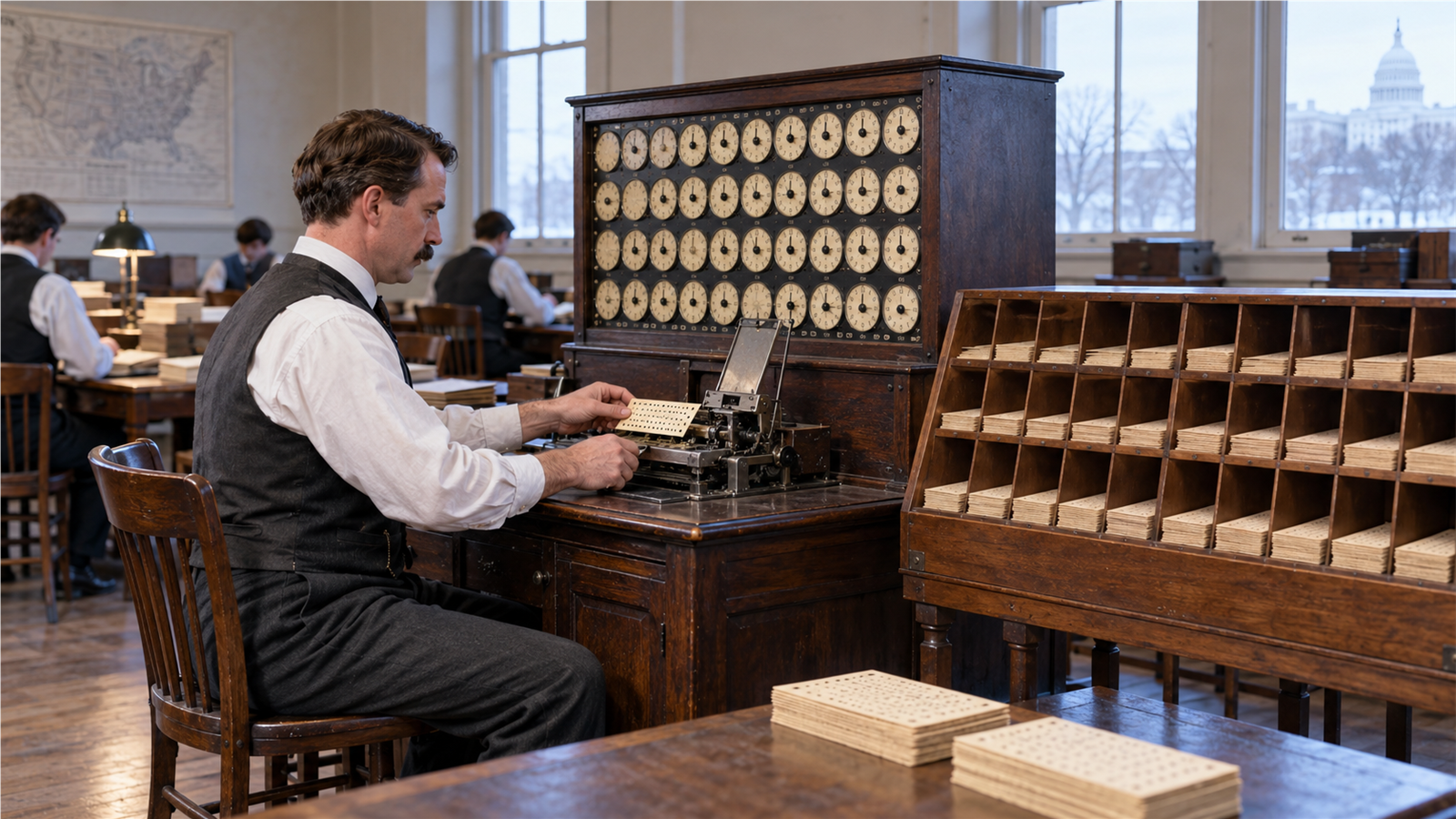
On January 8, 1889, the United States issued Herman Hollerith a group of patents covering methods and apparatus for compiling statistics with electrically read record cards. One of them, Patent No. 395,781, described a separate card for each person or subject, with information represented by index points at fixed positions. Related patents covered the equipment that detected those points and counted the results. Hollerith did not invent the general idea of punched media, which had older precedents in automated weaving, but he connected punched records, electrical sensing and mechanical counting into a system designed for large statistical workloads. The patent date gave legal form to an approach already being tested for the next federal census.
The business problem was scale. Results from the 1880 Census took years to tabulate, and officials expected the 1890 count to produce still more information. The Census Office held a competition in 1888 to compare faster methods. According to the U.S. Census Bureau, Hollerith completed the data-entry portion of the trial in 72.5 hours and the tabulation portion in 5.5 hours, substantially faster than the rival systems. His cards encoded characteristics such as age, sex and marital status. When spring-loaded pins passed through punched holes into mercury cups, they completed electrical circuits that advanced the appropriate counters and helped direct cards into sorting groups.
Winning the Census contract turned an invention into a commercial service. Hollerith supplied machines rather than simply transferring an idea, creating a recurring relationship around equipment, cards and technical expertise. The Census Bureau reported that the 1890 publications were completed 18 months sooner than the smaller body of 1880 work. Other governments and railroads later used versions of the system. In 1896 Hollerith organized the Tabulating Machine Company, which joined other equipment businesses in 1911 and eventually became part of the corporate lineage renamed International Business Machines in 1924. The path was not direct, but punched-card processing became an important office technology for decades.
The January 8 patents therefore mark an early step in treating information processing as an industrial business. Hollerith’s system separated data storage from a single handwritten ledger, let the same cards be regrouped for different counts and connected standardized records to specialized machinery. It still depended on people to punch, carry, inspect and operate the cards, and later machines would change the details substantially. Even so, the model anticipated a market in which organizations purchased or leased systems to manage growing volumes of information. The commercial legacy lies not only in the machine’s relationship to IBM, but also in the idea that faster, repeatable data handling could be sold as essential infrastructure for government and enterprise.
Hollerith had worked for the Census Office and saw how the expanding number of questions made hand tabulation slow, expensive and difficult to finish before the next census.
His patented method represented one person or subject on a separate card, using punched positions as standardized data points that could control electrical counting and sorting devices.
On January 8, 1889, the Patent Office issued several related Hollerith patents, including No. 395,781 for the art of compiling statistics and No. 395,783 for apparatus.
The technology did not remove human labor. Clerks still transferred information to cards, operated readers, checked results and moved cards into the indicated sorting compartments.
The Census Bureau used Hollerith equipment for the 1890 count and completed a larger set of publications sooner than the results from 1880 had been produced.
Hollerith later formed the Tabulating Machine Company. Through mergers and a later renaming, that business became part of IBM’s corporate ancestry and the wider punched-card industry.
Explore more of "On This Day ..."
Discover more events from the same date across news, politics, technology, sports, and other fields. Each link highlights significant moments that shaped history on different fronts.