

On This Day in Business: January 21, 1976
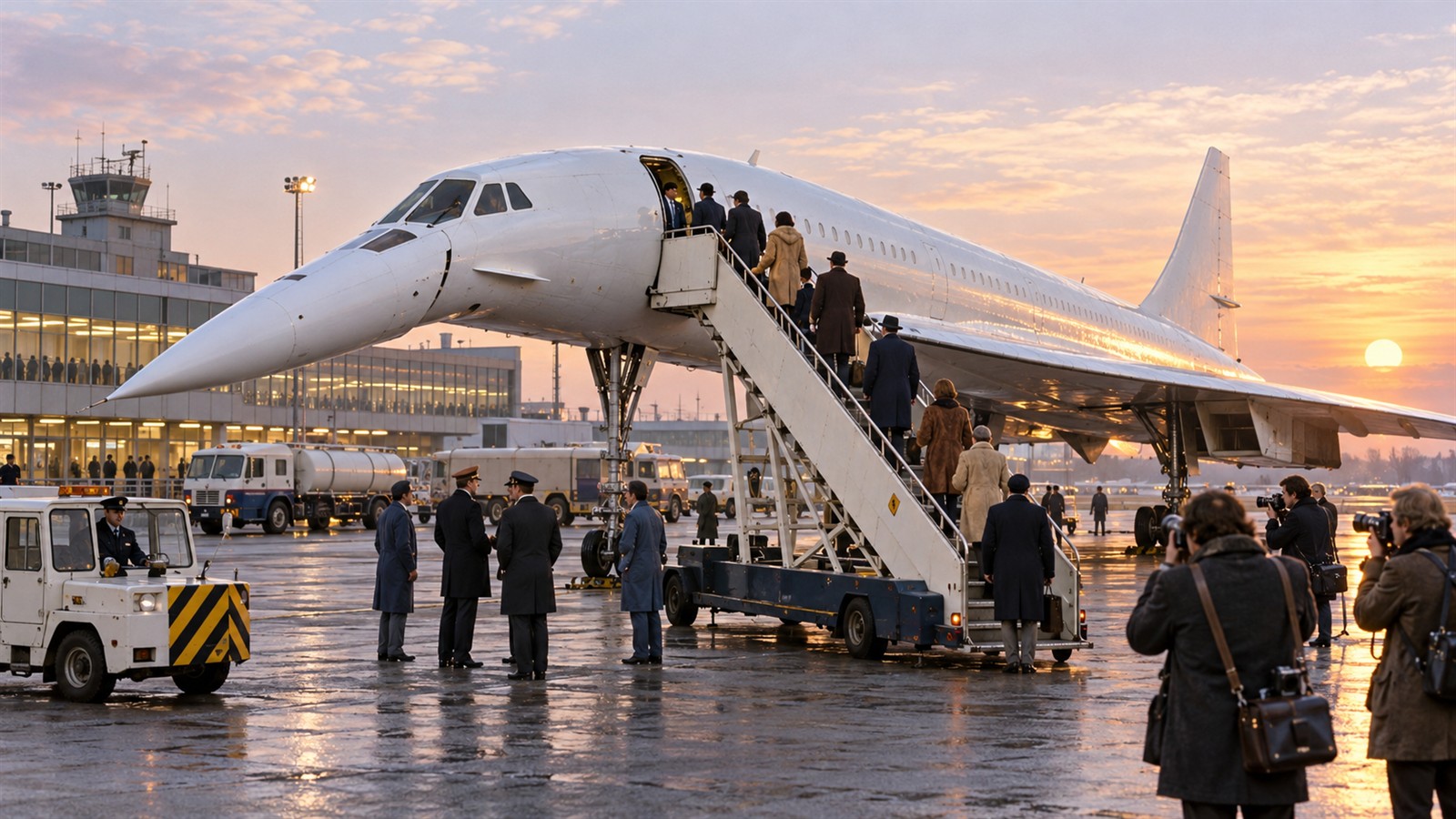
On January 21, 1976, British Airways and Air France began scheduled passenger service with Concorde, opening the commercial supersonic era. A British Airways aircraft flew from London Heathrow to Bahrain, while an Air France Concorde departed Paris for Rio de Janeiro with a stop in Dakar. The coordinated launches turned a long Anglo-French development program into an operating airline product. For travelers, the proposition was speed: Concorde could cruise at roughly twice the speed of sound and around 60,000 feet, high enough for passengers to see the curve of the Earth. For the airlines, it was a premium service whose prestige had to compensate for unusual cost and capacity constraints.
Concorde's business model differed sharply from the wide-body expansion represented by the Boeing 747. British Airways configured its aircraft for about 100 passengers, a small cabin for an airliner with four powerful afterburning engines. Its narrow fuselage, limited cargo space and high fuel consumption demanded premium fares and careful route selection. The original services avoided the United States while regulators debated noise, airport access and sonic booms. Routes to Washington began later in 1976, and New York service followed in 1977. The aircraft could cross the Atlantic in about three and a half hours, allowing some executives to conduct business on both sides of the ocean in the same day.
The launch also carried political and industrial meaning. Britain and France had signed a treaty to develop the aircraft together, distributing engineering and manufacturing across national companies and governments. The program demonstrated advanced aerodynamics, materials and engine control, yet development costs rose sharply and most prospective airline customers withdrew. Only British Airways and Air France operated scheduled fleets. That limited scale made the economics very different from ordinary mass-market aviation. Concorde became a high-profile service and marketing asset, but it could not spread development and operating costs across hundreds of aircraft or a broad network of carriers.
Scheduled Concorde service lasted for 27 years before both airlines retired the aircraft in 2003. It never became the universal successor to subsonic travel that early enthusiasts imagined, but it created an enduring luxury brand around time saved, engineering spectacle and exclusivity. January 21 matters because it was the moment a government-backed technical project met paying customers, airport rules and airline economics. The first flights showed that an aircraft can be operationally successful and culturally priceless without creating a scalable market. Concorde's legacy therefore belongs to business history as much as aviation history: a dramatic example of the tension between technological possibility, public investment and the commercial discipline of capacity, cost and demand.
Britain and France jointly developed Concorde through an international treaty, combining national aerospace capabilities in a technically ambitious program.
The jet promised Mach 2 travel at about 60,000 feet, but carried only around 100 passengers and required premium fares to offset high operating costs.
On January 21, 1976, British Airways flew London–Bahrain while Air France launched Paris–Dakar–Rio service in a coordinated commercial debut.
Noise rules, sonic-boom concerns and airport restrictions limited routes, delaying regular Washington and New York service until later.
Only the two national airlines operated scheduled fleets after other customers withdrew, preventing development and support costs from spreading widely.
Concorde remained in service until 2003, becoming a powerful luxury symbol even though supersonic passenger travel never achieved mass-market scale.
Explore more of "On This Day ..."
Discover more events from the same date across news, politics, technology, sports, and other fields. Each link highlights significant moments that shaped history on different fronts.