

On This Day in Business: February 26, 1935
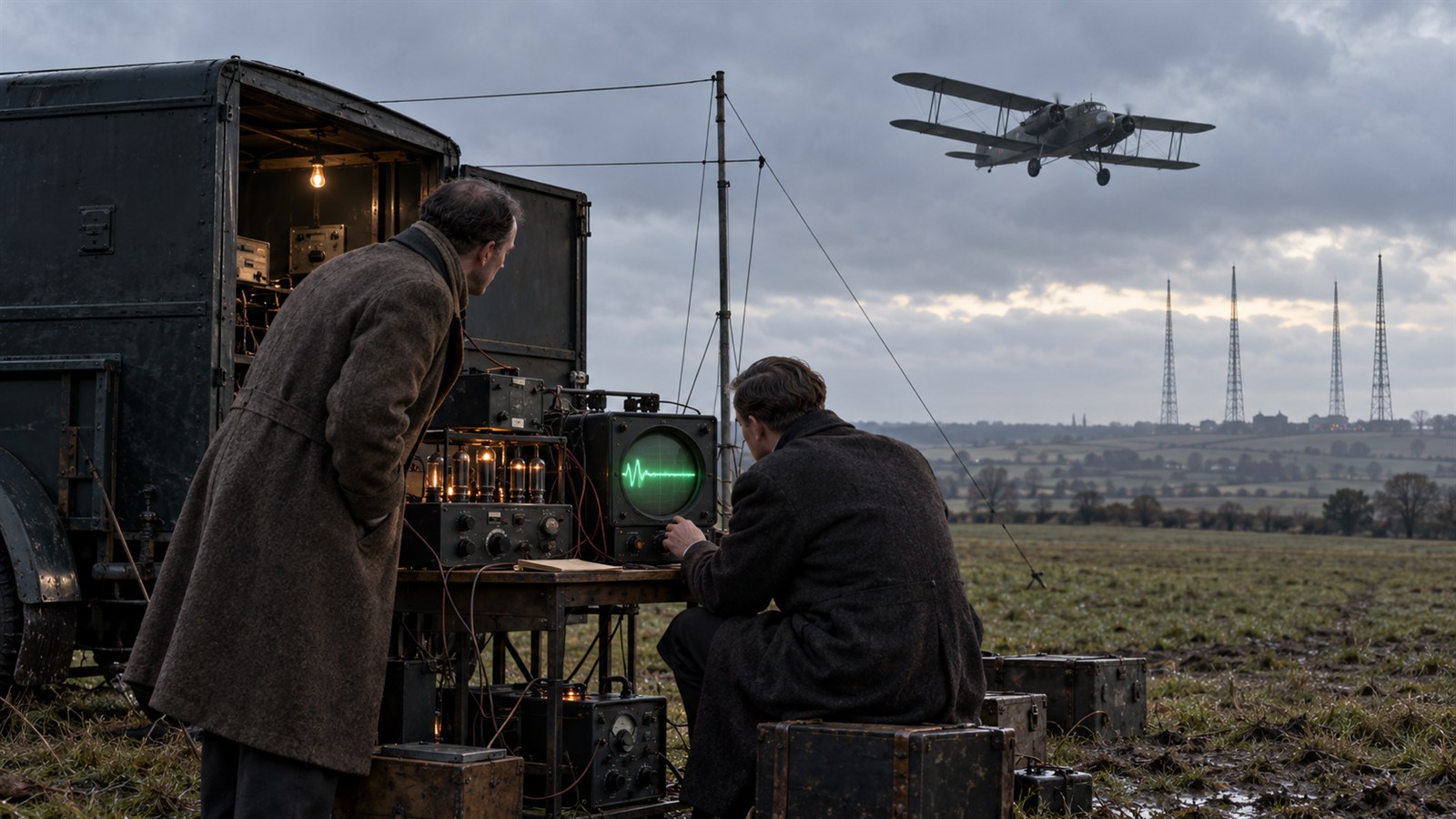
On February 26, 1935, a small British team demonstrated that radio waves could detect an aircraft. Near Daventry, Northamptonshire, physicist Robert Watson-Watt and assistant Arnold Wilkins positioned receiving equipment in a field while a Royal Air Force Heyford bomber flew through radio transmissions from the BBC's shortwave station at Borough Hill. The aircraft reflected enough energy to create a visible change on an oscilloscope. The improvised experiment, later known as the Daventry demonstration, proved that the underlying idea could work outside a laboratory.
The test answered an urgent government question. Officials wanted early warning against hostile bombers and had asked whether radio energy might damage aircraft. Watson-Watt explained that a practical death ray was unlikely but suggested detection by echoes instead. Wilkins calculated expected signal strength, and the team used an existing broadcaster so it could test quickly without building a transmitter. This frugal design isolated the central risk: could a receiver distinguish a moving airplane through reflected energy at useful range?
After the demonstration, the Air Ministry funded rapid development. Research at Orfordness and Bawdsey produced transmitters, receivers, antennas and operating methods for the Chain Home network along Britain's coast. The system did not supply a complete solution by itself; observers, communications, plotting rooms and fighter commands had to turn signals into action. Industry manufactured equipment at scale and trained personnel to maintain it. By the beginning of the Second World War, radar formed part of an integrated air-defense organization that improved the use of scarce aircraft.
February 26 matters because the field test converted an uncertain scientific proposal into a program with a customer, budget and operational path. The apparatus was crude, but it measured the one result decision-makers needed before committing larger resources. That is a classic demonstration strategy: borrow available infrastructure, test the hardest assumption and make the output visible. Radar later transformed aviation, shipping, weather forecasting, traffic control and speed measurement, creating markets far beyond air defense. The Daventry team could not deliver those industries in one afternoon, but it supplied credible evidence that waves already filling the air could become a new class of information. The demonstration's simplicity made the decision easier. Officials did not need to understand every future antenna or command room; they only had to see a repeatable trace linked to a known aircraft, turning a disputed concept into evidence that justified the next experiment. A visible result also aligned scientists, military planners and industrial suppliers around a shared development target.
British officials sought early warning against bombers and asked scientists whether radio energy could be used against approaching aircraft.
Robert Watson-Watt redirected the question from destruction to detection, while Arnold Wilkins calculated that reflected signals should be measurable.
On February 26, 1935, a receiver near Daventry detected a Heyford bomber crossing transmissions from an existing BBC shortwave station.
Using borrowed broadcast infrastructure let the team test the hardest technical assumption quickly and at far lower cost than a complete prototype.
Government funding then supported Chain Home stations and the operational network of operators, plotters, communications and fighter control built around them.
Radar expanded after the war into civil aviation, shipping, weather services and transportation, illustrating how a focused defense test can create broad commercial platforms.
Explore more of "On This Day ..."
Discover more events from the same date across news, politics, technology, sports, and other fields. Each link highlights significant moments that shaped history on different fronts.