

On This Day in Business: June 11, 1895
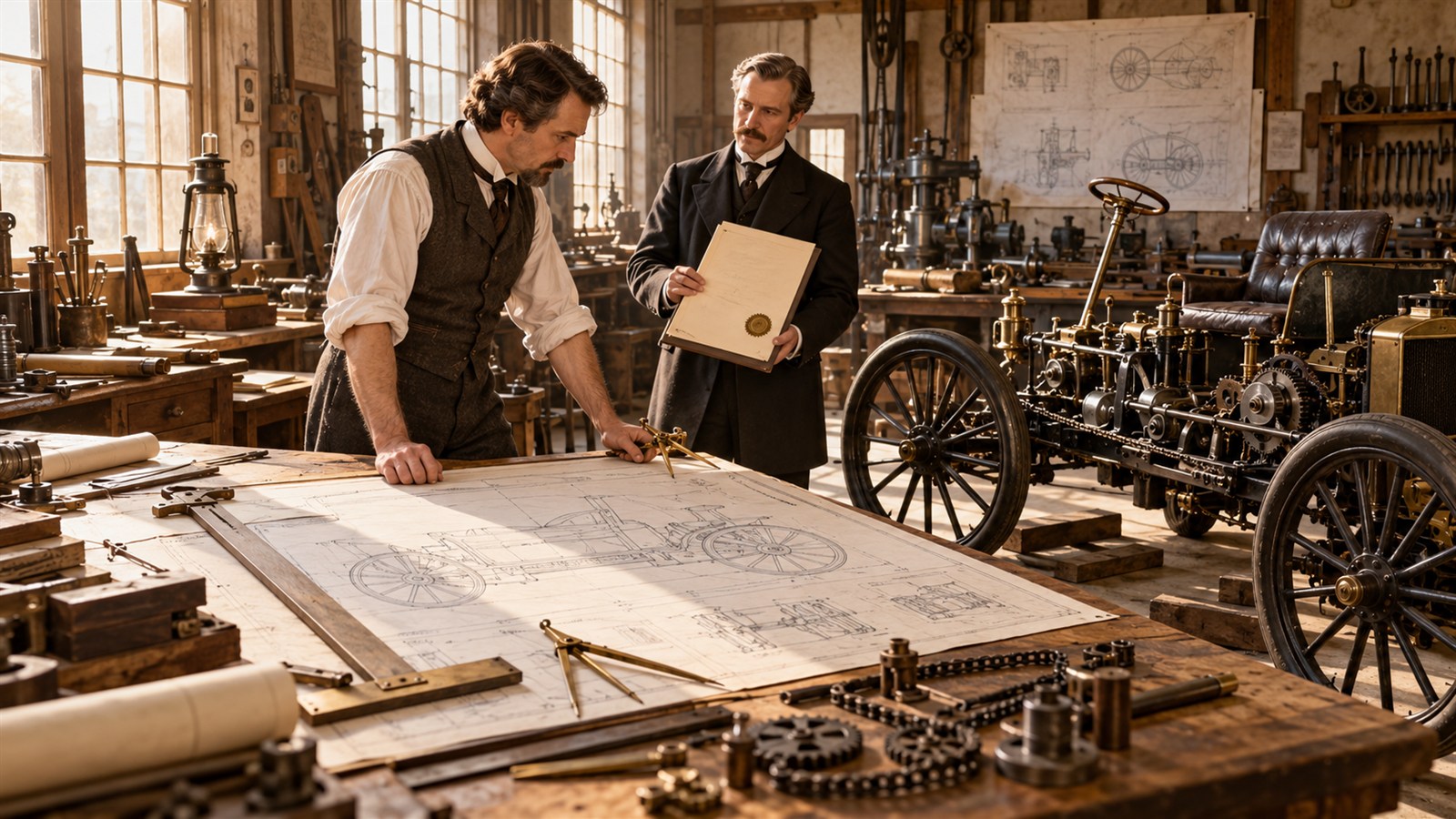
On June 11, 1895, the United States granted Charles E. Duryea Patent No. 540,648 for improvements in road vehicles. Charles and his brother Frank had built and tested an early American gasoline-powered automobile in Springfield, Massachusetts. The patent drawings described the chassis, steering, drive gearing, suspension, and arrangement of mechanical parts needed to make a light self-propelled carriage controllable on ordinary roads. The document did not create the automobile by itself, and the brothers later disputed credit for aspects of their work. It nevertheless recorded a practical design at a moment when American inventors were trying to turn experimental motor wagons into saleable machines.
Intellectual property helped define the venture for investors and competitors. A patent could protect specific mechanisms and provide an asset around which a company negotiated manufacturing plans. The Duryeas continued refining their vehicle and gained attention by winning the Chicago Times-Herald race in November 1895, a public demonstration of endurance under harsh conditions. In 1896, the Duryea Motor Wagon Company produced thirteen similar cars, often identified as the first commercial production run of gasoline automobiles in the United States. That quantity was tiny, but it required a shift from building one machine to procuring parts and repeating assembly.
Early automobile businesses faced problems larger than engine design. Roads were poor, fuel distribution was limited, skilled repair service was scarce, and many buyers doubted that motor vehicles were dependable. Producers had to explain operation, provide replacement parts, and persuade the public through races and demonstrations. Patent disputes could consume money while designs evolved faster than legal claims. The Duryea firm did not achieve the scale of later manufacturers, yet it helped show that an American company could build multiple gasoline cars for customers. Its experience belonged to the experimental market from which standards, suppliers, and consumer expectations gradually emerged.
The patent matters because invention becomes industry through documentation, repeatability, and public proof. A technical drawing makes relationships explicit; a race exposes performance; a production run tests whether labor and components can be coordinated more than once. Each stage answers a different business question. The Duryeas' small output should not be judged by later assembly-line volumes. It was an early bridge between workshop craftsmanship and organized automobile manufacturing. Today's hardware ventures face a similar progression from protected idea to working prototype, validated performance, and reliable production. The commercial risk often moves rather than disappears: once the machine works, the challenge becomes building, supporting, and selling it consistently.
Patent No. 540,648 documented improvements in the chassis, steering, gearing, suspension, and control of a road vehicle.
The Duryea brothers had already tested a gasoline automobile and were refining it for practical use and public demonstration.
Winning the 1895 Chicago race provided visible proof that the vehicle could endure conditions beyond a workshop test.
A 13-car run in 1896 forced the venture to repeat procurement and assembly rather than build a single experimental machine.
Poor roads, scarce fuel, limited repair skill, and skeptical buyers made the surrounding market as difficult as the engineering.
The Duryea story links patents, prototypes, demonstrations, and production as separate steps in commercializing physical technology.
Explore more of "On This Day ..."
Discover more events from the same date across news, politics, technology, sports, and other fields. Each link highlights significant moments that shaped history on different fronts.