

On This Day in Business: October 25, 2001
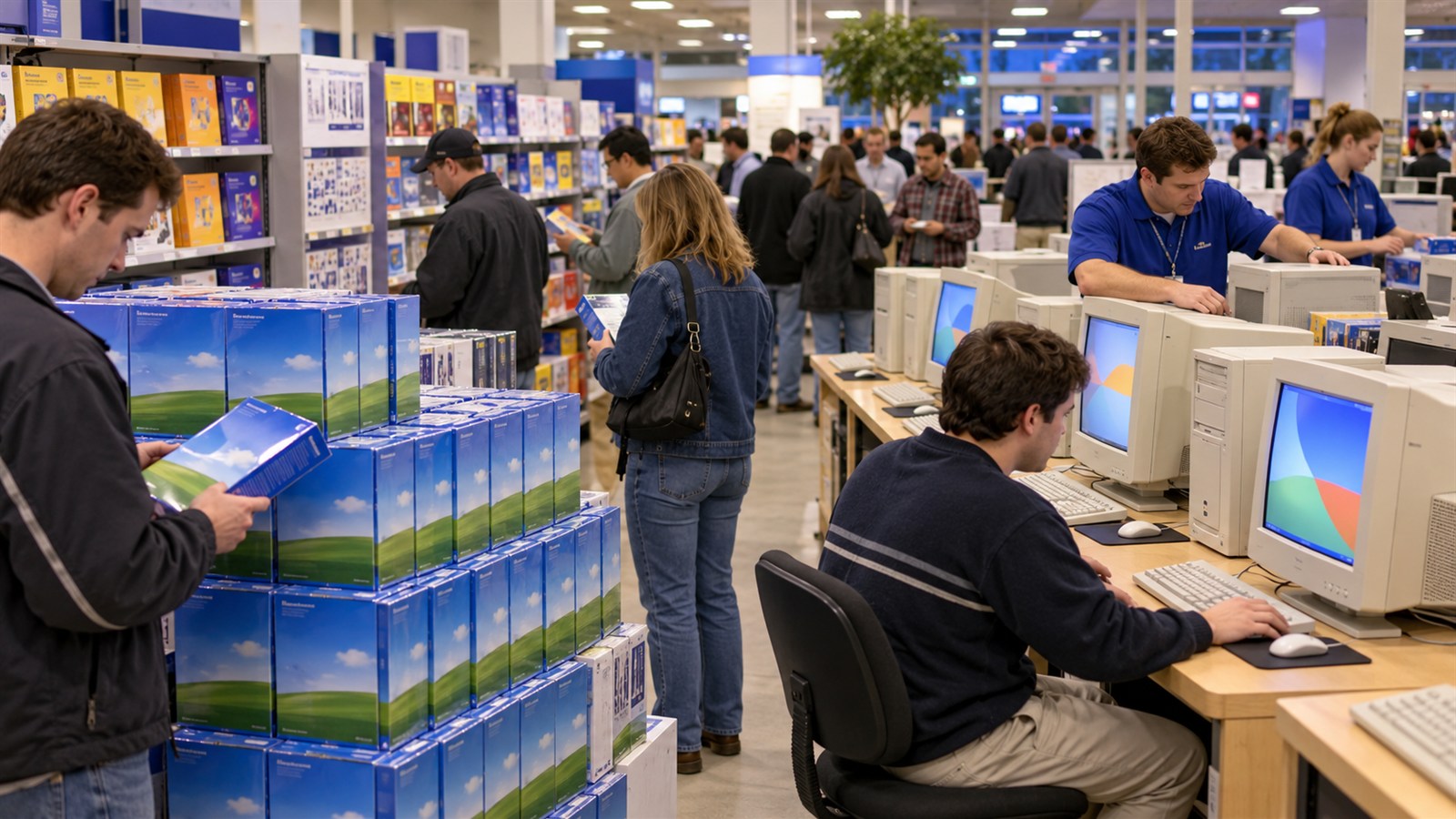
On October 25, 2001, Microsoft launched Windows XP for retail customers and new personal computers. The operating system brought the consumer Windows line onto the Windows NT technical foundation already used in business products, replacing the separate paths represented by Windows 95, 98, and Me. Microsoft marketed a brighter visual design, improved reliability, faster user switching, multimedia tools, and easier networking. The launch came during a weak technology market and only weeks after the September 11 attacks, yet it represented a major commercial reset for the dominant personal-computer platform.
An operating-system release coordinates a large ecosystem rather than just one vendor's code. Computer manufacturers needed compatible images and drivers; hardware makers needed devices to work at launch; software publishers had to test applications; retailers managed upgrades and new PCs; corporate technology departments planned migrations and training. Microsoft offered Home and Professional editions to address different users while keeping them on a related core. Product activation sought to limit casual copying, but it also introduced customer friction and privacy concerns. The system's value depended heavily on compatibility with the installed base.
Windows XP became unusually long-lived. Businesses valued its stability and delayed upgrades as applications, peripherals, and internal processes accumulated around it. That success created a support burden and a security target. Worms and other attacks exposed weaknesses in a world of always-connected PCs, prompting Microsoft to make major defensive changes in Service Pack 2 and to adopt a more systematic security-development process. Internet Explorer's inclusion and Microsoft's market power also sat within broader antitrust disputes about how a platform owner could bundle software and influence competition.
Microsoft ended extended support in 2014, nearly thirteen years after launch, but some specialized systems continued using XP longer. The product demonstrates both sides of platform durability. A stable standard reduces costs for customers and partners, yet deep dependence makes replacement expensive and can leave unsupported systems exposed. October 25 is therefore a milestone in lifecycle economics as much as software history. Launch revenue mattered, but so did years of patches, service packs, developer support, compatibility testing, and enterprise migration. Windows XP showed that the commercial obligation attached to a widely adopted platform lasts far beyond the day boxes reach store shelves. For enterprise customers, application testing and staff retraining often cost more than the software license. Migration timing became a portfolio decision involving hardware replacement, vendor support, security exposure, and business interruption. Platform upgrades were therefore operational programs, not ordinary purchases.
Microsoft launched Windows XP for retail availability on October 25, 2001.
The release unified consumer Windows with the more stable Windows NT technical foundation.
PC makers, software developers, hardware vendors, retailers, and corporate buyers all depended on compatibility.
Long adoption created a valuable standard but also a large support and security burden.
Major malware incidents contributed to stronger default defenses and new software-development practices.
XP's extended life illustrates how platform value and replacement cost grow together.
Explore more of "On This Day ..."
Discover more events from the same date across news, politics, technology, sports, and other fields. Each link highlights significant moments that shaped history on different fronts.