

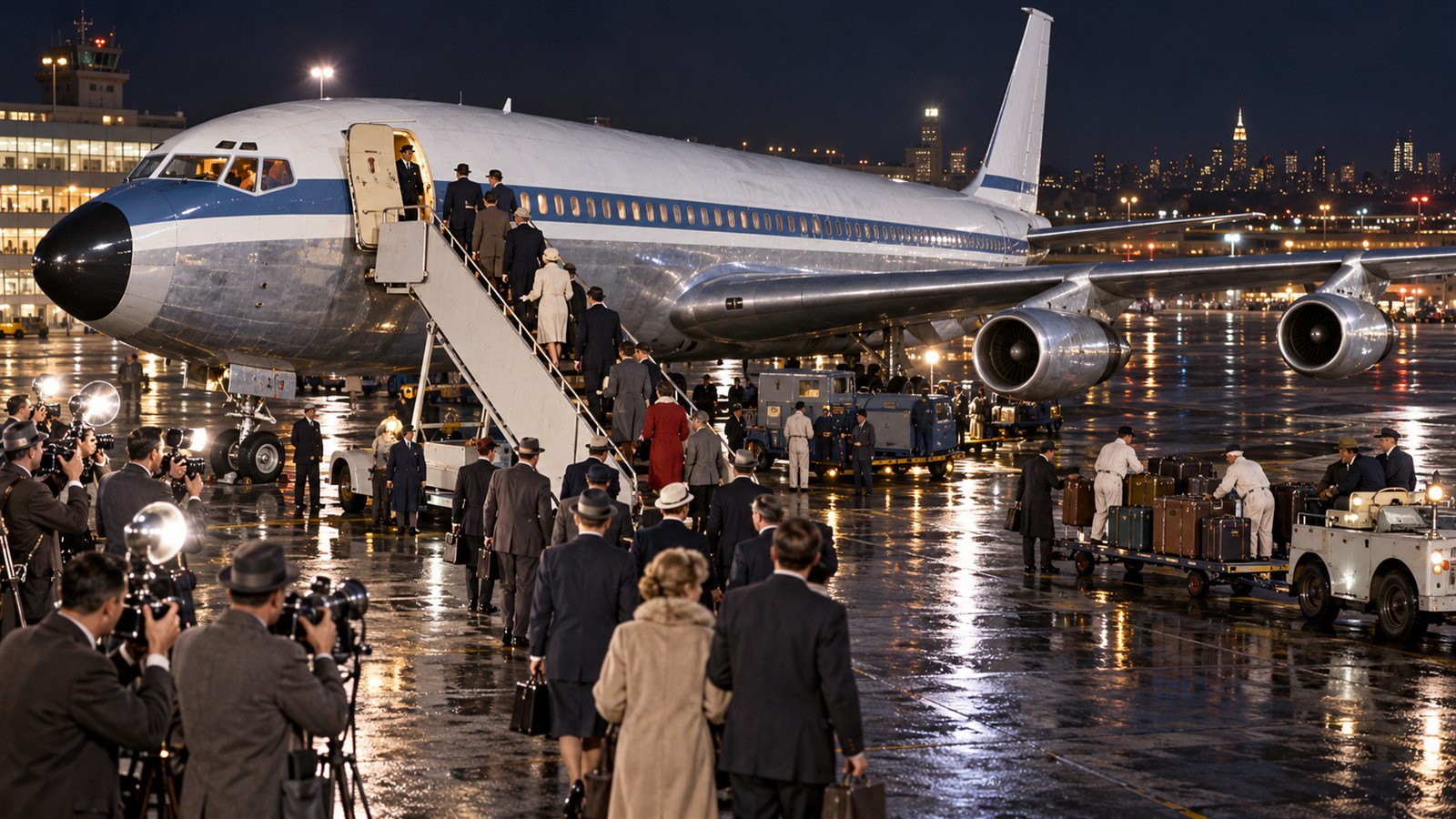
On This Day in Business: October 26, 1958
On October 26, 1958, Pan American World Airways began scheduled transatlantic service with the Boeing 707, flying from New York toward Paris with a refueling stop in Gander, Newfoundland. The swept-wing jet carried passengers at speeds and altitudes far beyond the piston airliners it replaced. Britain had already introduced the de Havilland Comet, but early accidents and redesigns delayed its commercial momentum. The 707's entry with a prominent international carrier helped make jet travel the new competitive standard on long routes and signaled that airlines, airports, and manufacturers would have to reorganize around a faster aircraft.
Boeing had invested in the Dash 80 prototype and drew on military tanker work to develop the 707 family. Pan Am's large order gave the program credibility, while competition with Douglas and its DC-8 pressed manufacturers to improve performance and delivery. For airlines, a jet promised more passenger-miles per day because it could fly faster and spend less time in the air on each trip. That productivity came with large capital requirements, fuel consumption, crew training, maintenance tools, and the risk of filling more seats consistently enough to cover fixed costs.
Airports lengthened and strengthened runways, expanded terminals, installed new ground equipment, and addressed noise. Reservations, catering, baggage, and international scheduling grew more complex as traffic increased. Shorter travel times made business trips and tourism across the Atlantic practical for more people, and freight benefited from speed as well. Airlines promoted modernity and glamour, but service remained costly, and the benefits were not initially available to everyone. Jet expansion also increased aviation's environmental footprint and intensified disputes over communities near airports.
The 707 became a defining early jetliner and helped Boeing establish a leading position in commercial aviation. Later wide-body aircraft lowered per-seat costs and expanded mass travel, while nonstop range reduced the need for refueling stops. October 26 shows how a new vehicle changes an entire operating system. The airplane alone did not create the Jet Age; financing, fuel, airports, air-traffic control, regulation, training, and international rights made scheduled service possible. Once those complements aligned, speed altered customer expectations and competitive economics so quickly that older fleets lost value even before they physically wore out. Aircraft manufacturers also learned that common families could spread development cost across passenger, cargo, and military variants. Airlines valued fleet commonality because parts, pilot qualifications, and maintenance procedures could be shared. Product architecture affected economics long after the first delivery.
Pan Am began scheduled Boeing 707 transatlantic service on October 26, 1958.
The inaugural route left New York for Paris and included a refueling stop in Newfoundland.
Jet speed increased daily aircraft productivity but demanded heavy capital and high load factors.
Airports had to upgrade runways, terminals, equipment, training, and noise management.
Faster crossings expanded international business travel, tourism, and time-sensitive cargo.
The Jet Age emerged from an ecosystem of aircraft, finance, infrastructure, regulation, and operations.
Explore more of "On This Day ..."
Discover more events from the same date across news, politics, technology, sports, and other fields. Each link highlights significant moments that shaped history on different fronts.