

On This Day in Business: October 28, 1965
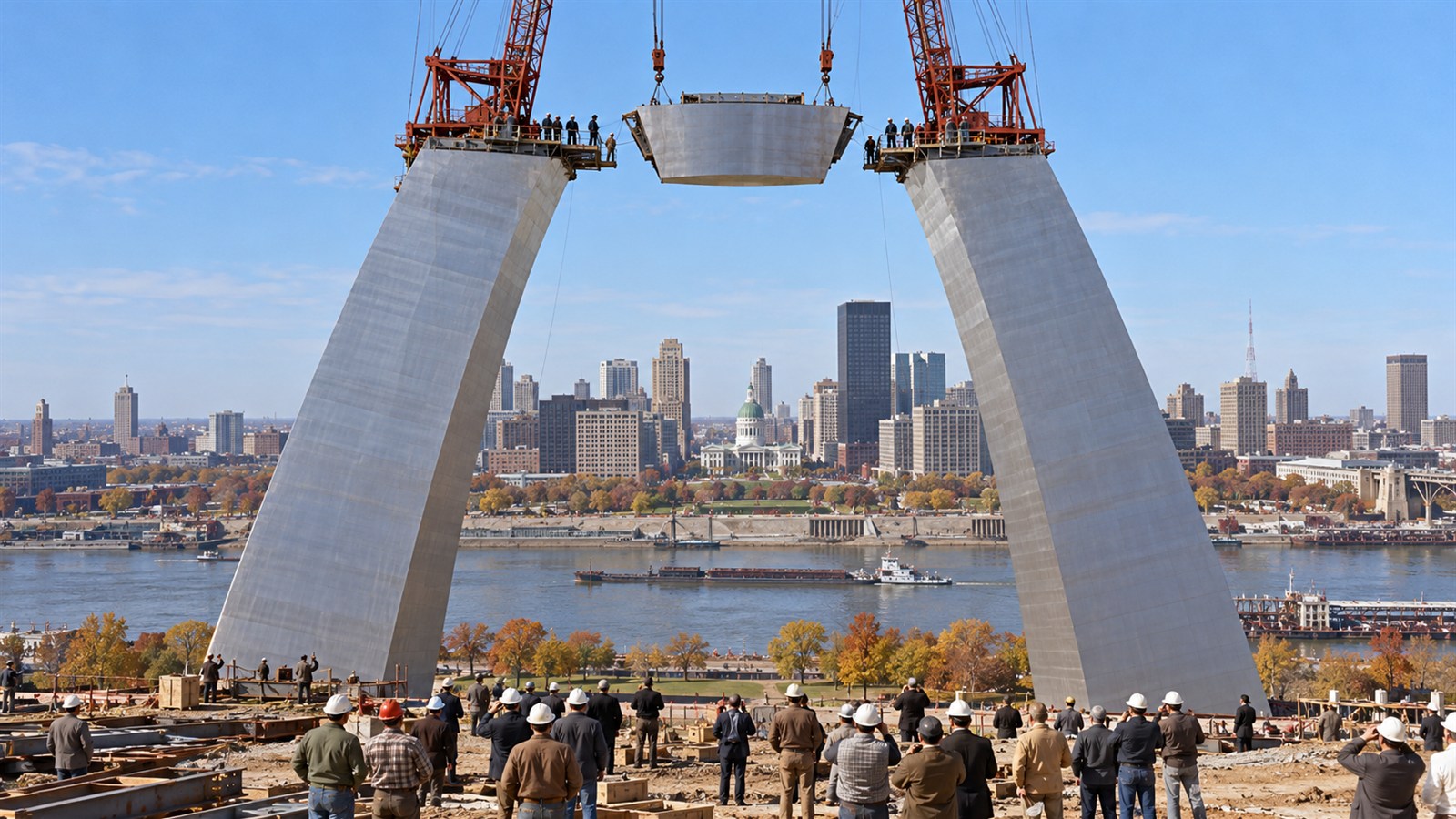
On October 28, 1965, crews placed the final stainless-steel section at the top of the Gateway Arch in St. Louis. The 630-foot monument, designed by Eero Saarinen, had risen as two tapering legs that needed to meet within extremely small tolerances. Hydraulic jacks spread the legs slightly so the last piece could be lowered into position, completing the exterior form. The arch was part of the Jefferson National Expansion Memorial, a federally backed effort to redevelop the riverfront and commemorate westward expansion. Its completion ended an extraordinary construction phase, though interior systems and visitor operations still had to be finished.
Building the catenary-shaped structure required custom cranes that climbed the legs, precise surveying, carbon-steel inner walls, stainless-steel outer skin, and concrete filling in lower sections. The project also needed a transportation system capable of carrying visitors through narrow, curved legs, producing the distinctive tram of small rotating capsules. Contractors and engineers had to turn an elegant competition drawing into a safe, maintainable structure. The feat demonstrates how specialized suppliers and one-off equipment can become necessary when architecture moves beyond standard construction methods.
The memorial's economic history is more complicated than its clean geometry. Riverfront redevelopment involved the demolition of many existing buildings and displaced businesses, while the national story traditionally presented at the site often celebrated expansion without fully confronting Indigenous dispossession, slavery, and conflict. As a tourism asset, the Arch created a powerful visual identity for St. Louis, drawing visitors who also spend on hotels, food, transport, and nearby attractions. Public investment generated benefits across the city that could not be captured solely through admission receipts.
The Arch opened to visitors in 1967 and later underwent major landscape and museum improvements. October 28 shows how landmark design can function as place branding and regional economic infrastructure, but also why project evaluation must include what was removed and whose history is told. The construction succeeded because design ambition was matched with engineering discipline and precise field measurement. Its long-term value depends on maintenance, interpretation, access, and surrounding public space. A monument may appear to be a finished object, yet its commercial and civic return is produced continuously through operations and the relationship it creates between a city and its visitors. A landmark can become distinctive inventory for a destination: an image used in conventions, advertising, film, souvenirs, and civic events. Protecting that asset requires conservation and a visitor experience equal to the promise made by the skyline.
Crews placed the final exterior section of the Gateway Arch on October 28, 1965.
The two 630-foot legs had to meet within extremely tight construction tolerances.
Custom climbing cranes, precision surveying, and a specialized tram solved unusual design requirements.
Riverfront redevelopment also demolished buildings and displaced existing businesses.
The Arch became a tourism anchor and a globally recognizable brand for St. Louis.
Its value depends on ongoing maintenance, inclusive interpretation, access, and surrounding public space.
Explore more of "On This Day ..."
Discover more events from the same date across news, politics, technology, sports, and other fields. Each link highlights significant moments that shaped history on different fronts.