

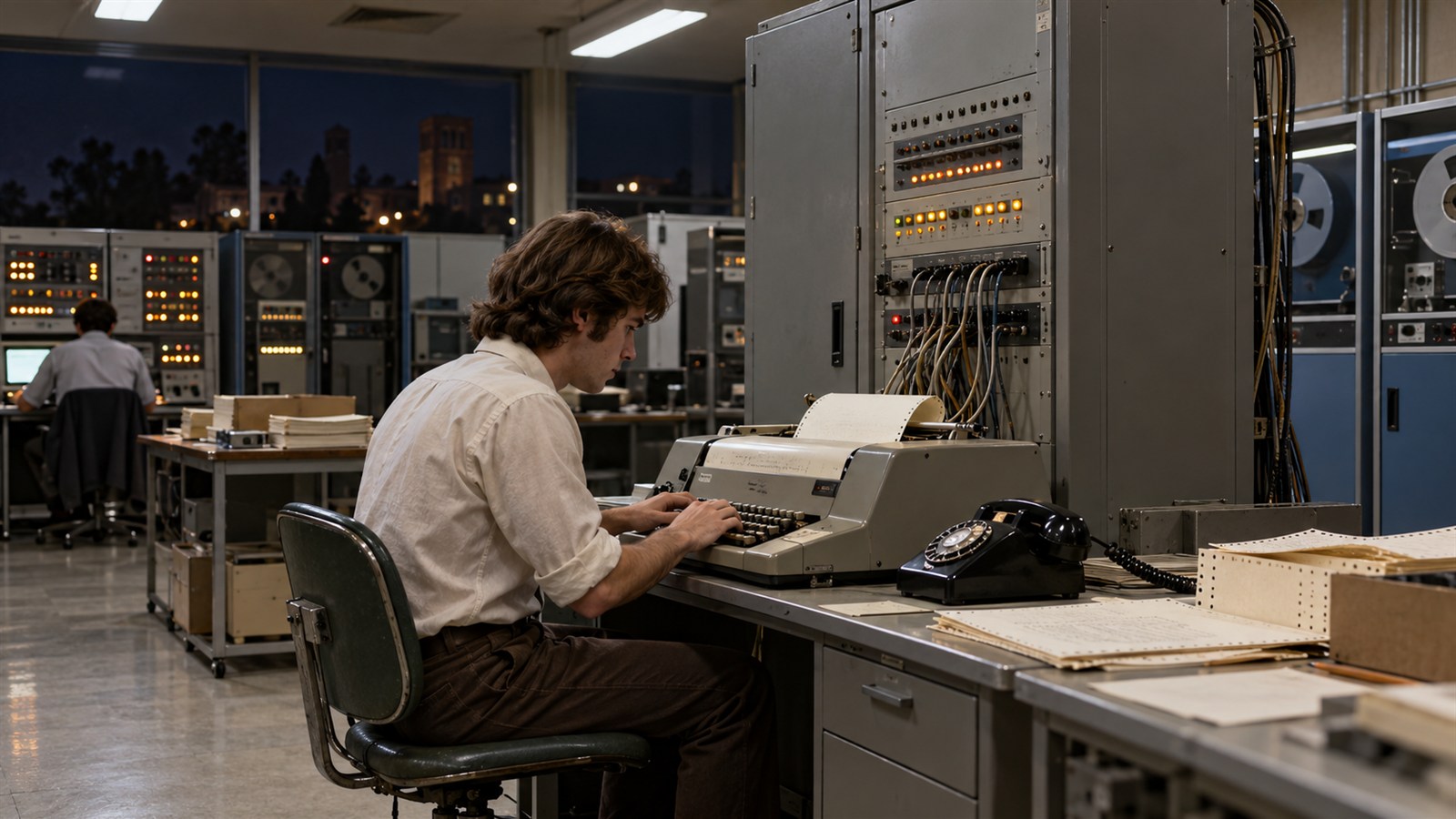
On This Day in Business: October 29, 1969
On October 29, 1969, a team at UCLA sent the first host-to-host message over ARPANET to a computer at the Stanford Research Institute. Programmer Charley Kline attempted to transmit the command LOGIN while Leonard Kleinrock's group communicated by telephone with researcher Bill Duvall in Menlo Park. The remote system received the letters L and O before it crashed. After repairs, the full command succeeded. The fragment 'LO' later became a memorable origin story, but the real achievement was that two different computers had exchanged data through packet-switching equipment across a long-distance network.
ARPANET was funded by the U.S. Department of Defense's Advanced Research Projects Agency to connect research sites and explore interactive computing. Bolt Beranek and Newman built Interface Message Processors that acted as switching nodes. Packet switching divided data into pieces that could travel through a shared network and be reassembled, using capacity more flexibly than a dedicated circuit. Universities, contractors, and government program managers formed an early ecosystem in which public funding supported risky infrastructure and researchers contributed protocols, software, and operational knowledge.
The network expanded to additional sites and services, including email, file transfer, and remote access. In 1983 ARPANET adopted the TCP/IP protocol suite, helping different networks interconnect. Commercial use of the internet grew later as policy changed, backbone capacity expanded, personal computers spread, and the World Wide Web made navigation accessible. Each layer created business opportunities for equipment makers, carriers, software companies, hosting providers, marketplaces, advertisers, and creators. The internet's value increased as more people and organizations could reach one another using common rules.
ARPANET itself was decommissioned in 1990, but the October 29 exchange represents the operational beginning of a general-purpose network. It was not a finished internet and was not designed as a retail marketplace. Its business importance lies in architecture: open interconnection allowed new applications to be added without rebuilding every underlying link. That flexibility supported innovation far beyond the original sponsor's forecast. The history also shows that foundational markets often emerge from patient public investment and shared standards before profitable uses are obvious. Two letters were a tiny transaction, but they proved a network model whose later economic scale depended on interoperability, decentralized experimentation, and trust. The first link also made failure visible and useful. The crash after two letters was not a commercial disaster; it was information for a small technical community that could repair the system and try again. Experimental networks improve when early faults are observable, shared, and inexpensive to correct.
UCLA sent the first host-to-host ARPANET message to SRI on October 29, 1969.
The system crashed after receiving L and O, then successfully completed the LOGIN command.
Interface Message Processors connected unlike computers through packet-switching technology.
Government funding linked universities and contractors before a commercial internet market existed.
Common protocols later allowed separate networks and new applications to interoperate.
The episode shows how open infrastructure can create opportunities its original sponsors could not predict.
Explore more of "On This Day ..."
Discover more events from the same date across news, politics, technology, sports, and other fields. Each link highlights significant moments that shaped history on different fronts.