

On This Day in Business: October 31, 1941
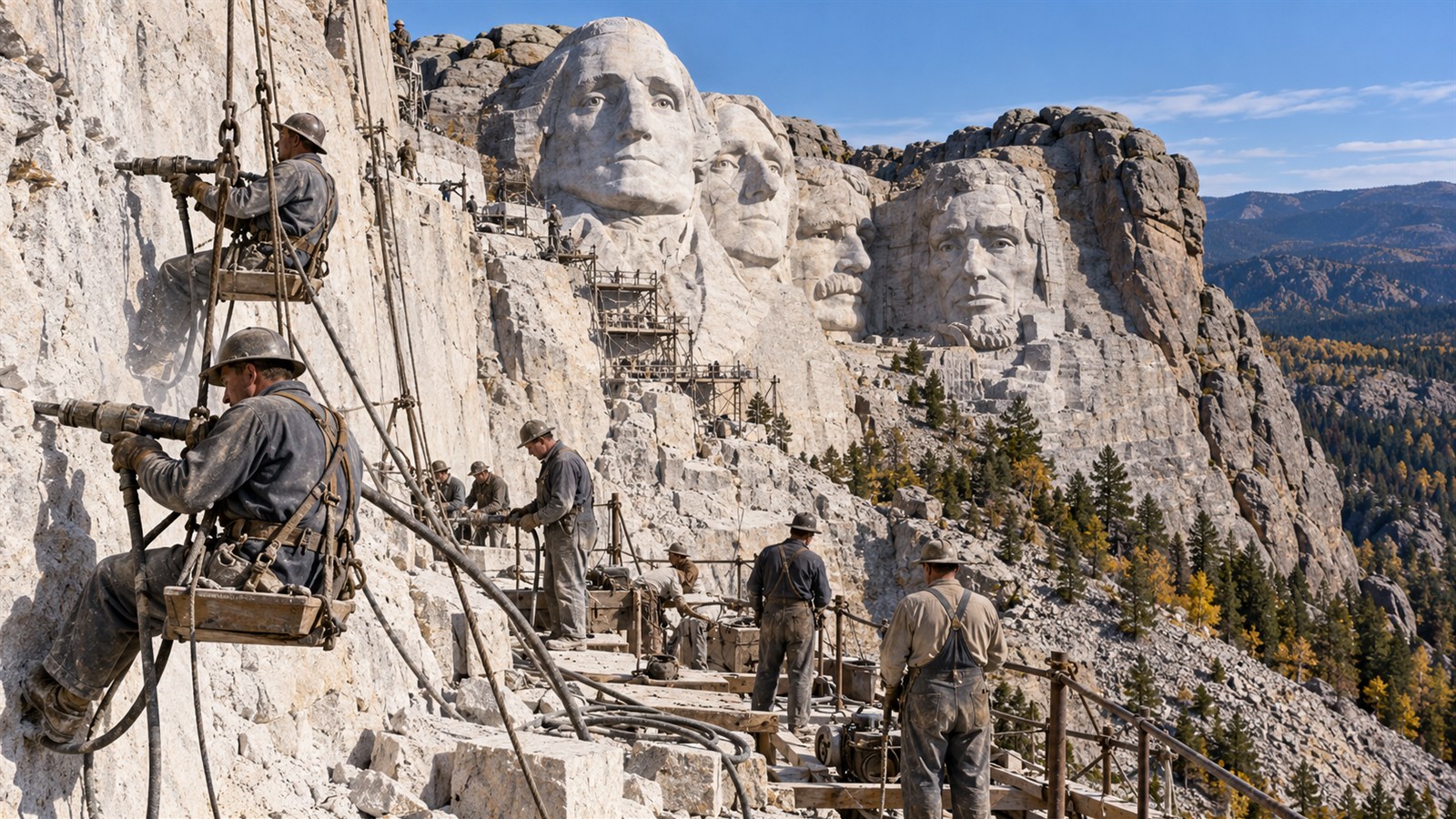
On October 31, 1941, drilling and carving work ended at Mount Rushmore in South Dakota's Black Hills. Sculptor Gutzon Borglum had died earlier that year, and his son Lincoln supervised the final months. From 1927 to 1941, nearly 400 workers used dynamite, pneumatic drills, cables, and hand tools to shape the granite faces of George Washington, Thomas Jefferson, Theodore Roosevelt, and Abraham Lincoln. Funding and wartime priorities stopped the project before Borglum's broader plans were realized. The result nonetheless became one of the country's most recognizable public monuments and a powerful engine for regional tourism.
Construction was an unusual production operation. Workers climbed hundreds of stairs, rode bosun chairs over a 500-foot face, and removed most material with carefully measured explosive charges. Closely spaced drilling called honeycombing brought the stone near its final surface before finishing tools smoothed it. No worker died during construction, despite the obvious hazards. Federal appropriations, private advocacy, engineering judgment, and local labor sustained a project whose direct financial return would not appear like revenue from an ordinary building.
The monument drew visitors who purchased lodging, food, fuel, souvenirs, and other services, linking national symbolism with South Dakota's visitor economy. Yet the site stands on land sacred to the Lakota and within the Black Hills, which the United States guaranteed to the Sioux under the 1868 Fort Laramie Treaty before taking it after the discovery of gold. The carved presidents and the tourism market built around them cannot be separated from that broken treaty and continuing Indigenous claims. Public interpretation has gradually included more of this context, though disagreement remains profound.
Mount Rushmore demonstrates how cultural infrastructure can generate decades of economic activity after construction ends. Its value depends on roads, visitor facilities, conservation, staffing, storytelling, and the image reproduced in media and merchandise. October 31 also exposes the choices hidden inside place branding: selecting heroes and a landscape elevates one narrative while potentially obscuring another. A complete business account therefore includes both regional income and the rights, history, and opportunity costs attached to the land. The monument was physically completed in 1941, but the work of maintaining it and honestly explaining what it represents is an ongoing public enterprise. Tourism concentration also creates operational risk. Wildfire, weather, transport disruption, or changing travel patterns can affect businesses across the region at once. Diversification and stewardship protect both the landscape visitors come to see and the livelihoods built around it.
Carving work at Mount Rushmore ended on October 31, 1941.
Nearly 400 workers used dynamite, drills, cables, and hand finishing over fourteen years.
Federal funding and local labor created a monument whose returns came largely through later tourism.
Visitor spending supports lodging, food, transport, retail, and public services across the region.
The site occupies Black Hills land sacred to the Lakota and tied to unresolved treaty claims.
Its history shows that place branding creates economic value while choosing which stories a landscape presents.
Explore more of "On This Day ..."
Discover more events from the same date across news, politics, technology, sports, and other fields. Each link highlights significant moments that shaped history on different fronts.