

On This Day in Business: November 4, 1879
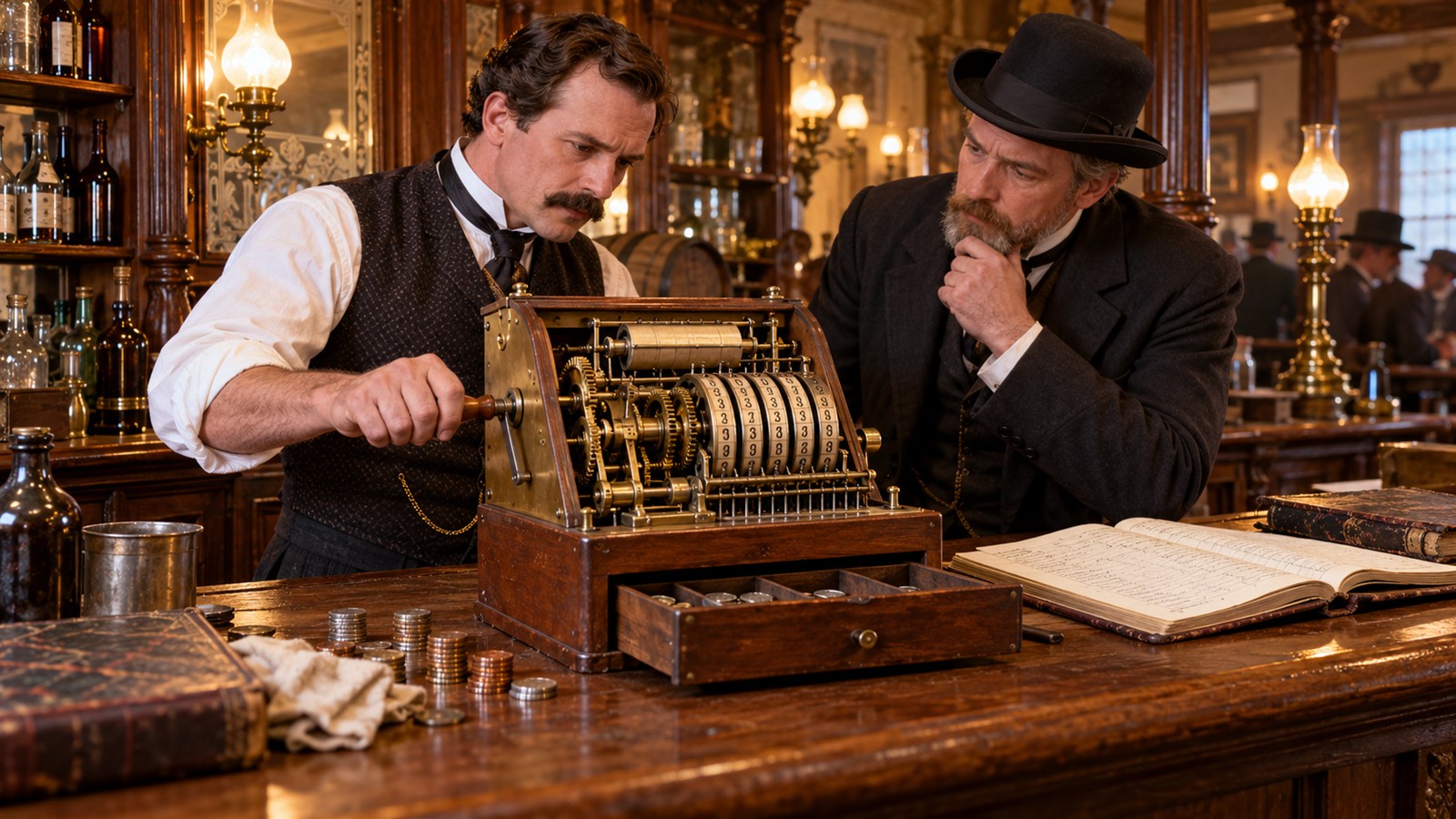
On November 4, 1879, the United States granted patent number 221,360 for a cash-recording machine associated with Dayton saloonkeeper James Ritty and his brother John. Ritty wanted a way to register sales and discourage employees from pocketing money. The early mechanism displayed transaction amounts and recorded the operation, turning a vulnerable moment at the counter into information an owner could check. The innovation addressed a basic business problem: turning activity into information that could be stored, compared, and acted upon. Better records reduce disputes, expose patterns, and make delegation possible because owners and managers no longer depend entirely on memory or personal supervision.
The invention did not immediately resemble the standardized registers that later filled stores. Its significance was the control principle: each sale produced a visible or mechanical trace. That connected the handling of cash with a record, reducing reliance on trust alone. Retailers could compare receipts, inventory movement, and the contents of the drawer with greater confidence. A useful information system must fit the work around it. Accuracy, speed, controls, and ease of use determine whether employees adopt the tool, while reports must reach people who can respond. The machine or method creates value only when it improves decisions and accountability.
Ritty eventually sold the business, and later owners developed it into the National Cash Register enterprise. Improvements added paper rolls, drawers, printing, and more reliable mechanisms. The register became both an appliance and a management system, while sales and service organizations taught merchants how to redesign checkout work around the machine. Once records become standardized, they support wider coordination—pricing, inventory, credit, auditing, planning, and performance measurement. That reach can improve productivity, but it also raises questions about surveillance, access, error correction, and who controls the resulting data.
The patent represents an early chapter in point-of-sale technology. Modern terminals authorize payments, update inventory, calculate tax, track employees, and feed analytics, but they still perform the core task Ritty pursued: making a transaction observable. The business value came from linking physical money, operational procedure, and an auditable record at the instant of sale. Modern firms still face the same design test. Collect only information tied to a clear purpose, protect it, and return useful signals to the people doing the work. Technology should make the business more understandable without turning measurement into a substitute for judgment. In practical terms, the advantage came from linking a clear customer promise to disciplined execution. Capital had to be allocated before demand was certain, employees and partners had to coordinate, and leaders had to keep learning after the initial milestone passed into history.
Patent 221,360 was granted on November 4, 1879.
The machine was designed to register cash transactions.
James Ritty sought to reduce losses at his Dayton saloon.
The concept linked every sale to a visible record.
Later owners developed the idea into the National Cash Register business.
Modern point-of-sale systems retain the same accountability principle.
Explore more of "On This Day ..."
Discover more events from the same date across news, politics, technology, sports, and other fields. Each link highlights significant moments that shaped history on different fronts.