

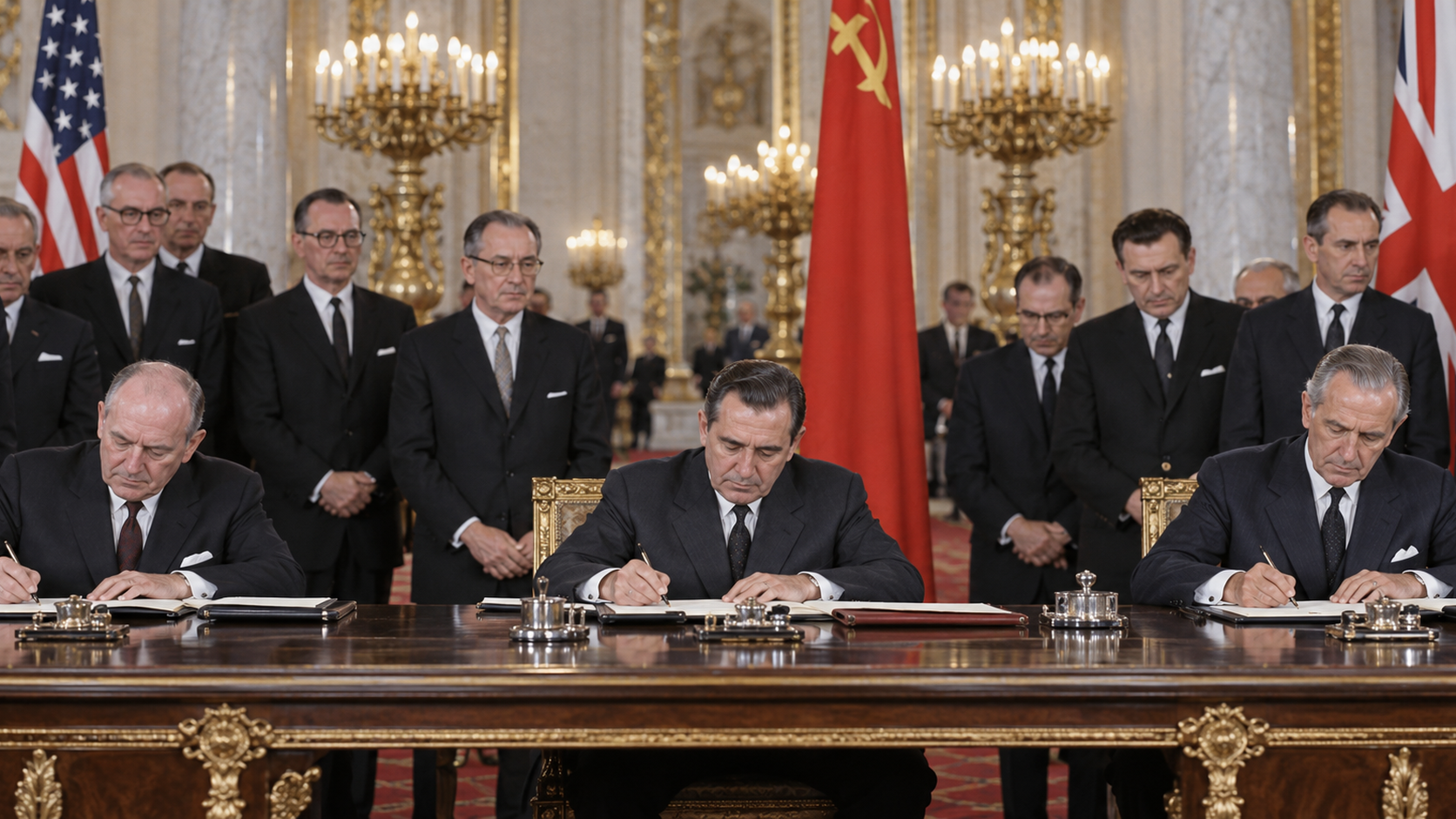
On This Day in Health: August 5, 1963
On August 5, 1963, representatives of the United States, Soviet Union, and United Kingdom signed the Limited Test Ban Treaty in Moscow. U.S. Secretary of State Dean Rusk, Soviet Foreign Minister Andrei Gromyko, and British Foreign Secretary Lord Home signed for the original parties. The treaty prohibited nuclear explosions in the atmosphere, outer space, and underwater. It also barred explosions in other environments when radioactive debris would travel beyond the testing country’s borders. The agreement entered into force on October 10 after ratification. Its text stated a desire to end contamination of the human environment by radioactive substances.
That health concern had become impossible to separate from nuclear policy. Hundreds of aboveground tests had sent radioactive material into the atmosphere since 1945. Fallout could settle on soil and water, enter crops and livestock, and reach people through food and inhalation. Radionuclides behave differently: iodine-131 concentrates in the thyroid, while cesium-137 persists much longer in the environment. Exposure to ionizing radiation can damage cells and raise cancer risk. Scientists monitored radioactivity in air, rain, and milk, and reports of contamination far from test sites helped turn an arms-control dispute into a public health and environmental demand.
The treaty was a limited agreement. It did not ban underground testing, and not every nuclear-armed country joined at once. Verification disagreements had blocked a comprehensive ban, so negotiators focused on environments where national detection systems could more readily identify explosions. The compromise allowed nuclear competition and underground tests to continue. Even so, the agreement ended most aboveground testing by the original parties and established a precedent for later arms-control treaties. Environmental radiation monitoring recorded declining day-to-day air readings after aboveground testing diminished, although earlier fallout and subsequent tests by other countries left a continuing scientific and public health legacy.
The signing also reflected public pressure. The 1954 Castle Bravo test had contaminated a Japanese fishing vessel and Pacific communities, and radioactive isotopes were detected in food and human tissue. Physicians, scientists, parents, activists, and political leaders argued that fallout crossed borders and exposed people who had no role in the tests. Their concern helped redefine environmental contamination as a shared international risk. August 5 therefore marks more than a diplomatic ceremony. It records an early global effort to reduce a preventable exposure through law. The treaty did not eliminate nuclear weapons, testing, or radiation harm, but it demonstrated that health evidence and public action could change how powerful states conducted dangerous technology.
The United States, Soviet Union, and United Kingdom signed the treaty in Moscow on August 5, 1963, after years of unsuccessful negotiations for a broader ban.
It prohibited nuclear explosions in the atmosphere, outer space, and underwater, along with tests elsewhere that spread radioactive debris beyond national borders.
Fallout from aboveground tests could move through air, soil, water, crops, livestock, and food, exposing populations far beyond the test sites.
The agreement did not prohibit underground tests, and some nuclear powers continued atmospheric testing because they had not joined the original treaty.
Most aboveground testing by the original parties ended, environmental air readings declined, and the treaty created an important precedent for later arms-control efforts.
The signing shows how monitoring, health research, public concern, and diplomacy can combine to reduce a widespread environmental exposure even when a solution is incomplete.
Explore more of "On This Day ..."
Discover more events from the same date across news, politics, technology, sports, and other fields. Each link highlights significant moments that shaped history on different fronts.