

On This Day in Health: September 4, 1906
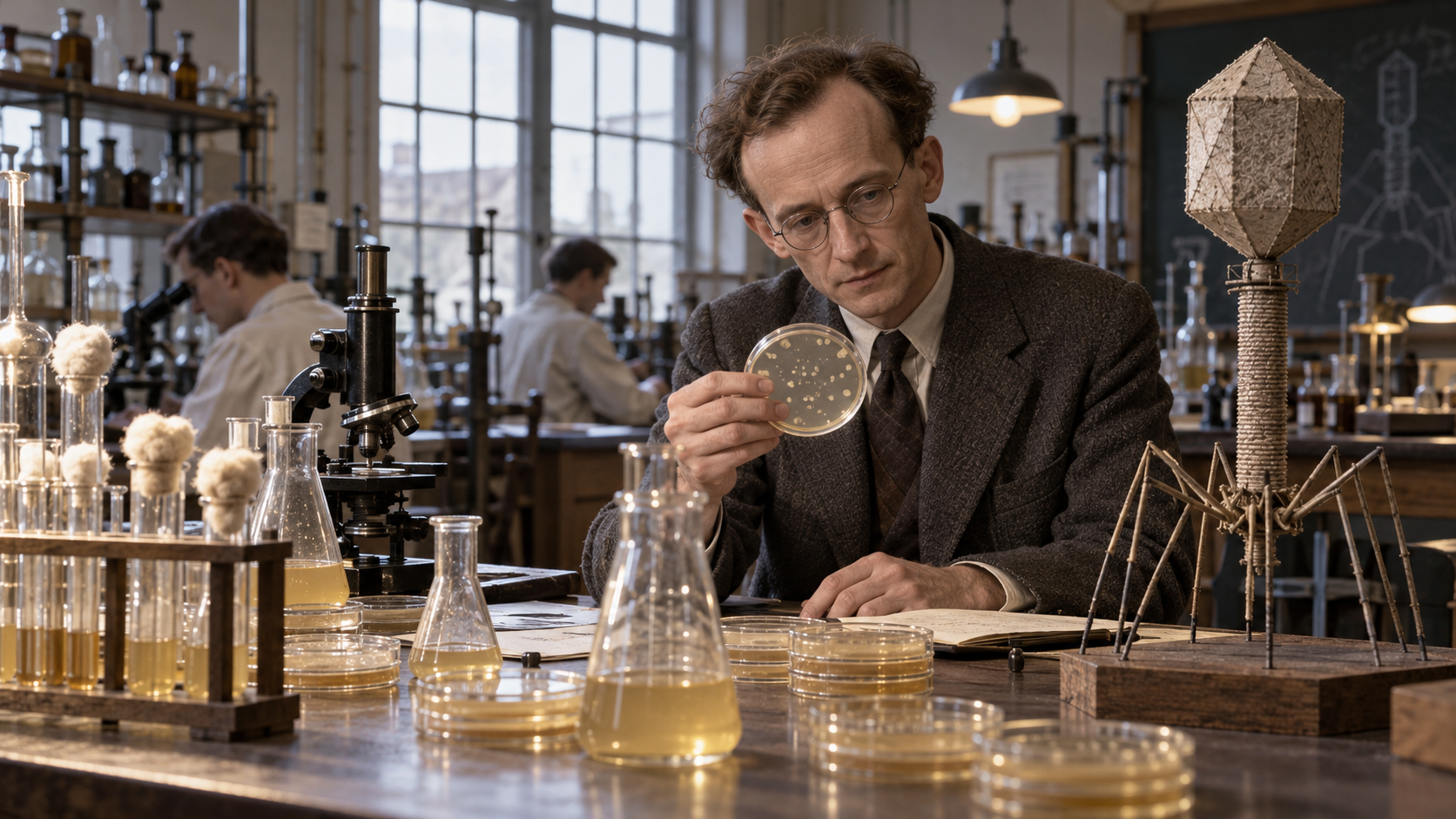
On September 4, 1906, Max Delbrück was born in Berlin-Charlottenburg. Trained first in theoretical physics, he later moved into biology and helped create an experimental culture that used bacteriophages, viruses that infect bacteria, to uncover basic rules of heredity. This date matters because it fixes a broad medical story to a specific moment, place, and group of people. It also shows how health history is shaped by institutions and practical choices as well as laboratory discoveries.
The background was already developing before that day. In the 1930s and 1940s, genes were real to geneticists but their physical behavior remained difficult to study. Bacteriophages offered simple, rapidly reproducing systems. Delbrück brought a physicist's preference for quantitative experiments and joined Salvador Luria, Alfred Hershey, and other investigators in building the informal phage group. Those conditions defined what participants could attempt and what patients or communities could reasonably expect. They also explain why later accounts sometimes compress years of preparation into a single anniversary. Looking at that preparation keeps credit broad and makes the turning point easier to understand without turning it into a miracle story.
What happened on the date was consequential but limited. The group's experiments showed that viruses reproduce through ordered biological processes and carry genetic information that can mutate and recombine. The Luria-Delbrück experiment demonstrated that bacterial resistance arises from random mutations before viral selection, rather than being produced by exposure itself. Early phage models simplified living systems and could not explain every feature of cells, organisms, or human disease. Their strength came from asking narrow questions under controlled conditions, then testing whether the principles held in more complex biology. The distinction is important: the event did not instantly solve the underlying health problem, and later progress depended on follow-up research, training, policy, funding, and public trust. Contemporary evidence also helps separate what participants knew then from interpretations added after the result became famous.
Its longer legacy reaches beyond the original setting. Delbrück, Luria, and Hershey shared the 1969 Nobel Prize for discoveries about viral replication and genetic structure. Their work helped establish molecular biology, strengthened microbial genetics, and influenced the study of viruses, cancer, antibiotic resistance, and gene regulation. Phages are again studied as possible treatments for resistant infections, while the experimental logic of the phage group remains central to biomedical research. Seen in context, the anniversary is useful because it connects a concrete historical episode with continuing questions about evidence, access, safety, and responsibility in health care. That connection is stronger when the people affected, the limits of the achievement, and the work still unfinished remain part of the account.
The group's experiments showed that viruses reproduce through ordered biological processes and carry genetic information that can mutate and recombine. The Luria-Delbrück experiment demonstrated that bacterial resistance arises from random mutations before viral selection, rather than being produced by exposure itself.
Early phage models simplified living systems and could not explain every feature of cells, organisms, or human disease. Their strength came from asking narrow questions under controlled conditions, then testing whether the principles held in more complex biology.
Delbrück, Luria, and Hershey shared the 1969 Nobel Prize for discoveries about viral replication and genetic structure. Their work helped establish molecular biology, strengthened microbial genetics, and influenced the study of viruses, cancer, antibiotic resistance, and gene regulation.
In the 1930s and 1940s, genes were real to geneticists but their physical behavior remained difficult to study. Bacteriophages offered simple, rapidly reproducing systems. Delbrück brought a physicist's preference for quantitative experiments and joined Salvador Luria, Alfred Hershey, and other investigators in building the informal phage group.
Max Delbrück was born in Berlin-Charlottenburg. Trained first in theoretical physics, he later moved into biology and helped create an experimental culture that used bacteriophages, viruses that infect bacteria, to uncover basic rules of heredity.
Phages are again studied as possible treatments for resistant infections, while the experimental logic of the phage group remains central to biomedical research.
Explore more of "On This Day ..."
Discover more events from the same date across news, politics, technology, sports, and other fields. Each link highlights significant moments that shaped history on different fronts.