

On This Day in Health: September 5, 1902
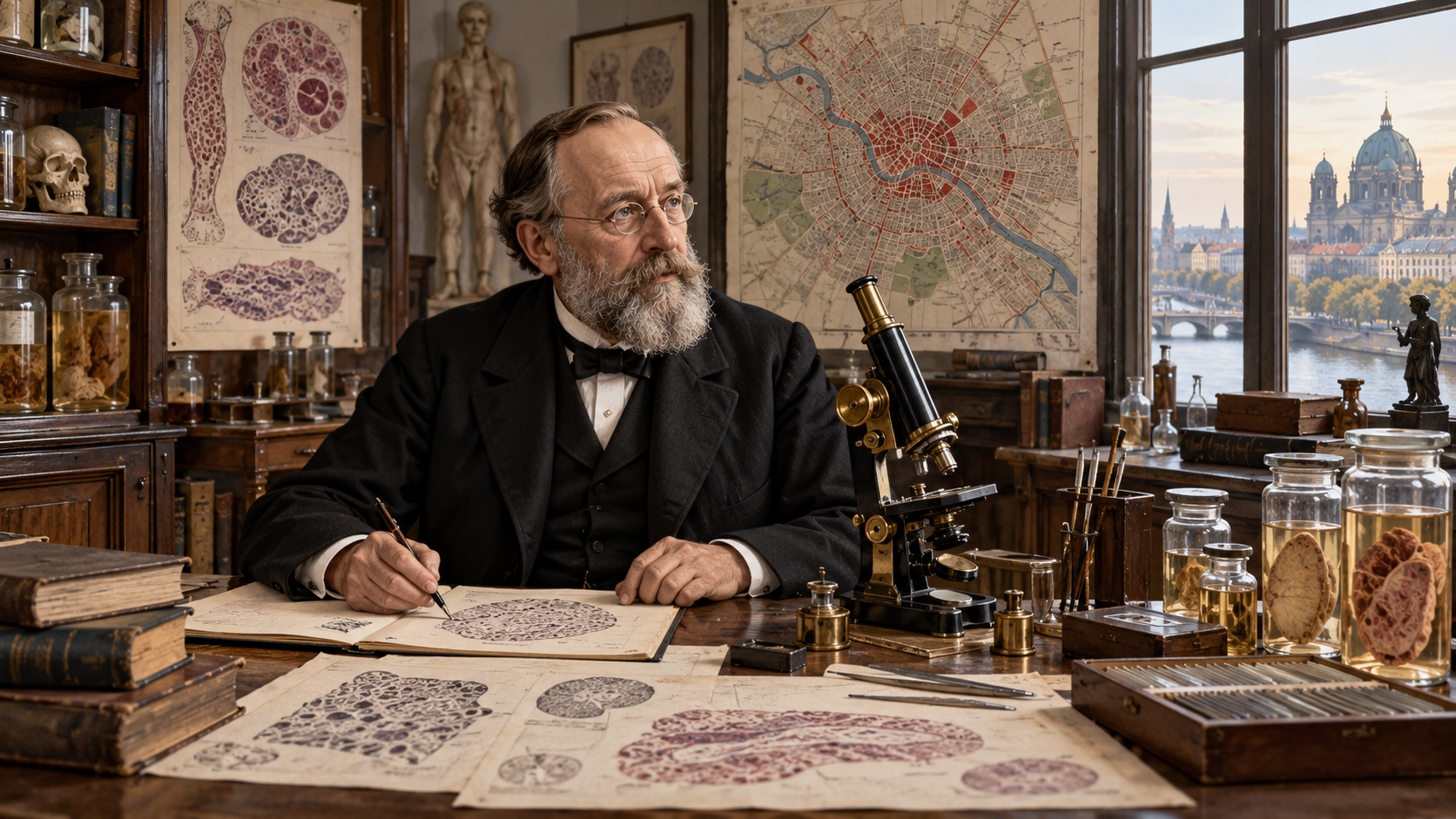
On September 5, 1902, Rudolf Virchow died at his home in Berlin at age 80. His death closed a career that changed how physicians understood disease, trained generations of pathologists, and connected laboratory medicine with sanitation, housing, nutrition, and political responsibility. This date matters because it fixes a broad medical story to a specific moment, place, and group of people. It also shows how health history is shaped by institutions and practical choices as well as laboratory discoveries.
The background was already developing before that day. Nineteenth-century medicine still carried older ideas that treated illness as an imbalance of the whole body. Virchow's microscopy supported a cellular view: diseased organs were made of altered cells, and new cells arose from existing cells. He also investigated a typhus epidemic in Upper Silesia and argued that poverty and social conditions drove disease. Those conditions defined what participants could attempt and what patients or communities could reasonably expect. They also explain why later accounts sometimes compress years of preparation into a single anniversary. Looking at that preparation keeps credit broad and makes the turning point easier to understand without turning it into a miracle story.
What happened on the date was consequential but limited. At the Charité and the University of Berlin, Virchow built pathology collections, taught systematic autopsy, and promoted close links between clinical symptoms and tissue changes. In municipal politics he supported modern water and sewer systems, hospitals, schools, and public health administration. Some of Virchow's scientific positions were later revised, and his wide-ranging anthropology contained assumptions that require critical reading today. His importance does not rest on every conclusion being correct; it rests on a method that joined observation, institutions, and social causes. The distinction is important: the event did not instantly solve the underlying health problem, and later progress depended on follow-up research, training, policy, funding, and public trust. Contemporary evidence also helps separate what participants knew then from interpretations added after the result became famous.
Its longer legacy reaches beyond the original setting. Cellular pathology became a foundation of diagnosis, cancer research, and laboratory medicine. His public-health work helped establish the principle that epidemics reflect living conditions and that governments have obligations to address preventable illness. The modern language of social determinants of health echoes questions Virchow raised: who becomes ill, what conditions shape exposure, and how medicine should respond beyond the clinic. Seen in context, the anniversary is useful because it connects a concrete historical episode with continuing questions about evidence, access, safety, and responsibility in health care. That connection is stronger when the people affected, the limits of the achievement, and the work still unfinished remain part of the account.
At the Charité and the University of Berlin, Virchow built pathology collections, taught systematic autopsy, and promoted close links between clinical symptoms and tissue changes. In municipal politics he supported modern water and sewer systems, hospitals, schools, and public health administration.
Some of Virchow's scientific positions were later revised, and his wide-ranging anthropology contained assumptions that require critical reading today. His importance does not rest on every conclusion being correct; it rests on a method that joined observation, institutions, and social causes.
Cellular pathology became a foundation of diagnosis, cancer research, and laboratory medicine. His public-health work helped establish the principle that epidemics reflect living conditions and that governments have obligations to address preventable illness.
Nineteenth-century medicine still carried older ideas that treated illness as an imbalance of the whole body. Virchow's microscopy supported a cellular view: diseased organs were made of altered cells, and new cells arose from existing cells. He also investigated a typhus epidemic in Upper Silesia and argued that poverty and social conditions drove disease.
Rudolf Virchow died at his home in Berlin at age 80. His death closed a career that changed how physicians understood disease, trained generations of pathologists, and connected laboratory medicine with sanitation, housing, nutrition, and political responsibility.
The modern language of social determinants of health echoes questions Virchow raised: who becomes ill, what conditions shape exposure, and how medicine should respond beyond the clinic.
Explore more of "On This Day ..."
Discover more events from the same date across news, politics, technology, sports, and other fields. Each link highlights significant moments that shaped history on different fronts.