

On This Day in Health: November 29, 1803
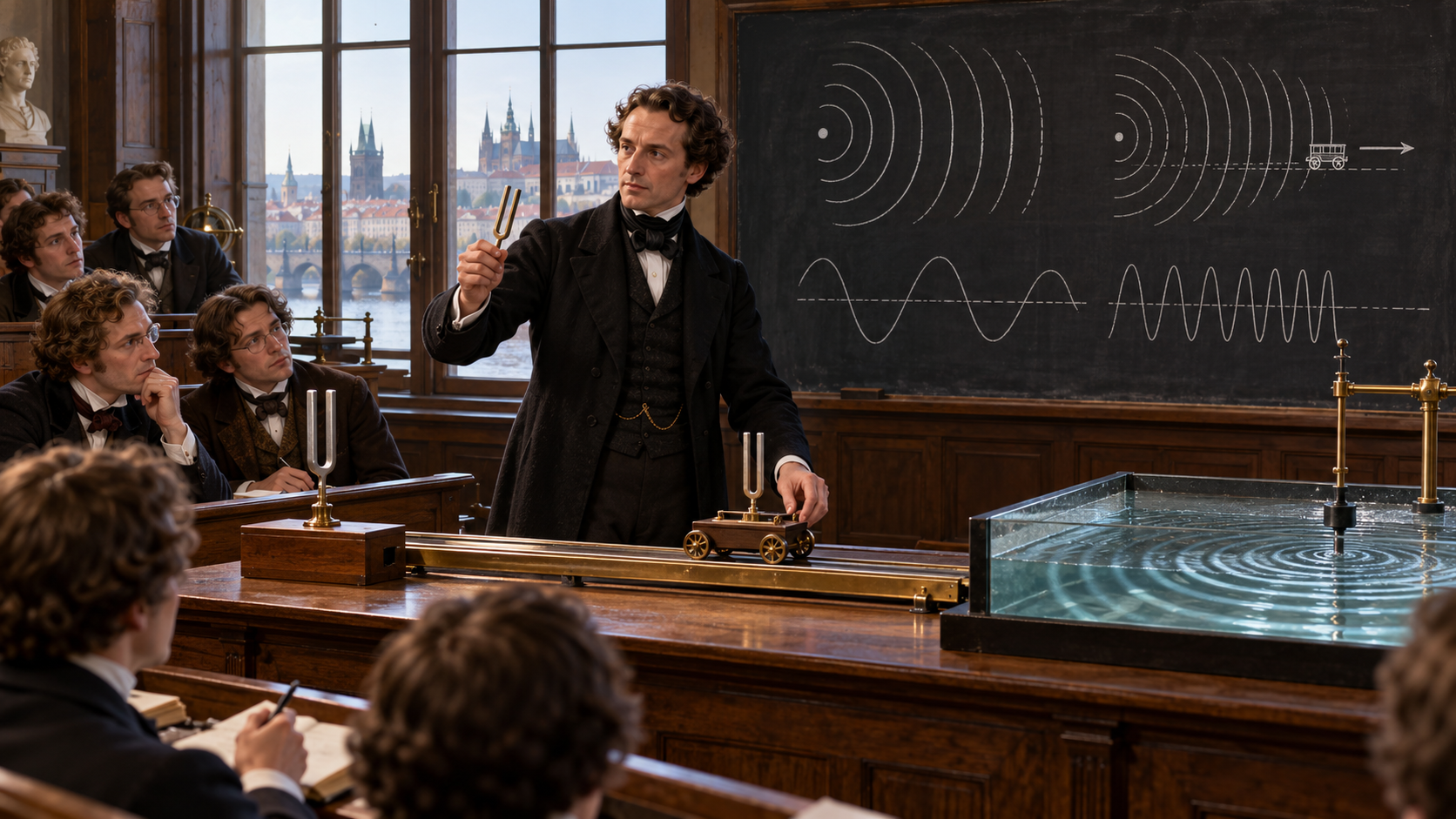
On November 29, 1803, Christian Andreas Doppler was born in Salzburg and later described how observed frequency changes when a wave source and observer move relative to one another. This date matters because it fixes a broad medical story to a specific moment, place, and group of people. It also shows how health history is shaped carefully by institutions and practical choices as well as laboratory discoveries.
The background was already developing before that day. Astronomers and physicists were trying to explain the colors of stars and the behavior of light and sound. Doppler brought mathematical reasoning to the relationship among motion, wavelength, and perceived frequency. Those conditions defined what participants could attempt and what patients or communities could reasonably expect. The available tools, social expectations, and professional structures all shaped the result. Change also depended on cooperation among people whose roles were not always recorded equally. They explain why later accounts sometimes compress years of preparation into a single anniversary. Looking at that preparation keeps credit broad and makes the turning point easier to understand without turning it into a miracle story.
What happened on the date was consequential but limited. In 1842 he presented the principle now called the Doppler effect. Although his astronomical examples were incomplete, the core relation was tested with sound and eventually applied to reflected ultrasound from moving blood cells. Doppler did not invent medical ultrasound, and translating the principle to living tissue required piezoelectric transducers, electronics, signal processing, clinical studies, and safety standards developed by many later teams. The distinction is important: the event did not instantly solve the underlying health problem, and later progress depended on follow-up research, training, policy, funding, and public trust. Contemporary evidence also helps separate what participants knew then from interpretations added after the result became famous.
Its longer legacy reaches beyond the original setting. Doppler ultrasound made it possible to estimate blood-flow direction and velocity without entering a vessel, supporting obstetrics, cardiology, vascular medicine, and bedside assessment. Color, spectral, tissue, and continuous-wave Doppler now reveal circulation and cardiac motion in real time, but accuracy still depends on beam angle, settings, anatomy, operator skill, and clinical context. Seen in context, the anniversary is useful because it connects a concrete historical episode with continuing questions about evidence, access, safety, and responsibility in health care. That connection is stronger when the people affected, the limits of the achievement, and the work still unfinished remain part of the account.
In 1842 he presented the principle now called the Doppler effect. Although his astronomical examples were incomplete, the core relation was tested with sound and eventually applied to reflected ultrasound from moving blood cells.
Doppler did not invent medical ultrasound, and translating the principle to living tissue required piezoelectric transducers, electronics, signal processing, clinical studies, and safety standards developed by many later teams.
Doppler ultrasound made it possible to estimate blood-flow direction and velocity without entering a vessel, supporting obstetrics, cardiology, vascular medicine, and bedside assessment.
Astronomers and physicists were trying to explain the colors of stars and the behavior of light and sound. Doppler brought mathematical reasoning to the relationship among motion, wavelength, and perceived frequency.
Christian Andreas Doppler was born in Salzburg and later described how observed frequency changes when a wave source and observer move relative to one another.
Color, spectral, tissue, and continuous-wave Doppler now reveal circulation and cardiac motion in real time, but accuracy still depends on beam angle, settings, anatomy, operator skill, and clinical context.
Explore more of "On This Day ..."
Discover more events from the same date across news, politics, technology, sports, and other fields. Each link highlights significant moments that shaped history on different fronts.