

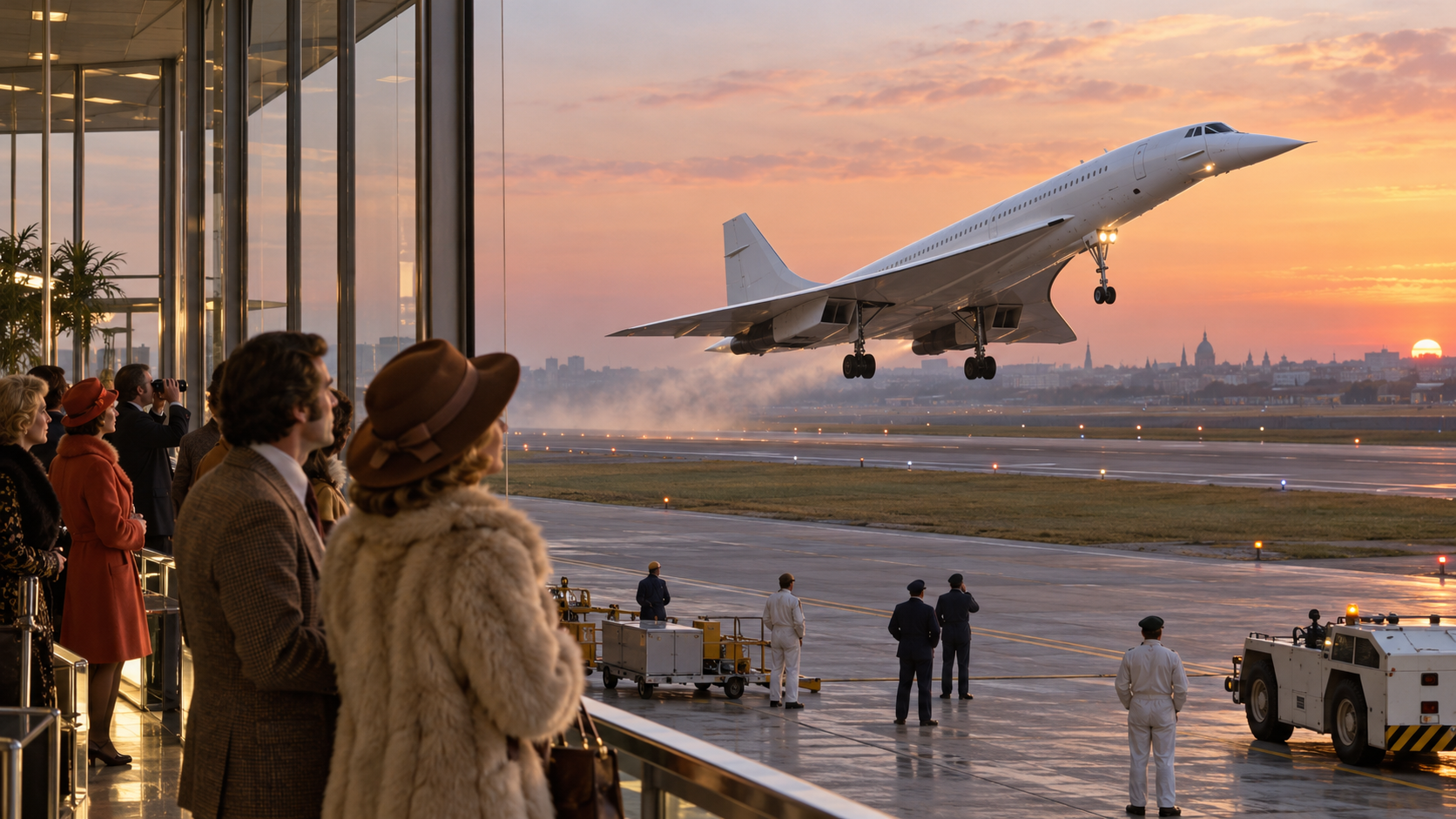
On This Day in Lifestyles: January 21, 1976
On January 21, 1976, Concorde carried its first paying passengers on scheduled service. British Airways flew from London to Bahrain while Air France departed Paris for Rio de Janeiro via Dakar. The sleek delta-wing aircraft cruised at more than twice the speed of sound, allowing journeys that dramatically shortened the map for travelers able to afford them. Its narrow cabin and relatively small windows were less spacious than the new wide-body jets, but speed was the luxury. Flight crews served elegant meals as passengers watched a display showing the aircraft cross Mach 1, turning a technical achievement into a distinctive social experience.
Concorde emerged from a costly partnership between Britain and France that combined national prestige, engineering ambition, and optimism about the future of aviation. Its long pointed nose drooped for takeoff and landing so pilots could see the runway, then straightened for efficient supersonic flight. The aircraft heated and stretched at speed, and its engines required afterburners during key phases. These qualities made it extraordinary but expensive. Fuel consumption, maintenance, limited seating, and airport restrictions challenged the business case. Sonic booms prevented routine overland supersonic travel in many places, shaping routes mostly around oceans.
Service to Washington and later New York made Concorde famous among executives, celebrities, and travelers marking special occasions. Because westbound transatlantic flights could arrive by the clock earlier than they departed, the aircraft became a symbol of compressed time. Yet the exclusivity also revealed a divide in air travel. The Boeing 747 and other wide-body aircraft were making long-distance flying available to many more people by emphasizing capacity and efficiency, while Concorde served a small premium market. One path democratized global tourism; the other offered unmatched speed to those with exceptional means.
Concorde’s commercial career ended in 2003 after a fatal 2000 crash, a long grounding, rising costs, and declining demand. Surviving aircraft became museum pieces, preserving a future that once seemed imminent but never became ordinary. New companies continue to pursue quieter and more efficient supersonic designs, while climate concerns place greater attention on aviation’s energy use. The first service day still captures a powerful lifestyle dream: breakfast in one capital, business across an ocean, and home sooner than geography once allowed. It also reminds us that a technological marvel becomes lasting transportation only when economics, safety, access, and environmental limits can travel with it. Its brief era still symbolizes a moment when speed itself was marketed as a luxury experience.
British Airways began London–Bahrain service as Air France opened Paris–Rio service via Dakar. Both airlines carried paying passengers on January 21.
Concorde cruised above Mach 2, cutting long journeys dramatically while carrying far fewer passengers than contemporary wide-body aircraft.
The cabin was narrow, but premium meals, attentive service, exclusivity, and the ability to save hours turned the flight itself into a status experience.
High fuel use, complex maintenance, expensive tickets, airport limits, and sonic-boom restrictions kept the market small.
Concorde retired in 2003 after a 2000 crash, grounding, rising costs, and reduced demand. The fleet now survives in museums.
Current supersonic projects must solve not only speed and noise but also affordability, safety, fuel use, and aviation’s environmental impact.
Explore more of “This Day in Lifestyles”
Discover more moments in everyday life, design, education, travel, food, fashion, and culture. Each story connects a calendar date with an event that changed how people lived.