

On This Day in Lifestyles: March 23, 1839
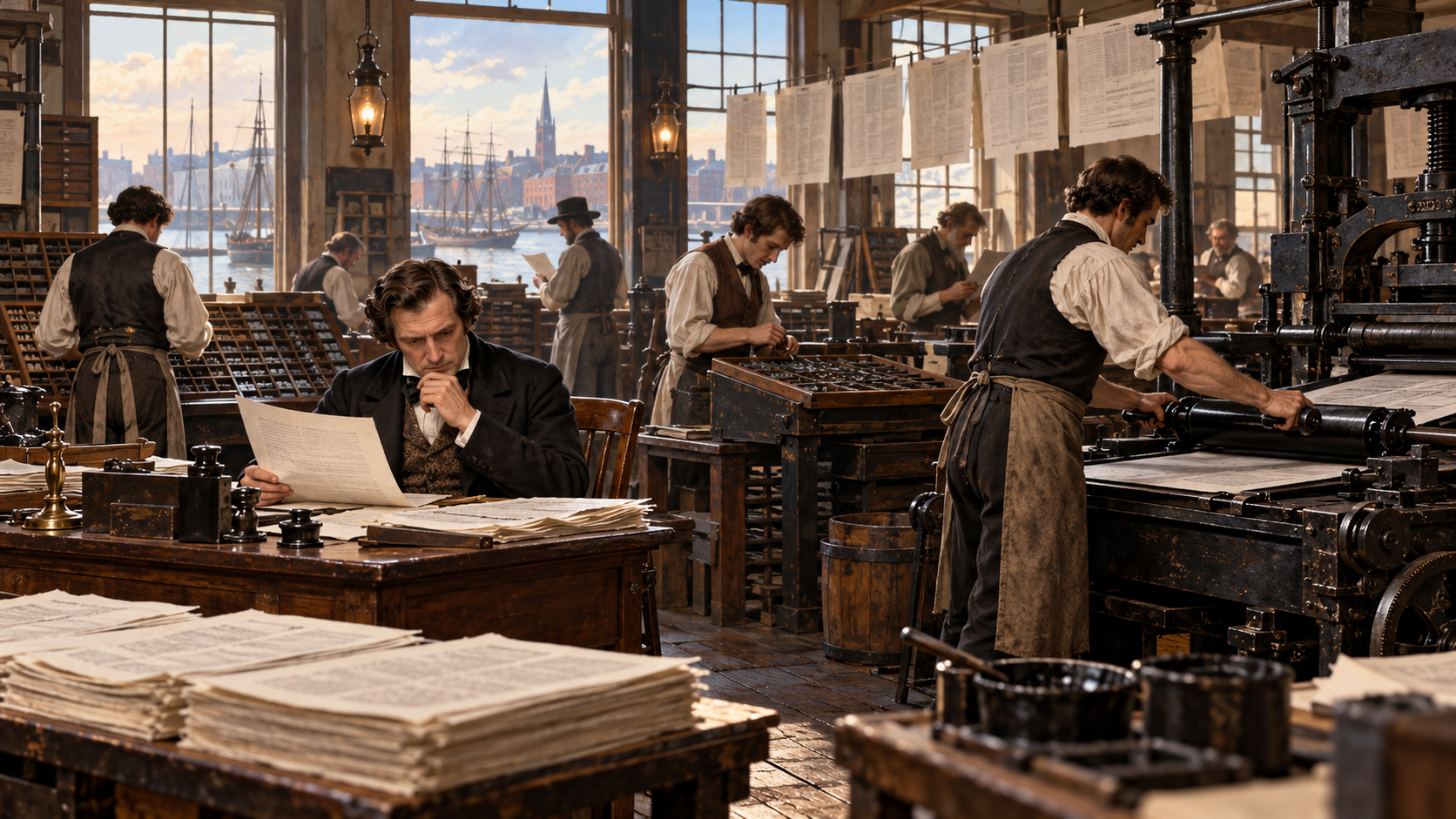
On March 23, 1839, The Boston Morning Post printed the abbreviation “O.K.” as part of a comic fashion for misspelled phrases, representing “oll korrect.” Editor Charles Gordon Greene used the joke in a newspaper item, creating the earliest widely accepted printed evidence for a term that would soon travel far beyond Boston. The date matters in lifestyle history because a newspaper joke became a universal tool of everyday coordination. Rather than remaining an isolated announcement or demonstration, the moment gave people a new way to think about agreeing, confirming, checking on someone, closing a task, or signaling that something is acceptable. Its importance became visible through familiar places, objects, and routines, where a broad historical change could be felt at human scale.
American newspapers of the late 1830s enjoyed playful abbreviations and deliberate misspellings. Most vanished, but O.K. gained a second boost during the 1840 presidential campaign, when supporters of Martin Van Buren organized around his nickname Old Kinderhook. The setting shaped how contemporaries understood the event. editors, readers, campaigners, telegraph operators, workers, travelers, families, and speakers across languages encountered it through newspapers, campaigns, telegraphy, conversation, forms, radio, film, computing, messaging, and interface buttons. Those details show that social change usually travels through ordinary systems such as workplaces, schools, shops, homes, streets, or public institutions. What seems inevitable in hindsight depended on people testing, organizing, purchasing, teaching, maintaining, or protecting the idea in real time.
The compact expression proved remarkably flexible: approval, agreement, confirmation, adequacy, well-being, transition, or reluctant acceptance could all fit into two sounds. Telegraphy, business forms, conversation, advertising, entertainment, and later computing rewarded short signals with clear social function. In daily life, people adopted two quick letters for situations that needed acknowledgment without a long explanation. The episode also exposed questions about uncertain tone, regional variation, commercial appropriation, translation, and the gap between mere adequacy and enthusiasm. Access and influence were never perfectly even, and later generations adapted the original development to different communities, values, and technologies. Still, the event changed expectations by making fast, flexible confirmation across many contexts easier to imagine, recognize, or demand.
O.K. became one of the world’s most widely recognized American expressions, adapted into many languages and technologies. Its endurance shows that language change can begin in a local joke and survive because people repeatedly find the form useful. Today, echoes remain in spoken conversation, text messages, workplace approvals, software dialogs, customer service, and global popular culture. Looking back helps separate the documented milestone from the myths that often accumulate around famous anniversaries. It also reminds us that lifestyle history is built from choices about design, health, work, leisure, communication, memory, and public space. On this day, the 1839 printing reminds us that even the smallest daily word has a history.
The Boston Morning Post printed the abbreviation “O.K.” as part of a comic fashion for misspelled phrases, representing “oll korrect.” Editor Charles Gordon Greene used the joke in a newspaper item, creating the earliest widely accepted printed evidence for a term that would soon travel far beyond Boston.
American newspapers of the late 1830s enjoyed playful abbreviations and deliberate misspellings. Most vanished, but O.K. gained a second boost during the 1840 presidential campaign, when supporters of Martin Van Buren organized around his nickname Old Kinderhook.
The compact expression proved remarkably flexible: approval, agreement, confirmation, adequacy, well-being, transition, or reluctant acceptance could all fit into two sounds. Telegraphy, business forms, conversation, advertising, entertainment, and later computing rewarded short signals with clear social function.
The larger theme was that a newspaper joke became a universal tool of everyday coordination.
O.K. became one of the world’s most widely recognized American expressions, adapted into many languages and technologies. Its endurance shows that language change can begin in a local joke and survive because people repeatedly find the form useful.
Today the story remains visible in spoken conversation, text messages, workplace approvals, software dialogs, customer service, and global popular culture.
Explore more of “This Day in Lifestyles”
Discover more moments in everyday life, design, education, travel, food, fashion, and culture. Each story connects a calendar date with an event that changed how people lived.