

On This Day in Lifestyles: March 24, 1882
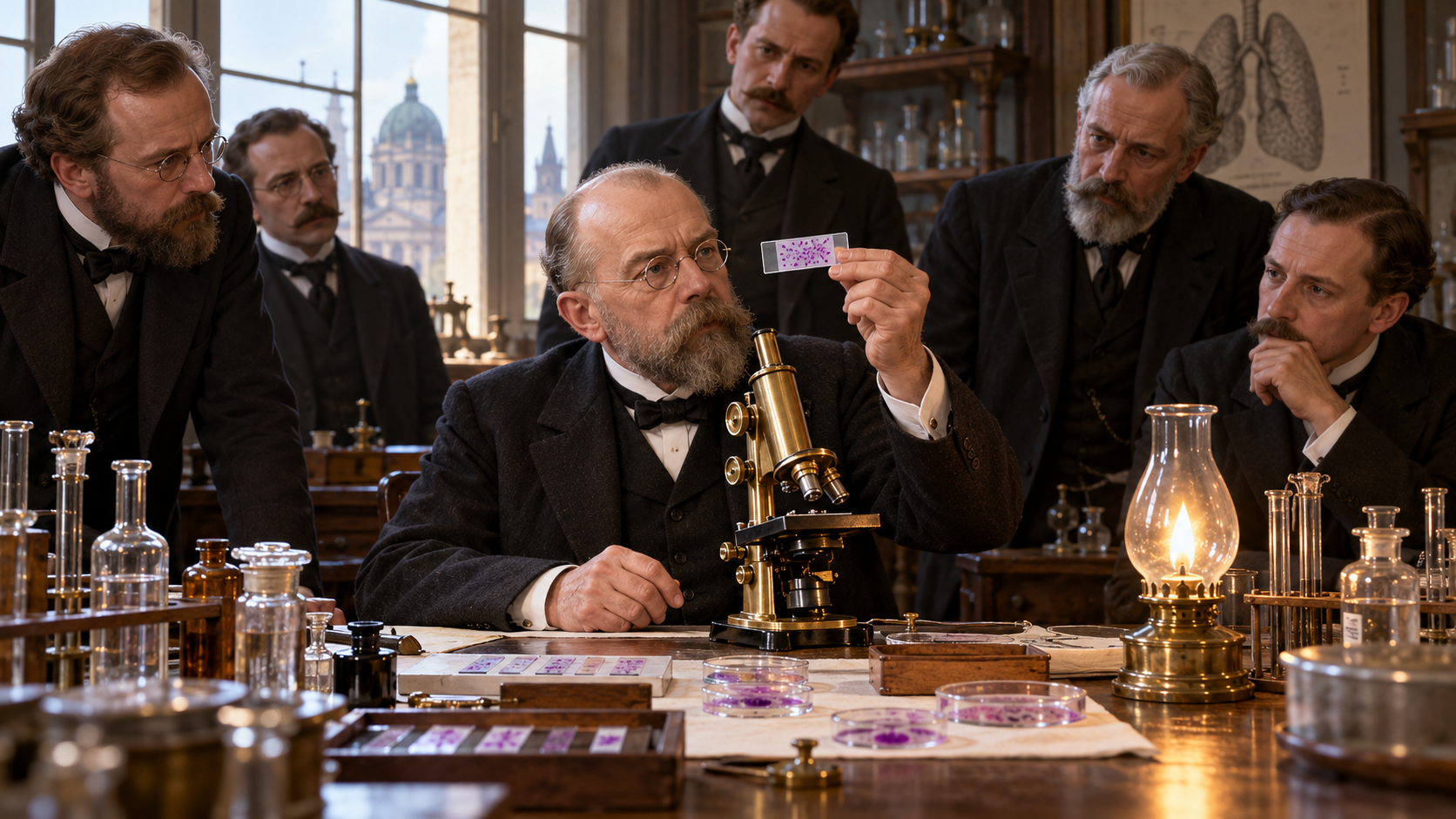
On March 24, 1882, Robert Koch presented evidence identifying Mycobacterium tuberculosis as the cause of tuberculosis to the Physiological Society in Berlin. Using improved staining, microscopy, culture methods, and animal experiments, he connected a specific microorganism with a disease then responsible for enormous loss of life. The date matters in lifestyle history because a microscopic organism gave medicine a clearer explanation for a devastating everyday illness. Rather than remaining an isolated announcement or demonstration, the moment gave people a new way to think about testing, isolating infection, improving ventilation, seeking treatment, and organizing public-health systems. Its importance became visible through familiar places, objects, and routines, where a broad historical change could be felt at human scale.
Tuberculosis was often understood through heredity, constitution, or environment without a clearly proven infectious agent. Koch’s demonstration made laboratory technique central to the argument and strengthened the emerging germ theory of disease. The setting shaped how contemporaries understood the event. patients, families, laboratory researchers, physicians, nurses, public-health workers, and communities facing unequal risk encountered it through microscopes, stained slides, scientific lectures, clinics, sanatoriums, public campaigns, laboratories, and screening programs. Those details show that social change usually travels through ordinary systems such as workplaces, schools, shops, homes, streets, or public institutions. What seems inevitable in hindsight depended on people testing, organizing, purchasing, teaching, maintaining, or protecting the idea in real time.
A known cause reshaped public-health campaigns involving reporting, sanitation, ventilation, screening, laboratories, and specialized care. The discovery did not produce an immediate cure, and many measures carried stigma or coercion, but it gave researchers a focused target for diagnostics, drugs, and vaccines. In daily life, societies increasingly treated tuberculosis as an infectious disease requiring coordinated detection and care. The episode also exposed questions about scientific progress, stigma, coercive policy, unequal housing and nutrition, drug resistance, and access to treatment. Access and influence were never perfectly even, and later generations adapted the original development to different communities, values, and technologies. Still, the event changed expectations by making more precise diagnosis and a foundation for effective control easier to imagine, recognize, or demand.
World Tuberculosis Day is observed on March 24 to connect the scientific milestone with unfinished work. TB remains preventable and curable, yet unequal access, drug resistance, crowded living conditions, and delayed diagnosis continue to cost lives. Today, echoes remain in TB testing, antibiotics, vaccination in many countries, contact tracing, research, and global efforts to close treatment gaps. Looking back helps separate the documented milestone from the myths that often accumulate around famous anniversaries. It also reminds us that lifestyle history is built from choices about design, health, work, leisure, communication, memory, and public space. On this day, Koch’s announcement changed what doctors could see while leaving society responsible for how knowledge is used.
Robert Koch presented evidence identifying Mycobacterium tuberculosis as the cause of tuberculosis to the Physiological Society in Berlin. Using improved staining, microscopy, culture methods, and animal experiments, he connected a specific microorganism with a disease then responsible for enormous loss of life.
Tuberculosis was often understood through heredity, constitution, or environment without a clearly proven infectious agent. Koch’s demonstration made laboratory technique central to the argument and strengthened the emerging germ theory of disease.
A known cause reshaped public-health campaigns involving reporting, sanitation, ventilation, screening, laboratories, and specialized care. The discovery did not produce an immediate cure, and many measures carried stigma or coercion, but it gave researchers a focused target for diagnostics, drugs, and vaccines.
The larger theme was that a microscopic organism gave medicine a clearer explanation for a devastating everyday illness.
World Tuberculosis Day is observed on March 24 to connect the scientific milestone with unfinished work. TB remains preventable and curable, yet unequal access, drug resistance, crowded living conditions, and delayed diagnosis continue to cost lives.
Today the story remains visible in TB testing, antibiotics, vaccination in many countries, contact tracing, research, and global efforts to close treatment gaps.
Explore more of “This Day in Lifestyles”
Discover more moments in everyday life, design, education, travel, food, fashion, and culture. Each story connects a calendar date with an event that changed how people lived.