

On This Day in News: January 11, 1964
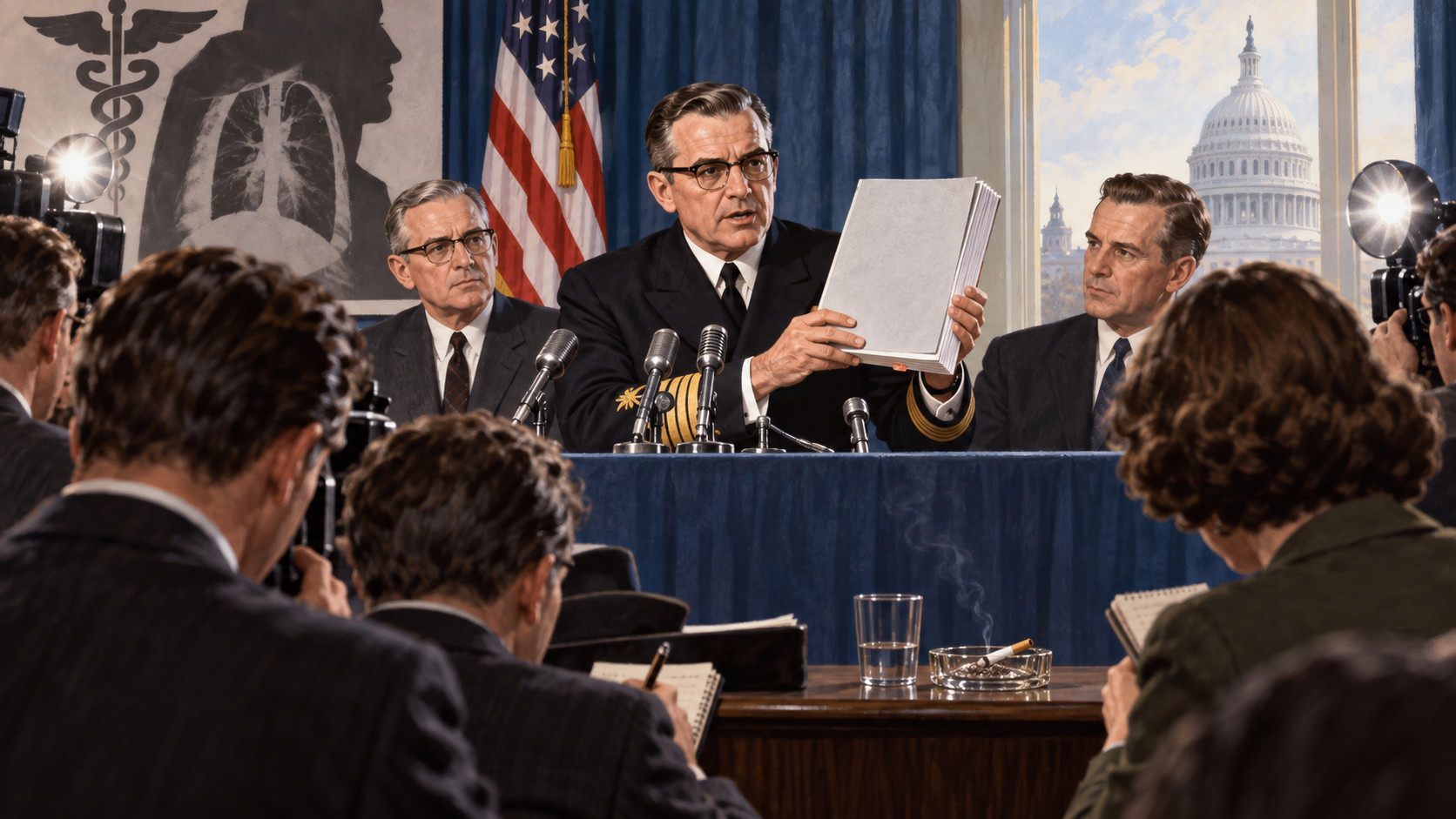
On January 11, 1964, U.S. Surgeon General Luther L. Terry stepped before more than 200 reporters in a packed auditorium at the State Department in Washington, D.C., to release a document that would upend how Americans thought about cigarettes. “Smoking and Health: Report of the Advisory Committee to the Surgeon General of the Public Health Service” distilled more than 7,000 scientific studies into one clear message: cigarette smoking causes lung cancer and chronic bronchitis, and is linked to other serious diseases, including heart disease and emphysema. For the first time, the federal government spoke in a single, authoritative voice about the dangers of a product used daily by tens of millions of people.
Officials chose a Saturday morning for the announcement, hoping to blunt any immediate shock to financial markets while still reaching the broad Sunday-newspaper audience. The advisory committee, composed of leading physicians and scientists—many of whom were smokers themselves—emphasized that the risks were not small. Average smokers, they reported, faced many times the risk of lung cancer compared with non-smokers, and heavy smokers faced far higher odds still. The report framed cigarette smoking not as a mere habit or personal preference, but as a major public health hazard demanding action from policymakers, doctors, and the public.
The immediate response was intense. The report quickly became front-page news, generating debate in living rooms, doctors’ offices, and state legislatures. Public health groups hailed it as a long-overdue acknowledgment of what research had been suggesting for years. The tobacco industry, by contrast, moved to question the findings and protect its business, launching public-relations campaigns and lobbying efforts in Congress. Yet the report’s clear language and the prestige of the Surgeon General’s office made it difficult to dismiss. Within a year, Congress passed legislation requiring health warnings on cigarette packages, and in the years that followed, restrictions on cigarette advertising and smoking in public places grew steadily.
Over time, the impact of Terry’s report could be measured not only in new laws but also in changing social norms. Smoking gradually lost its aura of glamour and normalcy, and quitting became a widely encouraged goal rather than a private struggle. The percentage of American adults who smoked began to decline, a trend that has continued, with significant benefits for life expectancy and rates of heart disease and cancer. While tobacco use remains a major cause of preventable death, the 1964 report marked a turning point: the moment when the U.S. government clearly stated that cigarettes were not just risky but deadly, and when the modern era of tobacco control truly began.
References for factual details.
By January 11, 1964, cigarette smoking was deeply ingrained in American life. A majority of adult men and a growing number of women smoked, and tobacco advertising was prominent in newspapers, magazines, radio, and television. At the same time, medical research over the previous decade had increasingly linked smoking to lung cancer, chronic bronchitis, and other serious illnesses, raising concern within the public health community.
In response to mounting evidence and pressure from medical organizations, the U.S. Public Health Service convened an expert advisory committee in 1962 to systematically review thousands of scientific studies. Led by Surgeon General Luther L. Terry, the committee worked in secrecy to avoid outside influence, ultimately producing a landmark report that would formally state the health risks of smoking and challenge the long-standing perception of cigarettes as a harmless habit.
When the report was released on January 11, 1964, officials deliberately chose a Saturday so that financial markets would be closed, reflecting concern about the economic and political implications. The report concluded that cigarette smoking causes lung cancer and chronic bronchitis in men and is a significant health hazard for the population. It received front-page coverage and sparked widespread public discussion, prompting many people to reconsider their own smoking habits.
The report itself did not ban cigarettes or immediately restrict their sale. Tobacco remained legal, and the industry quickly responded by questioning the findings and emphasizing personal choice. Nonetheless, the federal government’s clear, unified stance marked a major shift. Within a year, Congress passed legislation requiring health warnings on cigarette packages, and public health agencies began more systematic efforts to educate the public about smoking risks.
Over the long term, the 1964 Surgeon General’s report became a foundation for modern tobacco control. It helped justify stronger warning labels, restrictions on cigarette advertising, and later bans on smoking in airplanes, workplaces, and many public spaces. States and local governments drew on its findings as they crafted policies aimed at reducing exposure to secondhand smoke and discouraging youth smoking.
The report also reshaped how Americans viewed the role of government in promoting public health. It demonstrated that federal authorities could weigh scientific evidence and issue strong guidance on widely used, commercially important products. In the decades that followed, subsequent Surgeon General’s reports expanded on the risks of smoking and secondhand smoke, and the share of U.S. adults who smoke declined significantly, reflecting the enduring influence of the announcement made on this day.
Explore more of "On This Day ..."
Discover more events from the same date across news, politics, technology, sports, and other fields. Each link highlights significant moments that shaped history on different fronts.