

On This Day in Politics: January 5, 1972
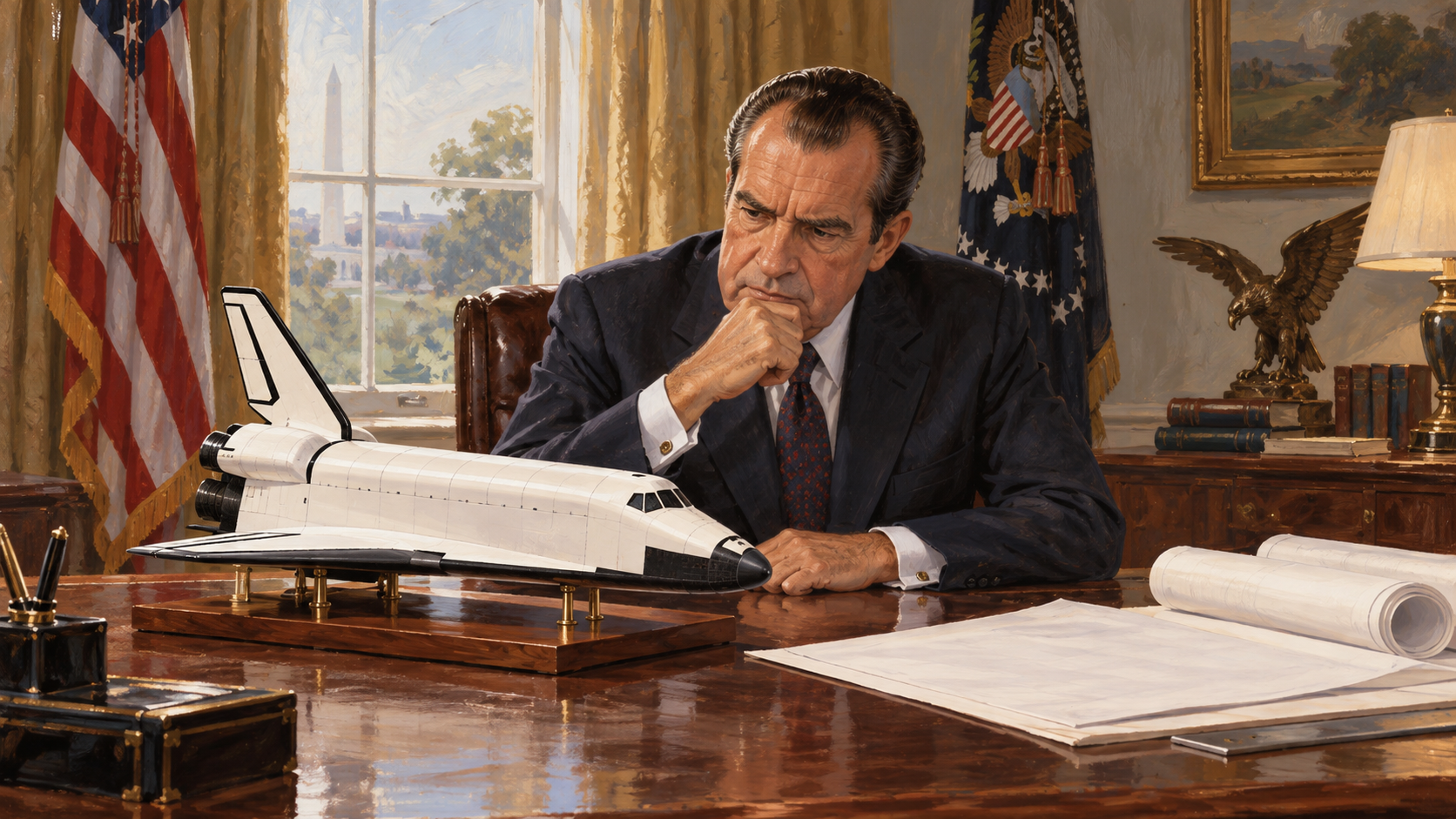
On January 5, 1972, President Richard Nixon formally directed NASA to proceed with the development of a reusable Space Shuttle system—a decision that would shape U.S. space policy for more than three decades. Coming less than three years after the Apollo 11 Moon landing, the announcement marked a shift away from lunar exploration and toward a long-term strategy that envisioned frequent, cost-effective access to low Earth orbit. Nixon framed the new initiative as essential to maintaining American leadership in space during a period of shifting geopolitical priorities and tightening federal budgets. The Space Shuttle, he argued, would serve national interests by lowering the cost of spaceflight, supporting scientific missions, and strengthening U.S. presence in an arena closely linked to Cold War competition.
The decision reflected a broader moment of transition within the U.S. space program. As the Apollo missions wound down and public enthusiasm for costly Moon landings waned, NASA faced pressure to justify its future direction. The agency proposed a modular space transportation system, with the Shuttle as its centerpiece—a craft capable of launching like a rocket, landing like an airplane, and being reused for multiple missions. Nixon’s approval signaled that the United States would pivot from monumental single-purpose expeditions toward a more versatile and practical infrastructure for science, defense, and emerging commercial activity. It also marked a rare instance in which both political and technical communities aligned behind a vision that promised innovation while acknowledging fiscal limits.
While the program ultimately proved more expensive and complex than its early advocates predicted, the January 5 decision stands as a defining moment in the evolution of U.S. space policy. Over the next decade, the Shuttle would move from design concept to flight hardware, culminating in the first orbital mission of the Shuttle Columbia in April 1981. From deploying satellites to constructing the International Space Station, Shuttle missions expanded the operational reach of American astronauts and redefined what sustained human presence in space could look like. The January 5 announcement thus laid the foundation for a new phase of space exploration—one that blended engineering imagination with political calculation in an era of evolving national priorities.
Looking back, Nixon’s directive represents both the promise and the complexity of long-term federal investments in science and technology. The Shuttle program achieved groundbreaking milestones, enabling work that would have been impossible with single-use rockets alone. Yet it also revealed the challenges inherent in managing sustained innovation within the constraints of government budgets, shifting administrations, and changing public expectations. Still, the date remains a pivotal chapter in American political history, illustrating how a single presidential decision can redirect the trajectory of national scientific ambition.
By January 5, 1972, the United States was reassessing its space ambitions in the aftermath of the Apollo Moon landings. NASA’s budget had been reduced, several planned lunar missions were canceled, and public enthusiasm for costly, one-time voyages was fading. Within this environment, the Nixon administration looked for a way to keep the U.S. active in space while placing greater emphasis on economic efficiency and practical applications in Earth orbit.
NASA proposed a reusable “Space Transportation System,” with a winged Space Shuttle at its core, designed to launch like a rocket, land like an aircraft, and fly multiple missions. On January 5, President Richard Nixon announced that the United States would proceed with this new system, framing it as the next logical step for the space program and a means to ensure continued American leadership beyond the Apollo era.
Nixon’s decision did not produce an operational shuttle overnight, but it set in motion the design, funding, and industrial work that would define NASA’s human spaceflight program for decades. It signaled to Congress, contractors, and international partners that the reusable shuttle would be the main vehicle for American missions, from launching satellites to supporting scientific research in orbit.
At the same time, the decision reflected political and budgetary compromises. Ambitious proposals for Moon bases and human missions to Mars were shelved, and the shuttle had to satisfy both civilian and national security requirements. These constraints shaped everything from its size and configuration to its long development timeline, embedding limitations into a program that was intended to reduce costs and increase flight frequency.
Over the long term, the January 5 decision helped define the character of U.S. space policy. The Space Shuttle became the backbone of American human spaceflight, carrying astronauts into low Earth orbit from the early 1980s through 2011, deploying and servicing major observatories like the Hubble Space Telescope, and playing a central role in building the International Space Station.
The shuttle era also highlighted the challenges of balancing visionary goals with fiscal and technical realities. While it expanded scientific and international cooperation, it never fully achieved the routine, low-cost access to space that early advocates envisioned. Still, the choice made on this day ensured that the United States remained a leading presence in orbit and influenced debates about risk, innovation, and the purposes of government-led exploration well into the 21st century.
Explore more of "On This Day ..."
Discover more events from the same date across news, politics, technology, sports, and other fields. Each link highlights significant moments that shaped history on different fronts.