

On This Day in Politics: January 6, 1941
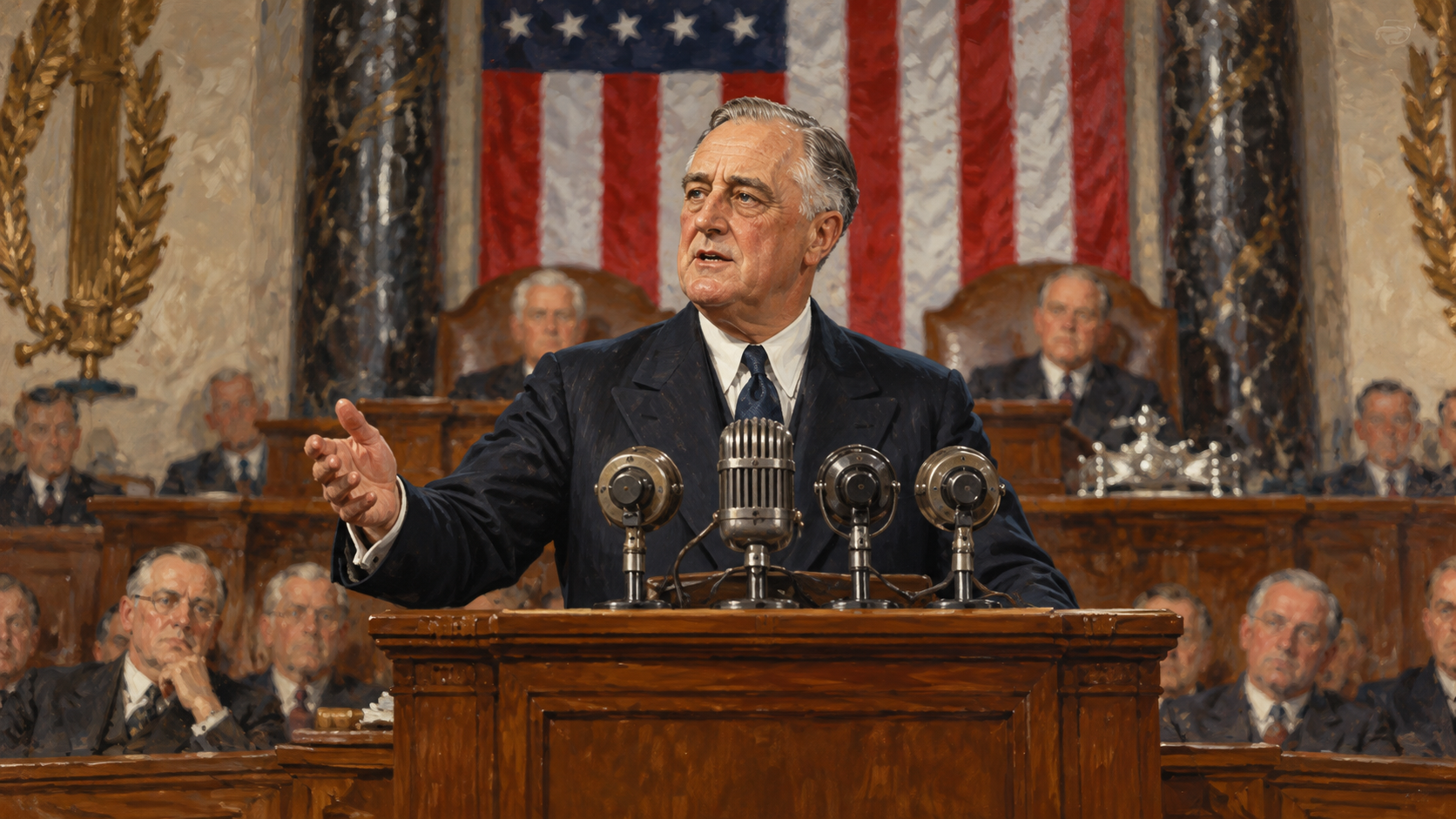
On January 6, 1941, President Franklin D. Roosevelt addressed Congress to deliver his annual State of the Union message—one that would become one of the most influential policy speeches in American history. Delivered as World War II raged across Europe and Asia, Roosevelt’s remarks aimed to persuade a still-neutral United States to expand support for nations resisting authoritarian aggression. As he framed the stakes of the global conflict, he introduced what he called the “Four Freedoms,” a set of universal principles he believed all people everywhere were entitled to enjoy: freedom of speech, freedom of worship, freedom from want, and freedom from fear. The speech crafted a moral and political framework for understanding the war’s broader significance beyond territorial disputes and military alliances.
In outlining these freedoms, Roosevelt sought to recenter the national conversation on shared values at a moment when Americans were deeply divided over how involved the nation should become in the widening conflict. While isolationist sentiment remained strong, Roosevelt emphasized that the U.S. could not ignore the growing threat posed by authoritarian powers. He presented the defense of democratic principles as essential not only for national security but for the stability of a future global order. The speech also laid the groundwork for the Lend-Lease program, which Roosevelt argued was crucial for supporting Britain, China, and other nations resisting Axis powers without requiring immediate American entry into the war. By connecting material aid to the defense of universal rights, he reframed foreign assistance as an investment in a world aligned with American democratic ideals.
The Four Freedoms quickly took on a symbolic force that extended far beyond the policy debates of the moment. They provided a concise and compelling expression of the values the Roosevelt administration believed should guide both wartime decisions and postwar planning. These ideas later influenced core elements of the Atlantic Charter, the formation of the United Nations, and the language of the Universal Declaration of Human Rights. At home, the freedoms helped shape national expectations about economic security, civil liberties, and the responsibilities of democratic governance during a period of profound uncertainty and rapid mobilization. Artists, writers, and civic organizations embraced the Four Freedoms as a unifying message capable of bridging political divides and inspiring public commitment to the war effort.
Today, Roosevelt’s address remains a defining moment in the evolution of American political thought, demonstrating how presidential rhetoric can shape both domestic attitudes and international norms. The Four Freedoms continue to serve as reference points in conversations about human rights, foreign policy, and the obligations of democratic nations. For “This Day in Politics,” January 6 marks the introduction of a vision that reimagined the role of the United States in global affairs and articulated a set of enduring principles that still frame debates over freedom, security, and collective responsibility.
By January 6, 1941, World War II was raging across Europe and Asia, even as the United States remained officially neutral. Nazi Germany had conquered much of Western Europe, Britain was under constant threat from air attacks, and debates in the U.S. over isolationism versus intervention were intense and unresolved.
In this environment, President Franklin D. Roosevelt delivered his State of the Union address to Congress. Rather than only listing policy proposals, he used the speech to define what was at stake in global terms, introducing the “Four Freedoms” as a set of universal rights – freedom of speech, freedom of worship, freedom from want, and freedom from fear – that he argued should be secured worldwide.
The Four Freedoms speech did not immediately bring the United States into the war, but it helped shift public conversation toward a more active role in supporting countries resisting aggression. It provided a moral framework for policies like Lend-Lease, through which the United States began supplying arms and aid to nations such as Britain and China.
At the same time, the vision outlined in the speech exceeded what American policy and society fully delivered in 1941. Many communities at home still faced discrimination, economic hardship, and limits on civil rights. Roosevelt’s words set an ambitious standard that highlighted tensions between America’s ideals and its realities, both domestically and abroad.
Over the long term, the Four Freedoms helped shape the language and goals of U.S. foreign and domestic policy. They influenced the Atlantic Charter later in 1941, guided thinking behind the formation of the United Nations, and echoed in the Universal Declaration of Human Rights adopted after the war.
The speech also became a reference point in later debates over civil rights, social welfare, and national security. Advocates for expanded protections and economic security often cited Roosevelt’s formulation as a benchmark for measuring progress toward a more secure and inclusive democracy, making January 6, 1941 a lasting milestone in the evolution of modern political ideals.
Explore more of "On This Day ..."
Discover more events from the same date across news, politics, technology, sports, and other fields. Each link highlights significant moments that shaped history on different fronts.