

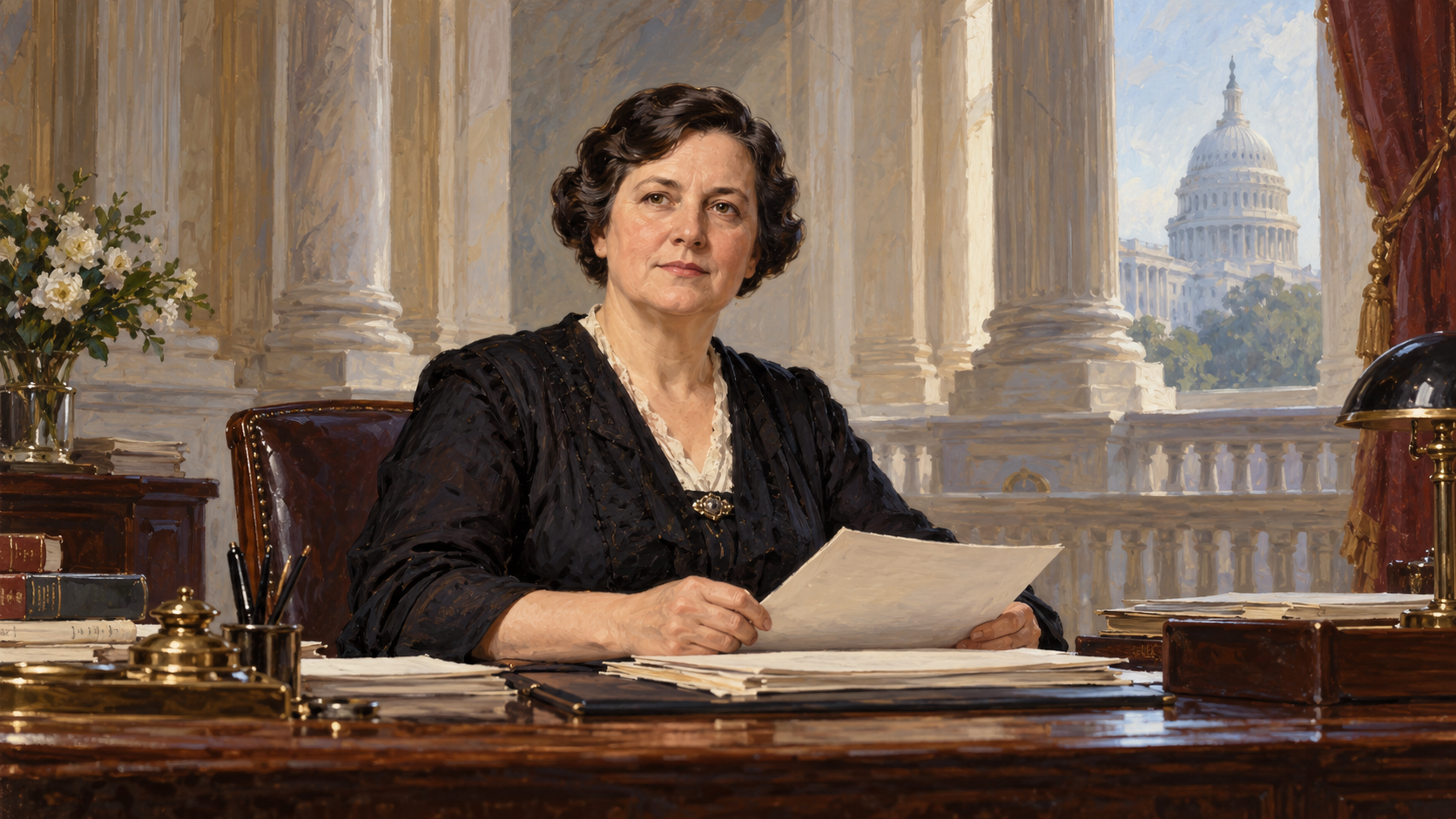
On This Day in Politics: January 12, 1932
On January 12, 1932, Arkansas voters elected Hattie Wyatt Caraway to the United States Senate, making her the first woman in American history to win a Senate seat through a general election. While several women had served brief appointed terms before her, Caraway’s victory represented a decisive milestone in women’s political participation, arriving just over a decade after the ratification of the 19th Amendment. Her election occurred during a period of economic crisis, political uncertainty, and shifting expectations about women’s roles in public life, giving her victory both symbolic and practical significance.
Caraway had initially been appointed to fill the seat of her late husband, Senator Thaddeus Caraway, in late 1931. Although such appointments were not uncommon for widows of political figures, few were expected to run for full terms. Caraway defied those expectations by choosing to stand for election in her own right, launching a disciplined and methodical campaign across Arkansas. With the support of populist Louisiana Senator Huey Long, who stumped vigorously on her behalf, Caraway broadened her profile and connected with rural voters who were deeply affected by the economic strains of the Great Depression. Her message—direct, practical, and grounded in local concerns—resonated with voters seeking steady leadership in unstable times.
Her election to the Senate was significant not just because she was a woman, but because she proved an effective and independent legislator once in office. Caraway aligned with New Deal programs, supported farm relief, backed labor protections, and worked on veterans’ issues. At a time when women in politics were often confined to ceremonial or narrowly defined roles, she demonstrated that they could take on the full responsibilities of national governance. Her steady work ethic earned her the nickname “Silent Hattie,” not because she lacked conviction, but because she preferred substance over grandstanding—a quality many constituents appreciated. Her reelection in 1938, another first for a woman senator, further solidified her influence and refuted perceptions that her initial victory had been a fluke or solely the product of sympathy.
For “This Day in Politics,” January 12 marks more than a milestone in representation; it marks a turning point in the evolution of democratic participation in the United States. Caraway’s election helped shift assumptions about who could serve in the highest legislative body in the nation. It opened the door—symbolically and practically—for future generations of women to pursue congressional leadership. Her success underscored a broader shift in American political culture as women’s voices increasingly shaped local, state, and national policy. Today, her victory stands as a reminder that political change often begins with a single, decisive moment when someone dares to do what history has not yet seen.
By January 12, 1932, the United States was deep in the Great Depression, with collapsing farm prices, widespread unemployment, and growing pressure on elected officials to respond. Political power in many Southern states, including Arkansas, was concentrated in Democratic Party machines and often dominated by male officeholders from long-established networks.
When Arkansas Senator Thaddeus Caraway died in 1931, his widow, Hattie Wyatt Caraway, was appointed to fill the vacancy on a temporary basis. Such appointments for widows were common but usually short-lived. On this day, however, she broke with precedent by standing for and winning election in her own right, becoming the first woman elected to the U.S. Senate through a general election.
Caraway’s victory immediately expanded women’s representation in the federal government, just over a decade after American women gained the right to vote nationwide. Her success challenged expectations that widows in politics would serve only as placeholders and showed that a woman could build her own electoral base in a conservative, rural state.
At the same time, her election did not transform the Senate overnight. She remained the only woman in the chamber for several years, and formal and informal barriers continued to limit women’s access to political power. Her quiet style and focus on constituent service led some colleagues and commentators to underestimate her, even as she supported major New Deal legislation and worked on issues important to farmers, veterans, and working families.
Over the longer term, the election held on January 12, 1932 became an important reference point in the history of women’s political participation. Caraway’s service, including her later reelection, demonstrated that women could not only win statewide office but also sustain careers in Congress, helping to normalize the idea of women as national lawmakers.
Her career foreshadowed the gradual increase in women serving in the Senate and House over the 20th and 21st centuries. Advocates for gender equality in politics have often pointed to Caraway’s path as evidence that representation can expand even under difficult circumstances. The date stands as a milestone in the evolving story of who is seen as eligible to exercise power in American democracy.
Explore more of "On This Day ..."
Discover more events from the same date across news, politics, technology, sports, and other fields. Each link highlights significant moments that shaped history on different fronts.