

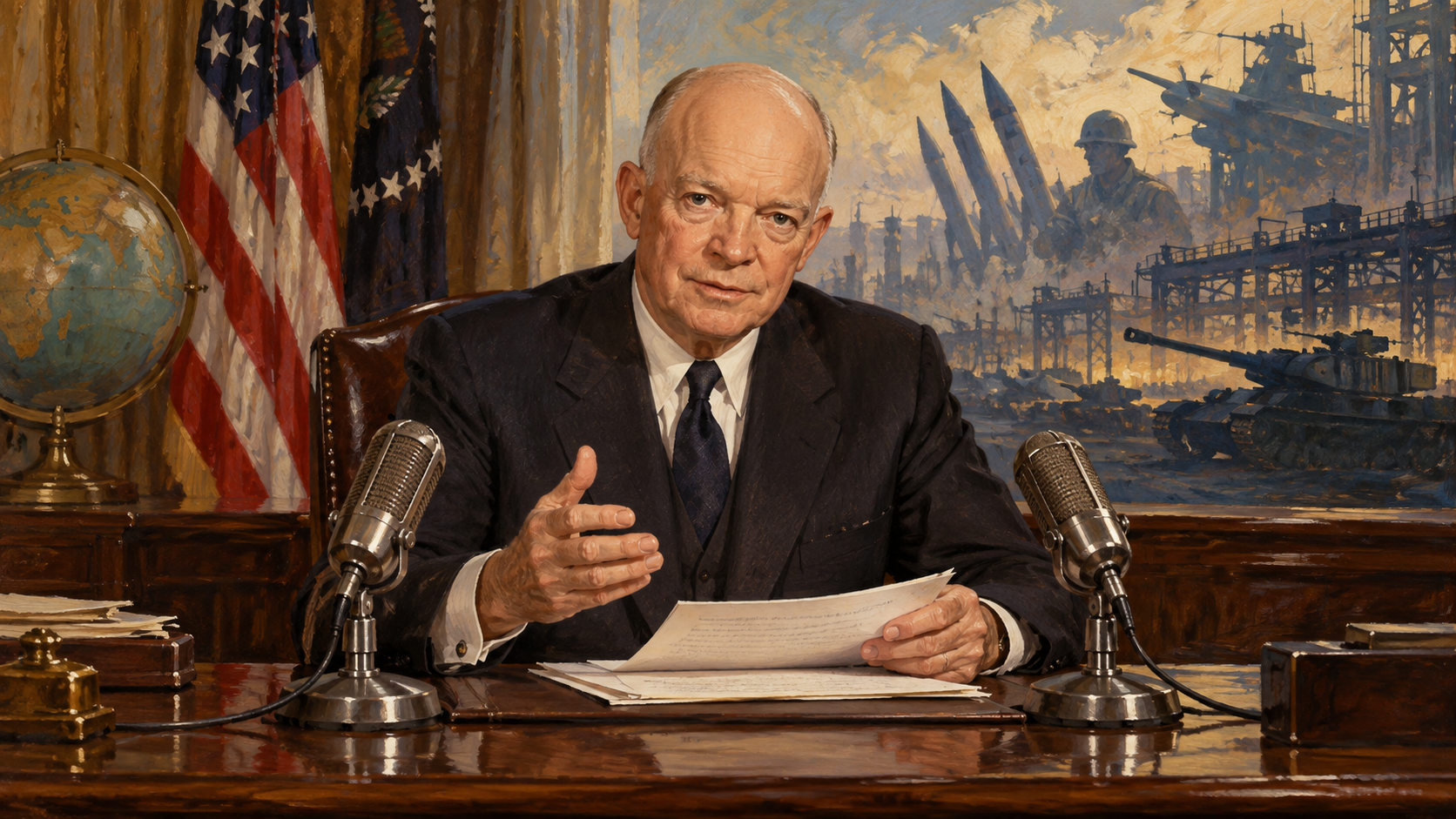
On This Day in Politics: January 17, 1961
On January 17, 1961, President Dwight D. Eisenhower delivered one of the most famous farewell addresses in American history, using his final televised speech to caution the nation about what he called the “military-industrial complex.” After eight years in office shaped by the Cold War, nuclear deterrence, and rapid technological development, Eisenhower was uniquely positioned to warn Americans about the long-term consequences of expanding defense infrastructure and its influence on national decision-making. His message was striking for its clarity and for coming from a five-star general whose career had been defined by military service. Rather than rejecting military strength, he urged a balanced approach—one that preserved security without sacrificing democratic oversight or economic stability.
Eisenhower’s warning reflected the extraordinary transformation of American defense policy during the post–World War II era. The United States had become a global superpower with permanent military alliances, global deployments, and an expanding nuclear arsenal. Defense spending had become a major driver of scientific research, industrial production, and technological innovation. While Eisenhower supported many of these developments, he feared that long-term reliance on massive defense budgets—combined with the growing political clout of defense contractors—risked eroding transparency, distorting public priorities, and creating pressures for increased militarization. His speech highlighted concerns that an interconnected network of government agencies, private corporations, and political institutions could shape policy in ways inconsistent with democratic values.
In addition to his central warning, Eisenhower’s address emphasized fiscal responsibility, scientific advancement, and the importance of maintaining a well-informed citizenry. He encouraged Americans to question assumptions about limitless spending and to evaluate national priorities with an eye toward long-term stability. He also acknowledged the complexities of the Cold War, recognizing that global commitments required careful management rather than unchecked expansion. Eisenhower’s call for balance reflected his belief that democratic governments must remain adaptable and accountable, even in times of geopolitical tension. Though overshadowed initially by the inauguration of John F. Kennedy days later, the speech gained influence in subsequent decades as debates about defense spending, foreign intervention, and government transparency grew more prominent.
For “This Day in Politics,” January 17 serves as a significant reminder of how presidential transitions can shape national dialogue. Eisenhower’s farewell address endures as one of the most enduring statements of caution in American political history—a message about the relationship between national security and democratic governance. His words continue to be cited across the political spectrum, illustrating their lasting relevance in discussions about defense budgets, surveillance, lobbying, and the proper balance between civilian authority and military power. What began as a closing reflection on a presidency became a touchstone for understanding the complexities of modern American statecraft.
By January 17, 1961, the United States had spent more than a decade locked in the Cold War, building a large peacetime military and an extensive global network of bases and alliances. Defense spending supported major industries, scientific research, and technological projects, from nuclear weapons to advanced aircraft and missiles.
On this day, President Dwight D. Eisenhower, a former five-star general and World War II Supreme Allied Commander, delivered his televised farewell address from the White House. As he prepared to leave office, he used the moment not to celebrate victory, but to warn Americans about the growing influence of what he called the “military-industrial complex.”
Eisenhower’s warning drew attention because it came from a respected military leader who had overseen both war and peace. He did not argue against a strong defense; instead, he cautioned that the permanent arms industry and a large standing military could gain “unwarranted influence” over policy if citizens and elected officials failed to exercise oversight.
In the short term, the speech did not dramatically alter defense budgets or Cold War strategy. The incoming Kennedy administration continued many existing programs, and the pressures of global competition with the Soviet Union remained strong. Still, Eisenhower’s words entered public debate, giving critics of excessive military spending and concentrated defense contracting a powerful reference point.
Over time, the farewell address delivered on January 17, 1961 became one of the most frequently cited presidential speeches in discussions of national security and democratic accountability. As U.S. involvement in Vietnam, later military interventions, and expanded intelligence and surveillance programs developed, observers returned to Eisenhower’s phrase to question how defense priorities shape budgets, research, and foreign policy.
The speech also helped frame broader debates about the relationship between government, private industry, and scientific institutions. Eisenhower called for a well-informed citizenry and responsible leadership to ensure that security needs did not overwhelm civil liberties or domestic priorities. His warning continues to influence how scholars, policymakers, and the public think about the balance between military power and democratic control, making this day a key moment in the political history of the Cold War era.
Explore more of "On This Day ..."
Discover more events from the same date across news, politics, technology, sports, and other fields. Each link highlights significant moments that shaped history on different fronts.